
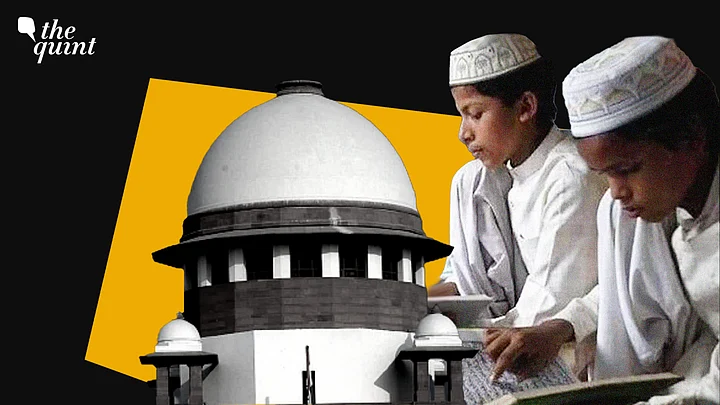
On 5 April 2024, the Supreme Court of India stayed (Anjum Kadari and Anr v. Union of India and Ors) the judgment of the Allahabad High Court which had ruled that the Uttar Pradesh Board of Madarsa Education Act, 2004, violates the principle of secularism and declared it "unconstitutional".
The High Court was of the view that while the students of other religions are getting educated in modern subjects, denial of the same quality by the Madarsa Board amounts to a violation of both Article 21-A as well as Article 21 of the Constitution of India.
"The State cannot hide behind the lame excuse that it is fulfilling its duty by providing traditional education on nominal fee…. Education being provided by the Madarsa Board, therefore, is in violation of the standards prescribed by the Supreme Court while interpreting constitutional provisions. Therefore, this Court has no hesitation in holding that the education being provided under the Madarsa Act is violative of Articles 21 and 21A of the Constitution of India.”