
Vajpayee, Mamata, Pawar: The Political Friendships in Sonia Gandhi's 'Belonging'
In ‘Belonging,’ Sonia Gandhi remembers a political culture and era when opponents could be friends
advertisement
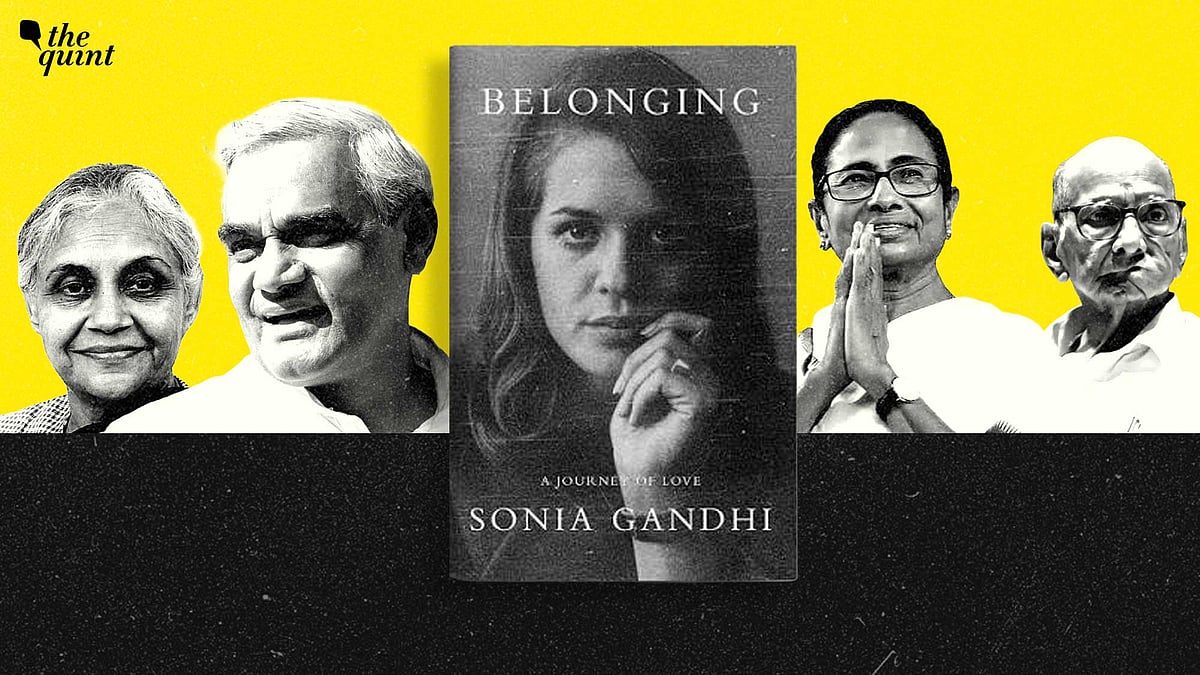
People across the country have not celebrated the act of reading a political book like this in a long time. Sonia Gandhi’s memoir, Belonging: A Journey of Love, has done just that. Readers remain a niche, yet the book has become a talking point inside that niche, across generations.
Gen Z turns to it with curiosity about an Opposition figure and a stretch of time they never saw. Sonia herself is the draw. No other public figure arrived from another country to marry the son of a sitting Prime Minister, then built a life with Rajiv Gandhi, with Indian food, with leaders, and finally with the Congress. Millennials open the pages because fragments of the Vajpayee years and the United Progressive Alliance decade still sit in memory. Older readers lived those years and want the private grain that public life rarely kept.
Most arrive with a demand. Many on the right hoped for a confession tape, a document that would list every wrong of the Congress, of Indira Gandhi, of Rajiv Gandhi, of Sonia herself, of Rahul Gandhi and of Priyanka Gandhi. Others read through the filter of their own politics. A political book invites political judgement. That is its work.
Public life brings expectations. A person who moves from one Indian state to another for work or study needs years to absorb the culture, the language and the local political grain. Understanding the politics of an entire country is harder.
Readers still expect that Sonia Gandhi, after decades in India, had fully absorbed its politics and should therefore offer clear confessions or apologies for every controversy that touched the family or the party. The book does not meet that demand. It offers something narrower.
Friendships Across the Line
What stays with a reader, beyond the love story, is the record of friendships inside politics. That record matters now because the texture of Indian politics has changed. Mutual regard across party lines has largely vanished. The memoir keeps a time when personal respect, even affection, formed part of ordinary practice. Courtesy across the divide could still outweigh the sharper logic of opposition.
It also shows how loyalty worked inside the Congress. Several leaders who were popular and respected never fully entered the circle of trust around the Gandhis. They never became friends in the personal sense. Looking at a few of those relationships, and at the distances that remained, reveals the limits of both affection and calculation.
Sheila Dikshit
Most of Sonia’s relationships with Congress colleagues stayed work-based. Sheila Dikshit was different. The former Delhi Chief Minister moved her. She writes: “Sheila Dikshit, with whom I shared many of my interests—in handlooms, music and the arts in general, and could discuss my concerns about a number of sensitive issues, including the state of our party.”
In 1998, when Sonia became party president and Dikshit was Chief Minister of Delhi, the affection was practical. Dikshit governed her MLAs with an iron hand, yet the personal regard held. Later the irritation surfaces.
The shared interests in handlooms and music gave the friendship a life outside the party office. The stubbornness over tickets and the 2019 result still sit on the page without softening. The warmth survived disagreement. It did not erase the daily friction of running a party.
Ambika Soni
Ambika Soni’s place in the book rests on long association and useful knowledge. She had served as president of the Youth Congress and worked closely with Sanjay Gandhi. She returned to the Congress in 1986 after falling out of favour with Indira Gandhi in 1978. When Sonia was still finding her feet, Soni’s “experience and knowledge were of great help.” She was “well informed on who was who, and who was doing what.”
Jyoti Basu
The recollection of Jyoti Basu carries a different temperature. The former West Bengal Chief Minister and Communist Party of India (Marxist) veteran became important during the formation of the United Progressive Alliance in 2004. The Left had long been among the sharpest critics of the Congress. At the CPI(M) headquarters Basu saw her off courteously and offered an affectionate word: “Good girl, good girl, you are doing a good job!”
Ideological opposition of long standing did not prevent the courtesy or the practical suggestion. The memoir treats the moment as human. In the present climate such a detail stands out because it is no longer ordinary.
Mamata Banerjee
Rajiv Gandhi spotted the firebrand Bengali leader early. He gave Mamata Banerjee her first Lok Sabha seat in 1984. She defeated the CPI(M) heavyweight Somnath Chatterjee in Jadavpur at the age of twenty-nine.
Later, from 1991 to 1993, she served as Union Minister of State for Human Resource Development, handling Youth Affairs and Sports as well as Women and Child Development under P. V. Narasimha Rao. The relationship with Sonia Gandhi stayed workable.
The departure from the Congress in 1997 is recorded as the result of differences with the party’s West Bengal leadership.
The sentence acknowledges independent political capacity after the break. It is not a claim of unbroken intimacy. It is a recognition that the achievement belonged to Mamata alone.
Sharad Pawar
The 1999 episode with Sharad Pawar is told as personal injury. In May that year Pawar, P. A. Sangma and Tariq Anwar questioned whether someone born outside India could hold the country’s highest constitutional offices.
At the Congress Working Committee meeting she felt the ground shift.
What hurt most was the questioning of her loyalty to India.
She resigned as Congress president. Colleagues persuaded her to withdraw the resignation. The three leaders were suspended. The Nationalist Congress Party followed.
Years later the political relationship recovered enough for an alliance in Maharashtra.
Pawar’s own memoir frames the 1999 split more as a warning about electoral vulnerability than as a personal attack. The two accounts sit beside each other. One records hurt. The other records calculation. The later alliance is presented as recovery, not as restored friendship. Inside the Congress, questions of origin and eligibility could break trust quickly.
P V Narasimha Rao
The pages on P V Narasimha Rao stay measured. He is called an “erudite statesman.” His command of languages and his experience in governance are noted.
He had been a trusted colleague of Indira Gandhi and had served in Rajiv Gandhi’s government. Distance remains.
No shared private conversations or warm political moments are recalled. The single acknowledged disagreement over the Rajiv Gandhi assassination investigation leaves space for larger tensions. The politeness is careful. The absence of closer detail makes the distance visible. The wish to establish that there was no personal animosity is clear. Any suggestion of particular closeness is absent.
Pranab Mukherjee
Pranab Mukherjee receives professional admiration for his experience, his encyclopaedic knowledge and his command of the Congress organisation.
A 2010 conversation still carries awkwardness.
She read the remark as an expression of his long-standing ambition to become Prime Minister.
She “gently changed the subject,” knowing he might have been disappointed. Abilities and contribution are not questioned. Ambition, once spoken, created discomfort. Courtesy did not remove it. Long service inside the Congress did not automatically produce the trust required for the highest office.
Atal Bihari Vajpayee
Whenever Atal Bihari Vajpayee appears, a note of regard surfaces even though they were vehement opponents. After the 2001 Parliament attack her first thought was for his safety. “My immediate thought was for the prime minister’s safety and I rang him at once.”
She later learnt that Vajpayee had told colleagues she was the first to call. Their exchanges were not always mild. Over the Prevention of Terrorism Act in Parliament in 2002 she admits she may have been too harsh. Months later, seeing him unwell, she writes: “I thought I’d gone a bit too far.”
The phone call and the later self-correction are small, concrete acts. They sit on the page as evidence of a courtesy that the present political climate rarely produces. Graciousness toward a political opponent is allowed to remain.
(Sayantan Ghosh is the author of two books, Battleground Bengal and The Aam Aadmi Party, and teaches at St. Xavier’s College (Autonomous), Kolkata. This is an opinion piece and the views expressed are the author's own. The Quint does not endorse or is responsible for them.)
- Access to all paywalled content on site
- Ad-free experience across The Quint
- Early previews of our Special Projects
Published: undefined