
Belonging At Last: The Ordinary Sonia Behind the Extraordinary Gandhis
Sonia Gandhi was made an enigma by her critics. Her memoir shows the other side of that prejudice, writes Ashutosh.
advertisement
Like the Mona Lisa painting, Sonia Gandhi has been seen to be the most enigmatic politician. Everyone has their own interpretations and conclusions about her persona. If anyone thought that her memoir would unravel the many mysteries about her, they have been grossly mistaken. Rather, it has only solidified.
But the moot question is: is she really an enigma wrapped in mystery? I don’t think so. In my opinion, she is a simple person who was ordained by history to a greater responsibility, and she carried that responsibility forward with great aplomb.
For me, Sonia Gandhi is no enigma. As a journalist, I have been observing for three decades, and I find her a normal person who is extremely dedicated to her family, with a great sense of history and understanding that, come what may, she has to protect and carry forward the great legacy of a family that was fortunate enough to reshape the idea of India.
It is very clear from her memoir and facts from history that she did not plan for herself to be in the position where she finally ended. She always wanted to live a normal life like any girl of her age. She did not plan to fall in love with the scion of a great family. She just fell in love, as happens with girls her age, when she met Rajiv Gandhi for the first time. She did not know that Rajiv belonged to the Nehru-Gandhi family, and that his grandfather was the architect of modern India, the one chosen by Mahatma Gandhi.
A Reluctant Politician
Sonia was a private person and always wanted to remain that way, as did her husband, but destiny willed otherwise. If Sanjay Gandhi were alive and had not met with an accident, probably we would have known her only as a member of the family, like many other dynasties. Before that accident, she was happy to be the wife of a pilot named Captain Rajiv, without his surname Gandhi.
The day Rajiv decided to help her mother, Sonia's world changed forever. Since then, it is not she who has chosen the course of her life; life has chosen to move her in a direction she did not choose. Sonia resisted many times. She resisted when Rajiv joined politics. She resisted when Rajiv was to be made the prime minister after Indira’s demise.
She resisted when the entire Congress party went to her to take the mantle of the party after Rajiv’s assassination. She even resisted when the Congress under Narasimha Rao and Sitaram Kesari became rudderless and fragmented in many parts, facing an existential crisis. Finally, she gave in to destiny; she joined the party to save the party, and as they say, the rest is history.
Sonia always knew that she was not the natural choice; she is an interregnum; she is the bridge between the two generations of the Nehru-Gandhi family; she was the regent; she had to save the ‘EMPIRE’, if I can borrow a word from the past, from the hawks of history, who were waiting in the wings to witness the disintegration of the grand old party, so that they could pursue their diabolical agenda and change the civilisational values and grand ethos of the freedom movement.
Conservator of Congress
In her mind, the Congress had to be saved to save India. It is up to history to judge if she succeeded or failed, but she can’t be faulted for her endeavour and efforts, and her struggle. Since she stood like a wall against those who wanted to see the demise of the Congress, she became the subject of hate for such people and organisations.
All kinds of rumours were spread, all kinds of fake stories were floated, the nastiest of things were said about her; this was an attempt to disintegrate her, discredit her, to break her down psychologically, so that she would leave the battle. But to the surprise of such people, she proved to be made of different mettle.
She learnt from the pages of history, of which she was a close witness; she had seen her mother-in-law fight back and transform herself from a ‘Goongi Gudia’ to ‘Durga’. Sonia Gandhi proved to be more wily than many could imagine.
She not only defeated the National Democratic Alliance (NDA) in 2004, led by stalwarts of Indian politics, but also carried the sword for another 10 years, and finally passed the baton to Rahul Gandhi when she thought the time had come for him to carry forward the family legacy. In a way, she played her role in history.
This was the moment she proved more astute than many of her contemporaries, such as VP Singh and Harkishan Singh Surjeet, who desperately wanted her to grace the prime ministerial chair. She used Gandhi’s tool of sacrifice to become unchallengeable, beyond the pursuits of the normal grammar of politics. She held no post in the government, and yet, she was the most powerful.
Prejudiced Play
It is this ‘sacrifice’ tag which enhanced her moral aura enormously; it also made her more enigmatic. Those who have no understanding of Indian traditions, memory and imagination, and always delve into real politics, could not fathom what hit them.
But she survived. She and her family had gone through hell since the United Progressive Alliance (UPA)’s defeat. All kinds of instruments of power were also used to break her and her family down, but it did not succeed beyond a point.
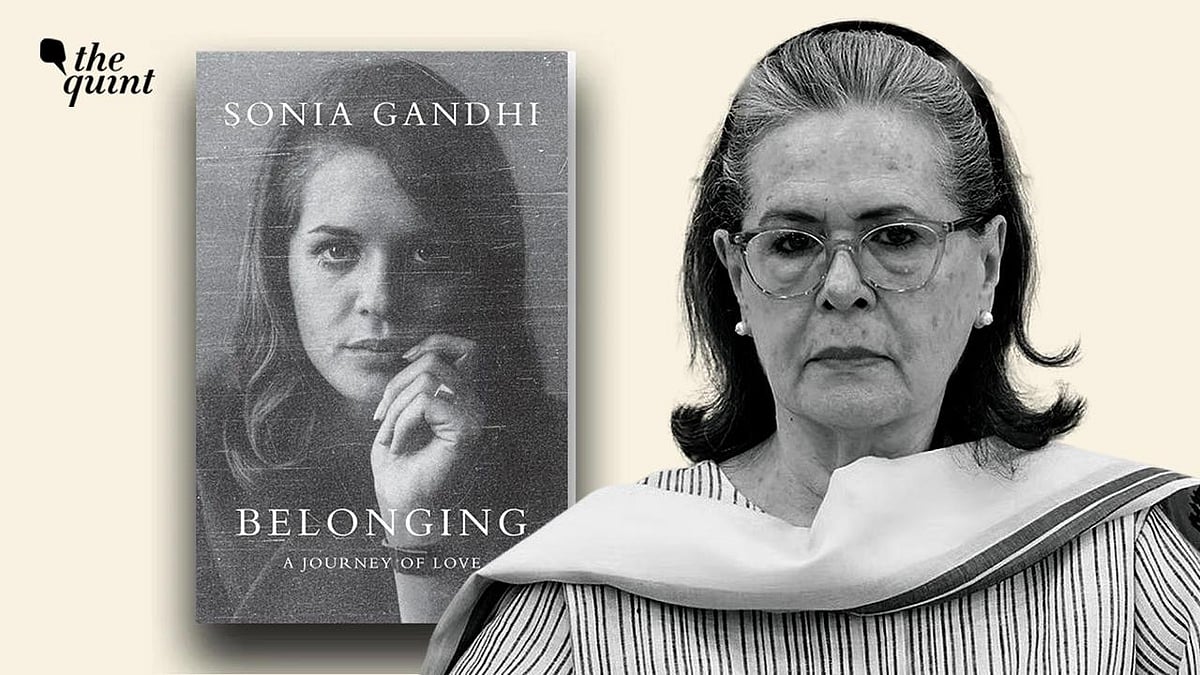
Now, the family is back with a vengeance, and the Congress is on the path to resurrection. It might take time to regain past glory, but the worst is over. At such a moment, the release of her memoir, ‘Belonging: A Journey of Love,’ is like a knife piercing into the hearts of those who always hated her.
These forces would have succeeded in their endeavour if she were treated like a normal human being, a girl next door who innocently fell for a handsome boy; if, like Columbus, they had not wrongly discovered the Americas of her ordinary life.
It is these forces that made her life more extraordinary and enigmatic; otherwise, she was a normal mother, a normal wife and a normal daughter-in-law, in a country of her choice. She did what was expected of a mother, a wife, and a daughter-in-law.
It is not her fault if she did what she was expected to do within the framework of the Indian ethos; the fault lies with those who always thought she was a foreigner. I wish they had treated her like an Indian.
(The writer is an author, columnist, co-founder of satyahindi.com and former spokesperson of AAP. He tweets at @ashutosh83B.This is an opinion piece and the views expressed above are the author’s own. The Quint neither endorses nor is responsible for the same.)
- Access to all paywalled content on site
- Ad-free experience across The Quint
- Early previews of our Special Projects
Published: undefined