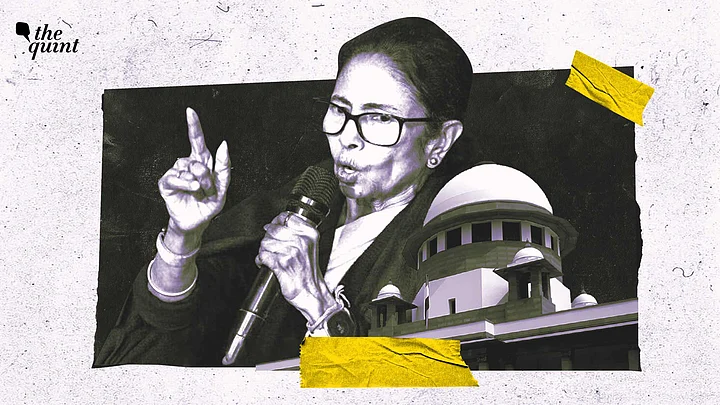
On 6 May, in her first interaction with party leaders and lawmakers after the West Bengal assembly election defeat, Trinamool Congress (TMC) chairperson Mamata Banerjee hinted that the party will increasingly focus on the legal battles—from challenging election results in a few dozen seats to safeguarding party workers from incidents of political violence.
“Chandrima and I will resume practising law in court. We—Chandrima, Biplab Mitra, and Biman Banerjee—will together handle the various cases as lawyers,” Banerjee told the gathering at her Kalighat residence, which also serves as the party’s central office.
Banerjee holds a law degree, but has rarely practiced, except for political posturing. Chandrima Bhattacharya, one of Banerjee’s most-trusted ministers in her government, was a reputed lawyer before getting involved in governance. Biman Banerjee, who served as the Speaker during the whole 15 year period of TMC rule, is also a lawyer and so is former minister Biplab Mitra.
Little did Banerjee know that she will, indeed, need a lot of lawyers pressed into service—not for her desired purpose of challenging electoral outcomes, but to ensure she does not lose her party, including the electoral symbol, funds, and assets, because the ownership of the Trinamool Congress brand itself is under threat.
First, she found it difficult to get losing candidates to challenge the results. Most of them reportedly said the verdict should be accepted. Then, the overwhelming majority of the party’s MPs and MLAs deserted her.
20 of the party’s 28 Lok Sabha MPs decided to merge with the obscure Nationalist Citizens’ Party of India (NCPI) and pledged support to the Prime Minister Narendra Modi-led National Democratic Alliance (NDA) government. Not stopping there, they also plan to stake their claims on TMC’s symbol and funds.
The disgruntled MLAs, apart from taking away the position of the opposition party in the West Bengal assembly, have also acted to ensure the party’s bank accounts got frozen. On 22 June, they held a separate meeting, replacing Mamata Banerjee with MLA Arup Roy as the chairperson.
Even outside the lawmakers, one leader after another holding party positions are quitting.
For Mamata Banerjee, a self-proclaimed ‘rough and tough’ street-fighter who built TMC from scratch and ruled Bengal for 15 years with an iron fist and populist appeal, this is an unprecedented challenge since she broke away from the Congress and launched her own party 28 years ago.
The Party
“We’ll challenge all these moves in court,” Madan Mitra, one of the few pro-Mamata MLAs, told The Quint. He insists that the organisational party is the main party, not the legislative party. The TMC, by its constitution, is chairperson-centric.
That the chairperson holds the ultimate authority on everything is clarified in the party constitution, which remains duly submitted with the election commission, Mitra said.
The party constitution says the chairperson “shall be the Supreme of the Association Body,” with power to nominate majority members in the national working committee and determine the number of office bearers in it and decide the national agenda, including electoral participation.
On 19 June, Abhishek Banerjee, the leader of the TMC’s pro-Mamata faction in the Lok Sabha, met Speaker Om Birla, seeking disqualification of the 20 MPs who broke away. Abhishek is Mamata’s nephew and political heir, holding the all-India general secretary post. MPs Sougata Roy, Kalyan Banerjee, and Mahua Moitra accompanied him. They argued that voluntarily giving up membership of one’s political party is a ground for disqualification under the provisions of the Tenth Schedule of the Indian Constitution. Forming a separate block or joining another party amounts to voluntarily giving up party membership, they said.
Besides, a merger with another party is valid only when two-thirds of the original political party—the organisational party—decides to merge with another political party. A valid merger requires support from two-thirds of the entire political organisation, including national committees, state committees, frontal organisations and party office-bearers, Abhishek argued.
However, the Tenth Schedule does not specify a time limit for the Speaker to decide on defection or disqualification petitions. The supreme court has said that Speakers should decide petitions within a “reasonable time.”
“We have requested the Speaker to adjudicate the matter at the earliest. Supreme Court judgments have made it clear that such matters should ordinarily be decided within three to four months,” Abhishek told journalists after submitting the disqualification petitions to the Speaker.
In the state Assembly, Speaker Rathindra Bose rejected the TMC’s pro-Mamata faction’s claim for the opposition party status and acknowledged an expelled MLA, Ritabrata Banerjee, as the leader of the opposition belonging to the TMC. Pro-Mamata leaders have called the Ritabrata faction as the ‘BJP’s B-team.’
The Mamata faction has challenged Speaker Bose’s move in the Calcutta High Court, which has refused to stay the Speaker’s ruling. The party will similarly have to move court if Speaker Birla’s ruling favours the breakaway faction MPs, led by Kakoli Ghosh Dastidar, Shatabdi Roy and Sudip Bandyopadhyay.
The Symbol
The battle for the party symbol can be even tougher, as recent precedents favour the group with legislative majority.
The ECI adjudicates symbol disputes under the Election Symbols (Reservation and Allotment) Order, 1968, and precedents like the Sadiq Ali case, based on tests of majority in the legislative and organisational wings and adherence to the party constitution.
Take the case of Shiv Sena for an example. In July 2022, Sena legislator Eknath Shinde approached the Election Commission of India (ECI), seeking recognition of his faction as the real Shiv Sena and to be allotted the party’s official ‘bow and arrow’ symbol. The ECI ruled in their favour–forcing the party president Uddhav Thackeray-led faction to rename the party as Shiv Sena (Uddhav Balasaheb Thackarey) or the Shiv Sena (UBT) and use a new symbol of flaming torch.
In 2023, the Thackeray faction moved the Supreme Court, challenging the ECI order. The hearing is yet to conclude and is expected to resume in July. Meanwhile, the Thackeray faction had to contest the 2024 Lok Sabha election and the assembly election six months later under the new name and symbol.
Nationalist Congress Party (NCP) chief Sharad Pawar similarly lost the name and symbol of his own party to his nephew Ajit Pawar-led faction. That case, too, is expected to be heard along with the Shiv Sena dispute. Effectively, Pawar had to contest the two major elections in 2024 under a new symbol.
Asked how they could claim a party’s symbol—the Jora Ghas Phul (two flowers and grass)—when they have already joined another, Sudip Bandyopadhyay, one of the TMC-turned-NCPI parliamentarians, said, “Let the election commission and the court decide it.”
Responding to their claim, the commission and court may freeze the symbol until the dispute is resolved, Bandyopadhyay said. He argued that in such a case, both rival factions may be allotted new symbols.
Since the breakaway MLAs have formed a separate committee, removing Mamata Banerjee from the position of chairperson, they, too, may claim the party symbol. However, whether the MPs or the MLAs would claim it first remains undecided, according to a breakaway MLA who spoke on condition of anonymity.
Frozen Funds and the Messi Mess
Things were already messy enough for Banerjee in mid-June, when a letter from Argentinian football legend Lionel Messi’s team to West Bengal police seemingly turned it messier for her.
The email, reportedly sent last week, blamed former minister Aroop Biswas for the chaos that unfolded during Messi’s December 2025 visit to Kolkata—complicating matters from Biswas, who has been one of the TMC chairperson’s closest aides for nearly two decades.
After the fall of the TMC government on 4 May, the police initiated fresh investigation into the chaos that led to Messi leaving the venue hurriedly after feeling mobbed.
Biswas evaded three police summons before finally appearing on 18 June, but not before making a move that landed Banerjee in trouble. On 18 June, as Biswas appeared before the police, news broke that he had already written to the bank hosting the party’s three main accounts, asking them to freeze the account. Biswas was the party's treasurer until early-June, when Banerjee dissolved all committees and reconstituted them two days later. Another old confidante, Subhashis Chakraborty, was named the treasurer. However, in his letter dated 12 June and received by the bank on June 16, Biswas identified himself as the treasurer.
Chakraborty was yet to formally inform the bank that he is the new treasurer, party leaders told The Quint. Therefore, in banking records, Biswas was still the cashier.
Over Rs 300 crore are reportedly parked in these three accounts. The immovable properties are mostly owned by a Trust which includes the chairperson, treasurer and the general secretary.
Things moved really fast thereafter after the news of Biswas’s letter broke and went viral.
Ritabrata Banerjee demanded that the TMC account should be frozen also because “proceeds from illegal deeds may have also been kept there.” An MLA of his camp formally wrote to the police, urging them to freeze three accounts. The cops acted swiftly and the accounts were frozen by June 19 evening.
After the Ritabrata camp formed the new committee, it became evident that Biswas, too, has switched sides. He has been named a vice-president in the new committee.
The Mamata faction now likely needs court orders to turn the accounts operational.
As the Shiv Sena defection controversy has revived with six of the nine Thackeray camp MPs switching sides, all eyes will be keenly on how the Shiv Sena and NCP disputes end in the Supreme Court.
(Snigdhendu Bhattacharya is a journalist who writes on politics, history, culture, environment, and climate change. He has authored books on leftwing insurgency and Hindu nationalism. This is an opinion piece. The views expressed above are the author's own. The Quint neither endorses nor is responsible for the same.)