
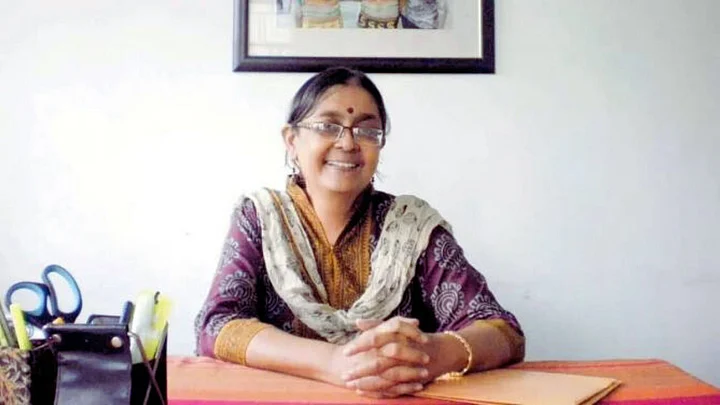
Born in the plush suburbs of Bombay, she grew up far away from the sweat, toil, and sufferings of the forest dwellers, farmers, Dalits, and other struggling sections of India's populace. Educated at St Joseph’s Convent, she went on to study English at the renowned Elphinstone College of Bombay, as the city then was. Higher studies took her to Nagpur and, years later, she ended up as an Associate Professor and the head of the English Literature Department of Nagpur University.
Shoma Kanti Sen was not content with simply teaching Hamlet and King Lear to her students. Over time, she got involved with many an organisation working for the upliftment of women, Dalits and other marginalised groups of people. One such organisation was Stree Chetna which focused on violence against women and dowry deaths. Sen was also associated with the Committee for the Protection of Democratic Rights (CPDR).
In Satyajit Ray’s masterful satire Hirak Rajar Deshe, the autocratic Hirak Raja felt most threatened by teachers, because he felt that they fed subversive and rebellious ideas into young minds. As he shut down schools, the King made the pupils learn by rote janar kono shesh nai, janar chesta britha tai (there is no limit to knowledge, hence it is futile trying to learn). No Bengali, even a probashi worth her salt, would be a stranger to Ray’s Hirak. It can be reasonably assumed that Sen was aware of Hirak Raja and the dangers of influencing young minds.