
Netflix's 'Lust Stories 3' Review: A Mixed Bag Of The Best Kind
'Lust Stories 3' reclaims the usually dismissive term of “a mixed bag”. It's a mixed bag of the best kind.
advertisement
Perhaps it’s because it’s been a while since the pandemic-era glut of them (Paava Kadhaigal, Ajeeb Daastaans, Unpaused, Navarasa, Ray), but the idea of an anthology remains inherently exciting. There’s just something about the collision of filmmakers, perspectives, interpretations and ideas; the permutations and combinations of casting and narrative possibility.
Perhaps it’s easier to be charmed by them after the fact, because, for me, Lust Stories 3 is the strongest of the series. I should clarify that. That’s not to say that these are necessarily the four best shorts or ‘segments’ of the entire Lust Stories series (those directed by Konkona Sen Sharma, Karan Johar, and Anurag Kashyap are all up there among the best). But it’s that Lust Stories 3 offers the most consistent mix so far.
Ali Fazal in a still from 'Lust Stories 3'.
(Photo Courtesy: YouTube)
These are four very different films, each rewarding in their own way, all of which invite discussion and debate. If that isn’t success, I don't know what is.
Vikramaditya Motwane At His Most Playful
At close to three hours, this is the longest Lust Stories yet. The four films also don’t have individual titles, which seems like an odd choice. Vikramaditya Motwane’s film, written by Avinash Sampath, kicks things off. His short sees the genre-jumper at his most pacy and playful yet. This is as close as we’ve ever come to a Vikramaditya Motwane comedy.
The film follows two Kandivali-based couples. Both marriages are going through something of a rough-patch-meets-dry spell. Shonali (Konkona Sen Sharma, whose husband is played by Abhishek Banerjee) has the objectively insane idea of swapping husbands for a night with her best friend, neighbour and colleague Padma (Radhika Apte, whose husband is played by Vijay Varma).
Not unlike Olivia Wilde’s glorious The Invite (which has a similar premise), Motwane’s film is a “sex comedy” on the surface that doubles as a relationship comedy that covers a melancholic drama at its core.
Friendship-wrecking aside, what if the women find themselves attracted to the other spouse more than their own? What if their husbands are more attracted to the friend than their own wives? Above all, given that the men aren’t actually in on the plan and both women are just trying to seduce the other’s husband, how are these women okay with their husbands essentially cheating on them? Of course, the idea colourfully backfires as Shonali starts a fire that she struggles to put out (pun not intended).
The “build-up” here is a lot more effective than the landing. The short throws out a lot of fun ideas-including creating its very own K-drama that the two women are obsessed with-but they don’t all quite come together as one. It could have also done without the out-of-nowhere, on-the-nose monologue about why women need to choose themselves over their spouses.
Radhika Apte in a still from 'Lust Stories 3'.
(Photo Courtesy: YouTube)
Kiran Rao The Unabashed Commercial Filmmaker
With her segment, Kiran Rao once again reminds us what a ‘commercial filmmaker’ she really is. It’s arguably the least “ambitious” of the lot, as a playful comedy that just wants to have a good time, but it had me entirely from the first moment to its last. It’s tough to get into without spoilers, given how much of the film, from writer Tanaji Dasgupta, relies on cheeky twists and reveals.
Put simply, it follows Karan (Gurfateh Pirzada’s most enjoyable performance yet), a food delivery partner who finds himself in an unlikely love triangle after falling for Lisa (striking, self-assured newcomer Sana Thampi), who works at a nearby nail salon.
Rao’s short is equally a love letter to Mumbai. The pair work in the colourful lanes of Kala Ghoda. He lives in a small rented room, hers in a cramped flat in a bustling building society. A key character spends his mornings with the city’s fishing community. Above all, for me, the film is a saucy commentary on the lack of personal space and privacy that comes with the impermanence of life in the maximum city.
Konkana Sen Sharma in a still from 'Lust Stories 3'.
(Photo Courtesy: YouTube)
Vishal Bhardwaj Back In His Element
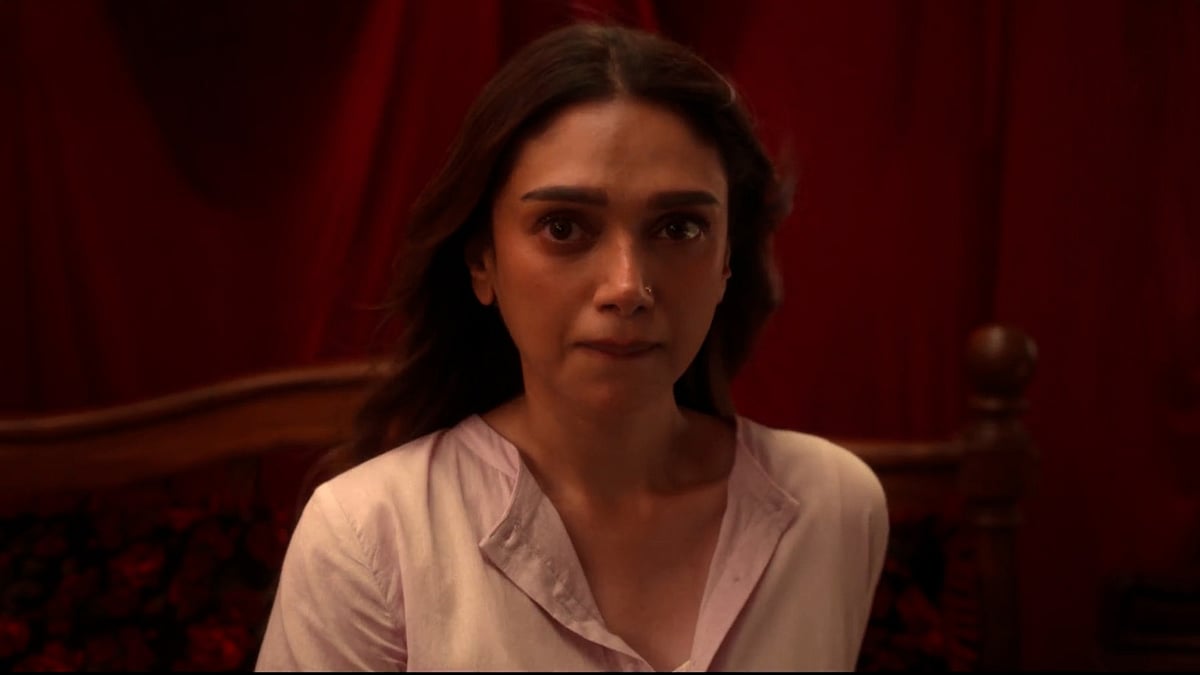
Vishal Bhardwaj’s film sees him back in his element. He creates the most distinctive world of the four. Bhardwaj hasn’t been this enjoyable to watch since, ironically, the last anthology he was a part of-Modern Love Mumbai. Set in Hyderabad in the late 80s, it follows Saira (a delightful Aditi Rao Hydari), an assistant professor at a local university. Saira wants nothing more than to find a way of telling her caring but boring homoeopathy doctor husband, Badru (played by real-life husband Sidharth), that she wants more than wam-bam-thank-you-ma’am in the bedroom.
She’s even created a fictional man in her head to represent her unfulfilled needs, whom she imagines when she pleasures herself. In one of the sweetest decisions in an incredibly sweet film, the man she imagines is a kooky, uncaged version of her own husband (we’ll call him Dream Badru) rather than some attractive stranger.
Dream Badru is Sidharth like we’ve never seen him. I loved that he doesn’t conform to a conventional, macho brand of brooding masculinity. Instead, Dream Badru is poetic, soft, silly and almost cartoonish in how much he dotes on Saira.
Saira teaches literature to a class of all-female students and, when they’re left alone by the senior faculty, the giggly group exchange notes on their evening exploits. They even convince Saira to try her hand at writing her own erotica, which sets in motion a sex-comedy of errors. But the real triumph here is the textures and tonality of this whimsical, dreamy world.
That, and perhaps Gajraj Rao, who plays Saira’s infinitely huggable father and who speaks only in the language of a mouthful of paan, spewing supportive monologues that only Saira seems to understand. Though Bhardwaj risks being too seduced by his own world, with the one film that overstays its welcome and has you feel its duration. But it’s delightful nonetheless as an almost adorable celebration of desire.
Siddharth in a still from 'Lust Stories 3'.
(Photo Courtesy: YouTube)
Shakun Batra Stands Out
But it's Shakun Batra that stands out, with the most solemn segment of the series. His film comes third in the sequence, but I’m choosing to write about it last. It’s the most ambitious, interesting and specific of the four.
After five years of marriage, Varun (Ali Fazal) and Sailee (Radhika Madan) are parting ways. Their respective divorce lawyers are now a bigger part of their lives than each other.
Batra’s film, written by Ashwathi Namboodiri, Sameeha Sabnis and Nitesh Bhatia, is a triumph on multiple fronts. For one, much of it is a two-people-in-a-room drama. It’s one of my favourite “genres”, but it’s also incredibly tricky to get right. A delicate dance of staging, dialogue and performance. Thankfully, it lands beautifully here.
Radhika Madan in a still from 'Lust Stories 3'.
(Photo Courtesy: YouTube)
Batra’s film would have you believe that the emotionally charged, subtext-heavy sex scenes are its ‘set pieces’, but it's actually the argument sequences. The ‘fight’ scenes strike an incredibly delicate tone of comedy (their pettiness) and drama (their cruelty).
The film is most alive in conflict, when Sailee and Varun are at each other's throats (figuratively), arguing about everything from how to divide the furniture to her constant travelling to his nosy mother. The escalation of those argument scenes is a thing of marvellously calibrated chaos.
They also include two of my favourite Hindi film moments of the year. The first is when, in a fit of mid-argument rage, Sailee gets up on a stool to match their height and level the playing field. The second is later on in a lift. To bring Varun back down to size and puncture his smugness, she grabs his crotch. Both moments are power moves. Both precede the inevitable.
It’s why the “second half” of the film risks losing its potency and melancholic magic when it becomes about healing. When the two start having convenient conversations over raw confrontations. It’s here that everything that goes unsaid risks being spelt out. Rather than being made to feel their history, it's recited to us.
As we learn through an overwritten couples-therapy scene featuring Rajat Kapoor and several conversations that follow, I wish we weren’t told what went wrong with their relationship, which is distilled down to a single traumatic event. Still, even in its quiet healing, the film finds a fragility and vulnerability that makes it shine brighter than the segments that come before or after it.
With its four segments, Lust Stories 3 reclaims the usually dismissive term of “a mixed bag”. Here is a mixed bag of the best kind.
Lust Stories 3 streams on Netflix on 18 September.
(Suchin Mehrotra is a critic and film journalist who covers Indian cinema for a range of publications. He's also the host of The Streaming Show podcast on his own YouTube channel. This is an opinion piece, and the views expressed above are the author’s own. The Quint neither endorses nor is responsible for the same.)
- Access to all paywalled content on site
- Ad-free experience across The Quint
- Early previews of our Special Projects
Published: undefined