
Xi-Putin Bonhomie Puts India's BRICS and Quad Bets Under Strain
How will growing China-Russia ties play out for India, especially with India-China still on the fence?
advertisement
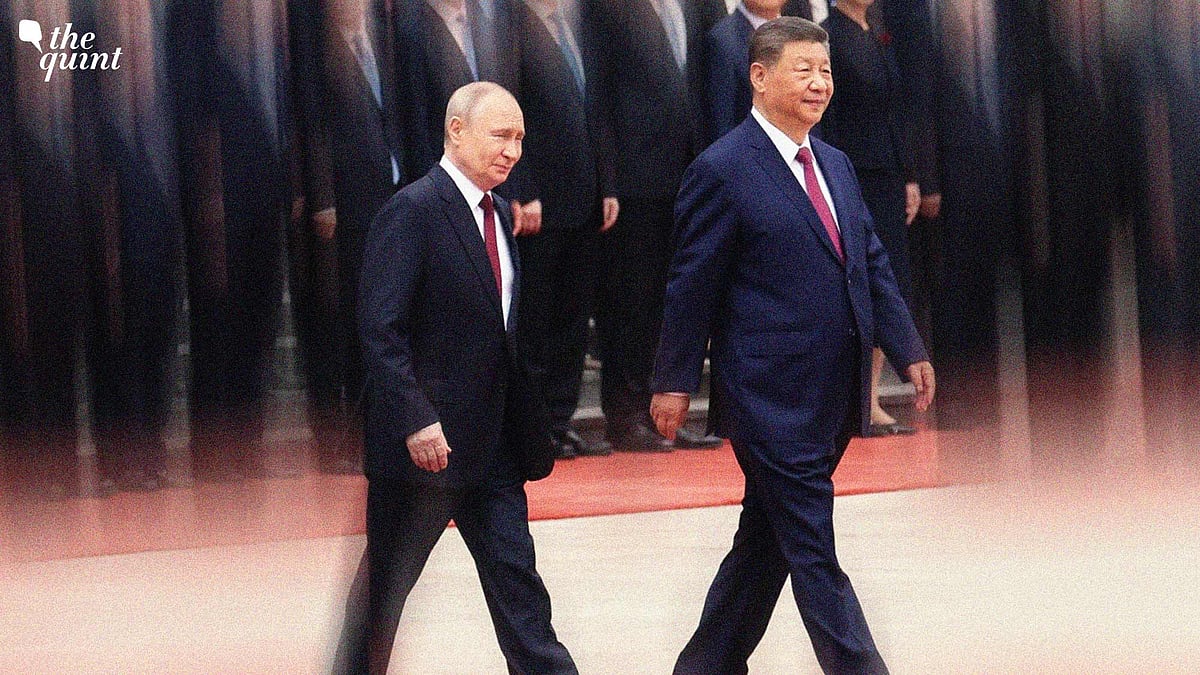
Russian President Vladimir Putin has met his Chinese counterpart, Xi Jinping, 43 times now. Of these, 25 times were in Beijing alone.
Although the Guinness Book of World Records has not stepped in to lend some perspective on which two leaders have most consistently met in different capitals for summits, these confabulations are enough to suggest that the two leaders—despite misgivings of Western commentators—get along very well.
Unlike his 2017 trip to Tianjin, Putin did not try his hand at making dumplings this time. But the two seemingly enjoyed each other’s company in Beijing just a few days after the much talked-about summit between US President Donald Trump and Xi in the Chinese capital.
The Putin-Xi meeting was successful to the extent that it achieved far more than what Trump sought to achieve. Putin and Xi asserted the imperative of strengthening a bloc other than that led by the US.
While insiders working closely with Putin claimed that he will attend the BRICS summit in New Delhi later in September this year, the Chinese have been rather ambivalent about Xi's attendance.
Worse still, for India, the Chinese have conveyed to their Indian counterparts that they will not do any trade with New Delhi. Their contention is that either they will have a relationship with India where it does not hold back anything or they will not have anything to do with it.
India, China & the Quad Conundrum
In fact, the relationship between India and China has worsened in recent days, with Russia not being able to broker a détente between them. The Chinese are reportedly upset with India being part of the Quad, which they consider an anti-China grouping.
Quietly, India has been told to get out of Quad if it wants to do business with Beijing. India is clinging on to the concept of strategic autonomy, but it is cognisant of how the ground is shifting in favour of China. The past few months have seen many world leaders head to Beijing to sign a deal. These include Mark Carney from Canada, Pablo Sanchez of Spain, Keir Starmer of the UK, Shahbaz Sharif of Pakistan, and many others.
(From left) Australian Foreign Minister Penny Wong, External Affairs Minister S Jaishankar, Japanese Foreign Minister Toshimitsu Motegi, and US Secretary of State Marco Rubio during a joint press conference after attending the Quad Foreign Ministers meeting in New Delhi.
(Photo: PTI)
The ostensible reason is that the Indian government cannot get Trump's dates to visit India in the coming months, but people who know are clear that India is trying very hard to inch closer to Beijing.
India believes that New Delhi has done enough to keep China happy, but it is not making an impact. Reports claim that the Chinese have paused giving visas to Indians.
The attitude of the Chinese towards Russian, in comparison, is totally different. Both the countries have positioned themselves against unipolarity, epitomised by the US. They are adamant in claiming that multipolarity, under no circumstances, means the destruction of the Western world.
Russia, China See Eye to Eye on Trumpism
Russia and China are of the firm view that the world is not a homogeneous entity dictated by the West in the name of global order, but an aggregation of sovereign states. Though the expectations that the two countries would sign an agreement to build another LNG pipeline—Power of Siberia II—to bypass Iran's Strait of Hormuz crisis remain unmet, there were other proposals discussed between the two leaders. The reason why the deal between China and Russia on the pipeline fell through was over pricing.
According to CNBC, “China reportedly wanted pricing terms for the new pipeline to match Russia’s domestic rate of around $120-130 per 1,000 cubic meters, while Moscow is seeking terms closer to Power of Siberia I, which analysts estimate would more than double that figure.”
Russia’s proposal involved finding a solution to the Iran negotiations with the US where Pakistan is the mediator. Russia offered to store Iran’s enriched uranium.
Putin further highlighted the dominant aspects of the relationship with China. He said:
War, Fuel & Geopolitics
Russia has managed to survive the plethora of sanctions that have been slapped on it ever since Moscow attacked Ukraine. China buys most of its crude oil from Russia, and even Iran. On the other hand, India, which does not believe in bilateral sanctions, succumbed to European and US pressure and stopped buying oil from Moscow.
Thanks to China’s relationship with Russia, the latter's foreign exchange reserves have grown. The total yearly trade between the two countries is $240 billion. The Iran war has further helped Russia sell oil at a premium, helping the Russians earn about $150 million per day and approximately $20 billion a month.
Both countries, Russia and China, have recognised the positive role the Iran war has played by de-dollarising the global economy. Iran, too, reportedly accepts toll fees from countries trying to get through the Strait of Hormuz in Chinese yuan.
The dollar is no longer recognised by Iran or Russia. India is still trying to protect the US dollar. It remains to be seen whether Russia and China manage to convince India to back a BRICS currency and support de-dollarisation.
(Sanjay Kapoor is a veteran journalist and founder of Hardnews Magazine. He is a foreign policy specialist focused on India and its neighbours, and West Asia. This is an opinion piece. All views expressed are the author’s own. The Quint neither endorses nor is responsible for them.)
- Access to all paywalled content on site
- Ad-free experience across The Quint
- Early previews of our Special Projects
Published: undefined