
West Asia War: India 'Tilts' Toward US-Israel, Russia Condemns, China Holds Back
India's desire to not get on the US or Israel's wrong side is inspired by PM Modi's own stance, an ex-diplomat said.
advertisement
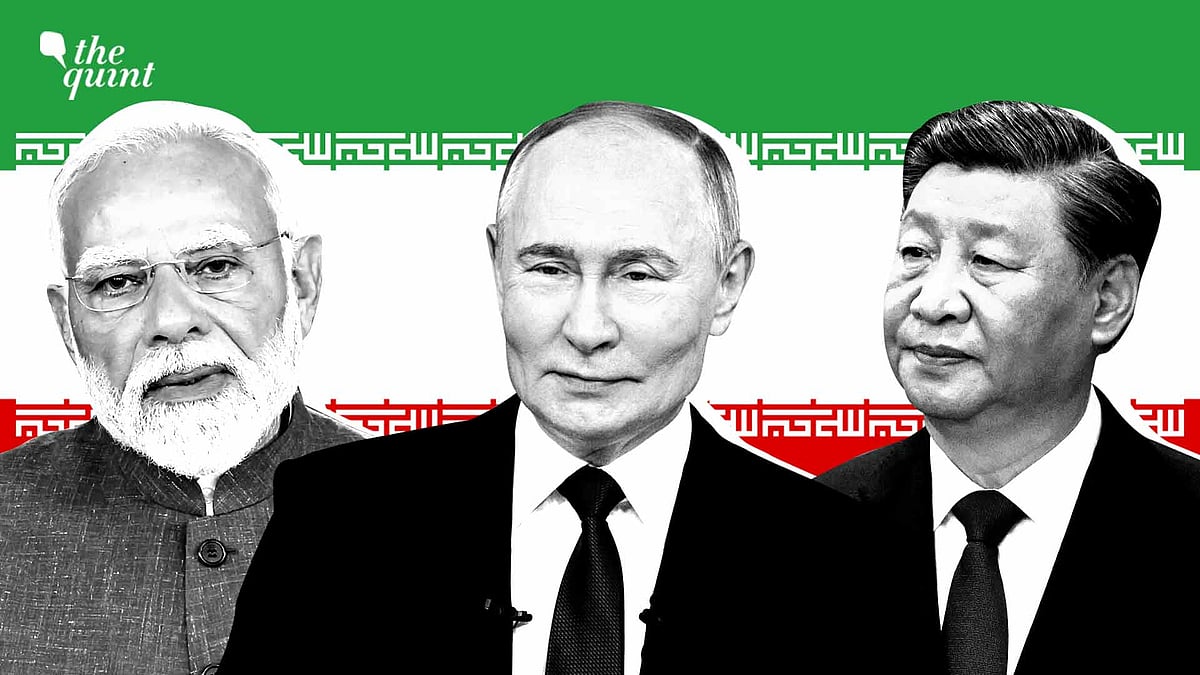
A slight 'tilt' by India towards the US and Israel. An official condemnation of US strikes by Russia but a refusal to get involved directly. And an oft-repeated 'wait and watch' policy by China.
In a nutshell, this is how the foreign policy stances of New Delhi, Moscow, and Beijing are being widely perceived regarding the ongoing conflict between the US and Israel on one side and Iran on the other.
However, beyond the official statements issued and phone calls made, there's far more to these countries' positions than meets the eye.
With help from former diplomats and academics, The Quint dissects the backdrop in which these three major stakeholders formed their foreign policy stances on the West Asian war.
India
Khamenei's assassination: To start with, it came as a surprise to many when New Delhi did not condole the death of Iran's slain Supreme Leader Ayatollah Ali Khamenei, who was killed by US-Israel joint strikes on 28 February.
As is the norm, Prime Minister Narendra Modi did not post a condolence message on X nor did he call Iranian President Masoud Pezeshkian to offer condolences. Instead, the government's response was limited to Foreign Secretary Vikram Misri signing a condolence book at the Iranian Embassy in New Delhi on 5 March—five days after the war began.
"India's delayed response in condoling Khamenei's death could have been avoided, and diplomatic norms should have been pursued with vigour," geopolitics expert Lt General Kamal Davar (retd) tells The Quint.
Calls made to Iran: Further, while PM Modi held talks on 2 March with his counterparts in Israel and Gulf nations targeted by Iran, no such courtesy was extended to Tehran. Modi's call to President Pezeshkian took place on 12 March, 10 days after he dialled the other stakeholders in the conflict.
Furthermore, official readouts from the call and the prime minister's post on X suggest that while he condoled the deaths of civilians, the main focus of the conversation was to urge Iran to let energy exports pass through the Strait of Hormuz, through which India obtains 40 percent of its crude and 50 percent of its LNG (liquiefied natural gas).
"I think it's clear that India doesn't want to upset or alienate Israel or the US," former Foreign Secretary Krishnan Srinivasan tells The Quint.
Srinivasan says that the government's position is orchestrated by the Ministry of External Affairs (MEA), which seems to be "directly under PM Modi's supervision".
Did Iran's attack on Gulf states facilitate India's 'tilt'? PM Modi's phone call to President Pezeshkian was followed by India co-sponsoring a UN resolution on 11 March led by Gulf Cooperation Council (GCC) countries condemning Iran's strikes in the region.
India could have abstained, given long-standing ties with Iran, but it did not.
Which begs the question: Would India's foreign policy stance have walked a more genuine middle path if Iran had not launched strikes against New Delhi's all-important Gulf partners? And by doing so, did Iran forgo the symbolic support it may have received from India and others which couldn't compromise on their ties with the Gulf under any circumstances?
The jury is divided.
"I don't feel Iran is seeing it from what India, Russia, and China will think," says retired senior diplomat TCA Raghavan while speaking to The Quint.
Other experts cited the varied links between India and the Gulf—not only in terms of strong economic relations but also the 10 million-strong Indian expatriate population that lives and works in West Asia—which may have influenced New Delhi's foreign policy stance and led to ties with Gulf nations taking precedence over ties with Iran.
"India's engagements in the Gulf are vital and core to our interests. So it is sacrosanct for us to be in regular touch with them regarding the developments taking place," retired senior diplomat Veena Sikri tells The Quint.
Sikri says that since India has traditionally enjoyed good relations with Iran, it's unlikely that Tehran would "misunderstand" New Delhi's position of reaching out to Gulf nations.
Indian 'diplomatic' win with Iran: One of the 'results' Sikri speaks of is Iran's decision to let at least two India-flagged ships—Shivalik and Nanda Devi—pass through the Strait of Hormuz. The two ships, carrying approximately 92,000 metric tonnes of LPG, docked in Gujarat earlier this week.
The decision to let India-bound ships through was taken by Iranian authorities on 14 March following a phone call between External Affairs Minister S Jaishankar and his Iranian counterpart Abbas Araghchi. The duo have held four phone calls since the conflict began.
Hence, while a tilt towards Israel and the US may be evident from India's actions, experts suggest that it would be naive to assume that New Delhi isn't diplomatically engaging with Tehran simultaneously.
"I must give credit to Indian diplomacy for still managing to maintain some kind of relationship with Iran," Sumit Ganguly, political scientist and senior fellow at the US-based Hoover Institution, tells The Quint.
Russia
Direct condemnation of Khamenei's killing: Unlike India, Russia was quick on its feet to condemn Khamenei's assassination, calling it a "cynical violation" of human morality and international law.
"Please accept my deepest condolences in connection with the assassination of the Supreme Leader of the Islamic Republic of Iran, Seyyed Ali Khamenei, and his family members," Russian President Vladimir Putin said in a message to his Iranian counterpart on 1 March, a day after Khamenei's death, as per Russia's TASS news agency.
Abstention from voting on UN resolution: Russia was one of only two countries (the other being China) that abstained from the UNSC resolution on 12 March, which condemned Iran's strikes against Gulf states.
Amidst the conflict, President Putin has also tried to position himself as a "peacemaker". For instance, as per a readout of a phone call between Putin and US President Donald Trump on 10 March, the Russian leader offered to act as a mediator between Iran and Israel given that it enjoys good ties with both countries.
"Russia has developed its relations with Iran over the years. Similarly with Israel, the relationship is relatively strong because of Russian Jews who emigrated there during the Soviet era. The Israeli leadership also regards Russia with some importance. That gives President Putin the chance to talk to both sides," says Veena Sikri.
What does Russia stand to gain? Further, several experts suggest that Russia has the most to gain from the conflict, particularly the disruption in global oil supply brought upon by the Strait of Hormuz's closure.
Amid the disruption, several countries have begun pivoting toward Moscow for their oil needs, including India. The US also "granted" New Delhi a 30-day waiver to purchase Russian oil on 5 March. Similarly, on 12 March, Washington authorised the General License 134 (G-134) to allow delivery and sale of Russia's crude oil loaded on vessels.
Yet another advantage Russia may derive is with regard to its battlefront with Ukraine. According to multiple reports, the US has been diverting portions of its military infrastructure away from Ukraine and towards West Asia amid the ongoing conflict.
In an interview with CNN on 15 March, Ukrainian President Volodymyr Zelenskyy also said that Kyiv could face heightened risks if the war in West Asia persists. "Yes, of course, we have big risks," Zelenskyy said, adding that the conflict would affect Ukraine's current arsenal of weapons provided by the US.
Rumours of intel-sharing with Iran: Further, a report by The Washington Post quoted US officials as saying that Russia has been providing sensitive intelligence to Iran, including locations of American warships and assets in the region. However, the US' special envoy to West Asia, Steve Witkoff, said in an interview with CNBC last week that the Russians have officially denied doing so during their communications with the White House.
However, some experts suggest that regardless of what Moscow's official stance may be, they could be playing a more "discreet" game behind the scenes.
"No matter what the Russians say, I'm sure they are providing intelligence to Iran," says Sumit Ganguly.
China
Calls made to Iran and Israel: China's Foreign Minister Wang Yi spoke to his counterparts in both Iran and Israel on 3 March. According to readouts of the calls, while Yi expressed solidarity with Tehran, it demanded an immediate halt to military activities by Jerusalem while speaking to Israel's Foreign Minister Gideon Sa'ar.
Similarly, China's Ministry of Foreign Affairs on 1 March released a statement calling the assassination of Khamenei a "grave violation of Iran's sovereignty and security".
Also, the two countries signed a 25-year cooperation agreement in 2021, as per which China pledged investments worth $400 billion in key sectors in Iran.
Did the attack on the Gulf facilitate a pivot by Beijing? However, when Iran launched strikes against Gulf states, Beijing's attention was diverted away from criticism of US-Israel strikes and towards placating its all-important Arab partners, some experts say. For instance, China's special envoy for West Asia, Zhai Jun, was dispatched last week to hold talks with countries like the UAE and Saudi Arabia, which are essential oil sources for China. At the same time, China has been urging Iran to re-open the Strait of Hormuz, through which it obtains roughly 40 percent of its oil needs.
Which begs the question: Has China's relationship with the Gulf states taken precedence over its ties with Iran amid the hostilities?
Yes, says Sumit Ganguly.
Others, however, suggest that China's attempt to not take a position too inclined toward Iran is in line with its desire to not get directly involved in the conflict. Another testament to this is that China has not supplied Iran any additional military equipment since the war began.
There is also speculation about whether Beijing's upcoming diplomatic engagements could have influenced its stance.
President Trump was scheduled to visit China later this month to hold trade talks. While Washington had slapped tariffs worth 50 percent on key Chinese industries, the US Supreme Court had struck down the sweeping levies as "unconstitutional". Hence, amid a lack of clarity regarding the US' tariffs, both countries would be eager to hammer out a trade deal in their own favour.
However, President Trump said while speaking to the press on 16 March that his administration has asked Beijing whether the visit could be postponed by a month or so due to the ongoing conflict.
Similarly, a China-Arab States Summit was scheduled to be held in Beijing in June 2026, which would include representatives from China's major oil suppliers. There's no clarity on whether that summit will take place either given the circumstances.
However, when asked whether these diplomatic engagements could have figured in Beijing's official policy stance, some experts suggested otherwise.
- Access to all paywalled content on site
- Ad-free experience across The Quint
- Early previews of our Special Projects
Published: undefined