
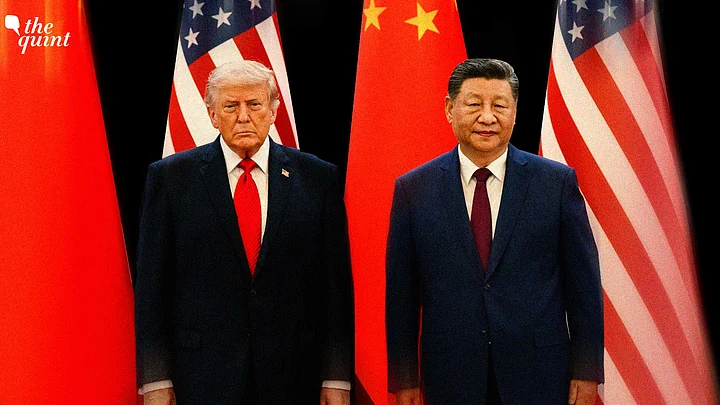
US President Donald Trump’s recent visit to Beijing provided an opportunity to the world’s two most powerful men to calm worldwide anxieties, including in their respective countries, on account of a very turbulent and contentious current global situation. This required that they should, above all, find common ground and agree on actionable steps on the main present crisis: The Iran war.
While the visit was rich in symbolism and pomp, Chinese President Xi Jinping and Trump did not arrive at any understanding on concrete steps which their two countries would take to help end the war.
Of course, as the US is a party to the war, it can end it unilaterally—but that is unlikely. Hence, the need for China to work with Iran and the US to stop it.
Concrete and actionable measures are different from statements of principles. Enunciating principles, while important, is relatively easy. The test lies in steps and measures especially to end a military conflict, which were absent, despite China having equities in Iran.
Even if this would have been a departure from the traditional style of Chinese diplomacy, it was necessary. And, both countries would have had to overcome their mutual wariness for global good. That was not seen.
No Consensus on Iran
There are times when leaders of the major powers have to act as global statesmen, but neither Trump nor Xi Jinping were willing or perhaps even capable of that stature.
This was especially ironic in the case of the Chinese leader because he spoke eloquently of the world being at an inflexion point seen only once in a hundred years. He also mentioned the need for US-China cooperation to address global issues—and no issue is as pressing as the opening of the Strait of Hormuz—but refused to translate words into a joint programme of concrete actions.
No US-China joint statement was issued at the conclusion of the visit. That practice has perhaps been given up by the Chinese. Its absence makes it difficult to authoritatively know what the leaders actually agreed to. For instance, Trump claimed that Xi agreed that the Strait of Hormuz should remain open, and that Iran should not have any nuclear weapons.
Xi did not make any public comment on his talks with Trump. And the Chinese Foreign Ministry spokesperson did not speak in the same terms as Trump did, especially on the nuclear issue. The question, therefore, is: was Trump exaggerating on what Xi told him on these two matters?
The spokesperson addressed a media conference after Trump’s departure from Beijing. Responding to a question on discussions between the two presidents on the Iran war, the spokesperson reeled off a set of principles.
He began by stating the impact of the war in these words “the conflict has put a heavy strain on global economic growth, supply chains, international trade order and the stability of global energy supply”. Thereafter, he took a dig at Trump without naming him.
He said, “There is no point in continuing this conflict which should not have happened in the first place.” Thus, he placed the onus of starting the war on Trump and indirectly also placed the onus of ending it on the US President.
The Trump administration would have been hardly pleased with these words, but it is unlikely to react harshly as it did when the Europeans had questioned the need for starting the Iran war.
If these words would have left Trump unhappy, he would have been pleased that China endorsed the view on the need to open the Strait of Hormuz. But the words used were indirect.
The spokesperson said,
“It is important to reopen the shipping lanes as soon as possible to respond to the call of the international community and jointly keep the global supply chains stable and unimpeded.”
On the nuclear issue, the spokesperson’s response did not match Trump’s claim. He said, “It is important to steady the momentum in easing the situation, keep to the direction of political settlement, engage in dialogue and consultation, and reach a settlement on the Iranian nuclear issue and other issues that accommodates the concerns of all parties”.
Finally, China would like the ceasefire to become permanent. Hence, it would most likely condemn any resumption of military action by Trump.
Not Good News for India
The Indian diplomatic foreign policy machinery would have been eying the extent of the impact Trump’s China visit would have on bringing forth a concrete decision regarding the Iran war. That does not seem to have happened.
The prospects of an early end of the war now seems remote. India should, therefore, anticipate tight energy markets continuing for the next many months. India would like the ceasefire to continue—and the emphasis placed by the Chinese spokesperson was in line with its own thinking. Trump has been threatening to order the resumption of military action but it is difficult to visualise if he will do so.
In addition to the Iran war, India would have also closely observed if any important breakthroughs were made by Trump and Xi Jinping in US-China bilateral ties, especially in the areas of trade and technology.
Trump and the US business elite want China to open up its market but China is going to calibrate that process. Chinese-US cooperation in trade and technology is bound to have a fall out on India. An increase in US tech majors' attention to China may be at the cost of India. This will not be good news for India because it needs to attract more flows of investments and technology, especially in Artificial Intelligence.
The American approaches towards China in the security sector and in the Indo-Pacific region are of vital importance to India. Xi forcefully reiterated China’s position on Taiwan. Trump told the media that he just heard him out.
There are no reports if other aspects of the Indo-Pacific security were raised by either leader. Indian diplomats would. For India, an important issue is the US commitment to QUAD. There were no pointers on this question from the summit either. It will, therefore, be prudent for India to continue to look to itself—and no foreign power for its own security.
(The author is a former Secretary [West], Ministry of External Affairs. He can be reached @VivekKatju. This is a personal blog, and the views expressed above are the author’s own.The Quint neither endorses nor is responsible for them.)
