
DU Student's NSA Case: Allahabad HC Rightly Warns of 'Orwellian Dystopia'
The court observed that detention under NSA is an exception, not a substitute for ordinary criminal law.
advertisement
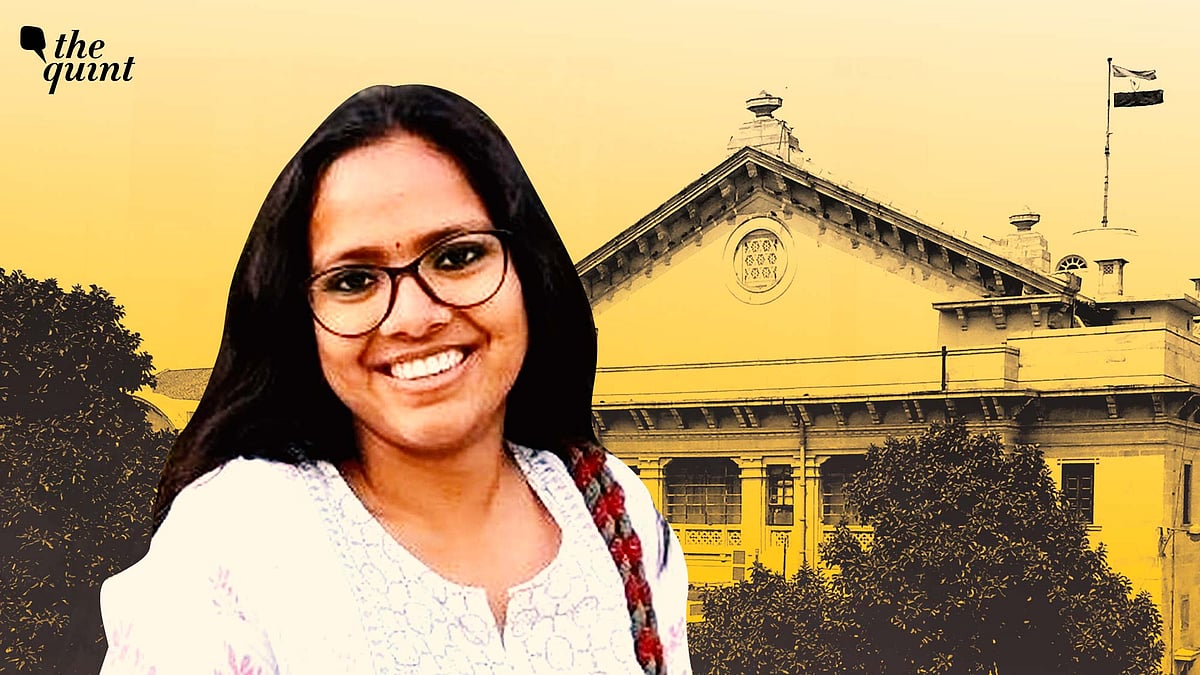
In a significant judgment that upholds civil liberties against executive overreach, the Allahabad High Court quashed the National Security Act (NSA) detention of Akriti Chaudhary, a 25-year-old Delhi University history graduate who spent five months in custody in connection with the Noida workers' protest of April 2026.
“Preventing people from gathering in public spaces or agitating their rights on the grounds of assumed breach of peace, would be throwing the baby out of the bath water,” Justice Atul Sreedharan, who authored the judgment, wrote.
The Division Bench of Justice Atul Sreedharan and Justice Achal Sachdev not only ordered her immediate release but also awarded Rs 5 lakh compensation, directing its recovery from the salary of the District Magistrate (DM) of Gautam Buddha Nagar, Medha Roopam, along with other officials responsible, "right down to the SHO".
Delivering a stinging rebuke to the Uttar Pradesh administration, the Court warned that continued "despotic" conduct by errant bureaucracy could reduce Uttar Pradesh to an "Orwellian Dystopia". The Bench held that Chaudhary's continued incarceration under the NSA violated her Fundamental Right under Article 21, as the detention order and grounds were devoid of material and passed "without application of mind".
The court observed,
The Genesis of the Case
The case arises from the widespread agitation by labourers in Gautam Buddha Nagar in April 2026, who protested against low salaries, lack of wage increases for several years, and inhumane working conditions of up to twelve hours a day. Workers numbering in thousands came out into the streets near industrial establishments, allegedly indulging in acts of vandalism and arson, destroying factory facades and setting ablaze vehicles, including police vehicles.
Chaudhary, a history graduate from Daulat Ram College pursuing her first year of law at Delhi University with no previous criminal record, was arrested in cases arising from the protest. The UP Police subsequently invoked the NSA against her and activist-journalist Satyam Verma on 13 May, alleging that she was the "agent provocateur" who conspired to foment violence.
However, the Court closely examined the sequence of her arrest and found serious procedural lapses. Chaudhary maintained she was taken into custody at about 5:30 PM on 11 April 2026, at Botanical Garden Metro Station in Noida, while the State claimed her arrest took place on 12 April. The State relied upon a notice under Section 130 of the Bharatiya Nagarik Suraksha Sanhita (BNSS) concerning a bond for good behaviour, but the Court noted that the notice mentioned General Diary Entry No. 37, which had itself been generated at 10:20 AM on 12 April—proving the notice was prepared post-arrest.
Key Observations from the Judgment
On Bureaucracy and Police Conduct
The Court made significant observations on the roles of bureaucracy and police, emphasising that officers are entrusted with immense powers because they bear responsibility for upholding citizens' constitutional and legal rights. However, the Bench stressed that their "loyalty is towards the Constitution and not the political executive," adding that officers are servants who serve the people, who are "the masters in a democracy".
On the District Magistrate's Conduct
The Court was particularly critical of the conduct of DM Medha Roopam, holding that where the police report contained only allegations without credible supporting material, the DM was expected to examine the record "threadbare" before deciding whether the stringent provisions of the NSA were warranted. The Bench observed that Chaudhary was a female student activist with no previous criminal record, and the material did not show that she had incited violence.
The Court concluded that the "conduct of the District Magistrate Gautam Buddha Nagar who passed the impugned order, is worthy of derision". It further held that the DM "desired to set an example" out of Chaudhary and deter others from exercising their right to freedom of speech and expression in public spaces in support of labourers.
On Discrepancies in the Police Case
The Court found serious discrepancies regarding Chaudhary's arrest. Noting that the notice under Section 130 BNSS bore a GD number generated after the alleged arrest time, the Court observed: "Mentioning the GD (General Diary) number in the notice under Section 130 of the BNSS reveals that the Petitioner was already arrested and the procedure of giving a notice under Section 130 of the BNSS was ex post facto the arrest and nothing more than a sham". The Court agreed with Justice Achal Sachdev that "the notice u/s. 130 of the BNSS was prepared after the arrest of the Petitioner and that is the reason why the time of issuance is not mentioned in the notice and its omission is deliberate".
On the Absence of Incitement Evidence
While examining WhatsApp conversations and videos relied upon by the State, the Bench repeatedly asked the State to identify material showing that Chaudhary had incited people to indulge in rioting, arson, or destruction of public and private property.
On NSA and the Nature of Preventive Detention
The High Court observed that detention under the NSA is an exception and cannot be used as a substitute for ordinary criminal law. The grounds of detention were "repetitive, speculative and are only opinion based," without a shred of evidence or material supporting those opinions. The Bench stressed that the extraordinary power resulting in incarceration "cannot be exercised lightly on the basis of 'surmises, biases, conjectures and opinions'".
The Court further emphasised that the exercise of such discretion, which directly violates a person's rights under Article 21 of the Constitution, must be grounded in material that would satisfy a constitutional court that the subjective satisfaction of the detaining authority crosses the threshold of mere surmises and is justly based upon the record.
On Peaceful Protest and Democratic Dissent
The Bench made crucial observations on the nature of peaceful protest in a democracy. It observed that freedom of speech and expression extends to people coming onto the streets, gathering peacefully and agitating for their rights. The Court cautioned against preventing public gatherings merely on the basis of an assumed breach of peace.
It also described peaceful protest as a "safety valve" in a democracy, ensuring that the building up of pressure is released rather than bottled up to the point where violence becomes inevitable and difficult for law enforcement to control.
The Supreme Court on the Right to Protest
The right to protest, as a manifestation of the freedoms of speech and expression and peaceful assembly, has been consistently recognized by the Supreme Court of India as a fundamental right emanating from Article 19(1)(a) and (b) of the Constitution. In the landmark case of Himat Lal K Shah v. Commissioner of Police, Ahmedabad (1973), the Supreme Court struck down a rule allowing the police commissioner to impose a total ban on public meetings and processions. The Court held that while the State can regulate assemblies to maintain public order, it cannot impose a blanket prohibition. This principle establishes that public spaces are not just thoroughfares but are arenas for democratic expression and participation.
The Court affirmed that citizens have a legitimate right to protest, and there should be no attempt to curtail it, provided that such protests do not damage life or property. The Supreme Court has also held that the right to assembly cannot be arbitrarily taken away by executive or legislative actions, as affirmed in Ramlila Maidan Incident, In Re ((2012) 5 SCC 1). Further in Mazdoor Kisan Shakti Sangathan v. Union of India ((2018) 17 SCC 324), it went further, recognising protest as a democratic entitlement vital to marginalised groups.
These pronouncements underscore that the right to protest is an essential pillar of Indian democracy, derived from the fundamental rights guaranteed under the Constitution, and cannot be suppressed on the mere subjective opinion of the State.
NSA Misuse: A Troubling Pattern
This case is unfortunately not an isolated instance of the NSA being invoked against citizens exercising their constitutional rights. The Act, originally intended to be used only in exceptional circumstances where ordinary law is inadequate to prevent a threat to public order, has often been deployed to stifle dissent and punish political expression.
A prominent example is the case of Dr Kafeel Khan, a pediatrician from Gorakhpur who was detained under the NSA on February 13, 2020, for a speech he delivered at Aligarh Muslim University during anti-CAA protests in December 2019.
The Allahabad High Court quashed his detention on 1 September 2020, ruling that his speech was "a call for national integrity and unity" and not "any effort to promote hatred or violence". The Court found that the DM had engaged in "selective reading and selective mention of few phrases from the speech ignoring its true intent".
Critically, the NSA was invoked against Dr Khan immediately after he was granted bail in the underlying criminal case, suggesting it was used to frustrate the bail order—a pattern also visible in the Akriti Chaudhary case, where the NSA detention seems designed to keep her incarcerated even after her bail applications were rejected.
In that regard, the Allahabad High Court's judgment in Akriti Chaudhary's case stands as a robust defense of constitutional liberties against arbitrary state action. By quashing her NSA detention, awarding compensation recoverable from erring officials personally, and directing that the Court's displeasure be recorded in their service records, the Bench has sent an unequivocal message that the misuse of preventive detention laws will not be tolerated.
The Court's warning over the outcome of "despotic" bureaucratic conduct serves as a sobering reminder of the dangers inherent when extraordinary powers are exercised without adequate cause or due process.
While the judgment brings relief, Akriti Chaudhary continues to remain in judicial custody in the underlying criminal cases, as her bail applications have been rejected. This highlights the continuing challenge of ensuring that preventive detention laws are not used to circumvent the ordinary criminal justice system.
However, the broader lesson from this case is the urgent need for systemic safeguards to prevent the NSA from becoming a tool for political suppression rather than genuine national security concerns.
(Areeb Uddin Ahmed is an advocate practising at the Allahabad High Court. He writes on various legal developments. This is an opinion piece and the views expressed above are the author’s own. The Quint neither endorses nor is responsible for them.)
- Access to all paywalled content on site
- Ad-free experience across The Quint
- Early previews of our Special Projects
Published: undefined