AI Videos Spread Unchecked During State Elections, Defying Labelling Rules
We traced at least 19 AI-generated visuals between January-April that were not labelled on social media platforms.
advertisement
As assembly elections come to an end across Assam, West Bengal, Kerala, Tamil Nadu and Puducherry, artificial intelligence (AI) has emerged as a double-edged tool in political campaigning, driving outreach while also enabling the spread of misleading and manipulative content.
In February 2026, the Ministry of Electronics and Information Technology (MeitY) enforced amendments to the IT Intermediary Rules requiring clear disclosure and traceability of AI-generated content, while the Election Commission of India (ECI) cautioned political parties against the misuse of deepfakes and stressed proper labelling.
However, an analysis by Team WebQoof finds that compliance remains inconsistent. Between January and April 2026, at least 19 AI-generated videos linked to elections in Assam, West Bengal, Kerala and Tamil Nadu were widely circulated, often without adequate disclosure, underscoring gaps between policy intent and on-ground practice.
The AI War: Parties Clash on Social Media Platforms
In February, the Bharatiya Janata Party’s (BJP) Assam faction shared an AI-generated video that showed Chief Minister Himanta Biswa Sarma shooting at framed photographs of men wearing skullcaps.
The video, which quickly went viral on social media platforms, attracted severe criticism from people and opposition parties. Following the backlash, the video was deleted. But was the damage already done?
The report was last updated on 8 February.
(Source: The Hindu/Screenshot)
While people might argue that election season often witnesses mudslinging and politicians leaving no stones unturned to woo the voters, but, it also raises a question that where do we draw the line when it comes to using Artificial Intelligence (AI) during this sensitive period.
But is it only the BJP? Not really. The Congress party’s Assam unit, on its official Instagram handle, had also relied on AI visuals to target the Sarma-led government in the state.
The report was last updated on 4 November 2025.
The report was last updated on 14 February 2026.
In November 2025, Prime Minister Narendra Modi had asked BJP women office bearers at booth level to be wary of the use of AI by the opponents ahead of the state assembly elections in Bihar.
Congress MP Shashi Tharoor, who has become one of the favourite targets of deepfakes, condemned the circulation of an AI-generated video that showed him praising Pakistan. He had asked people to refrain from sharing such unverified information and requested the platforms for the immediate removal of such content.
The irony? Both the BJP and Congress have still relied on AI tools to share videos to not only target their political opponents but also to promote their schemes or manifestos. However, it should be noted that other parties have also tested the waters by using AI content on their Meta platforms.
Before the 2024 Lok Sabha Elections, The Quint had published a piece highlighting how deepfakes could be easily used to spread disinformation and further narratives.
But now the problem has moved beyond deepfakes; it revolves fully around the creation of AI-generated content and the lack of intervention from the social media platforms. While the Election Commission of India has issued guidelines for AI visuals, platforms like Meta have not taken major steps to address the problems.
In 2024, Meta had said that it will start labelling AI-generated and manipulated content. The statement read, “We will begin adding “AI info” labels to a wider range of video, audio and image content when we detect industry standard AI image indicators or when people disclose that they’re uploading AI-generated content.”
However, this comes with its own set of problems. The labelling is not often found on AI-generated visuals, which are visible from the examples we shared above. The other part is that even if the content is labelled, it doesn’t specify how much of it was created using AI.
Unlabelled AI Visuals: What Are the Themes?
Using a range of keywords, Team WebQoof identified around 19 AI-generated videos circulated between January and April 2026 in connection with state elections in Assam, West Bengal, Kerala and Tamil Nadu.
None of these videos was labelled as AI-generated by either the users who posted them, or the social media platforms hosting them.
Several of these clips were also shared by official social media handles of major political parties, including the BJP, Congress party, and Dravida Munnetra Kazhagam (DMK).
The videos were broadly categorised into three groups: content targeting political leaders and opponents, voter outreach and welfare messaging, and a miscellaneous category.
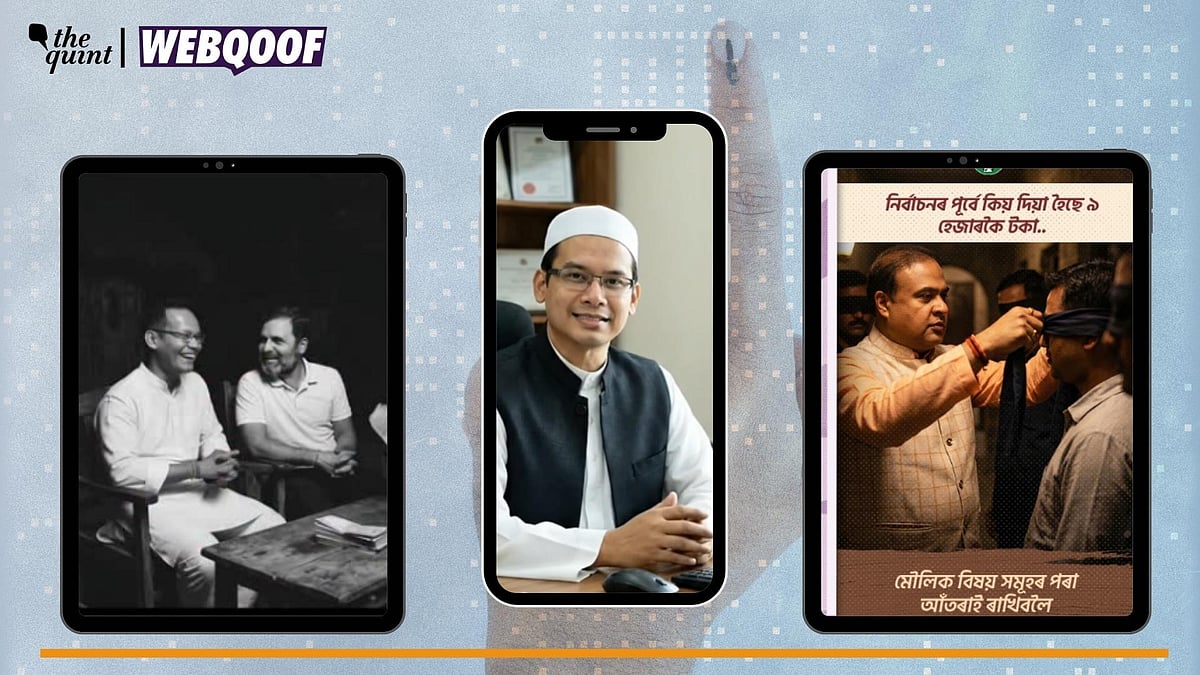
Targeting political leaders and parties: Videos circulating from platforms such as assam.stories and just.assam.vibes appear to focus heavily on targeting Congress leader Gaurav Gogoi, with some clips depicting him wearing a skull cap. The content often insinuates that Gogoi appeases Muslims in Assam, portraying him as anti-Assam and anti-Hindu.
A recurring feature across these videos is the use of emotionally charged language and visuals to create a sense of urgency or threat. By blending cultural references with political messaging, such clips seek to influence voter perception, often without clearly disclosing the use of AI-generated or heavily edited visuals.
Similar narratives have also been echoed by Assam Chief Minister Himanta Biswa Sarma, who has previously criticised Gogoi, alleging in July 2025 that his speech in Parliament on national security issues suggested he was “acting on behalf of Pakistan.”
Another AI-generated video shows Congress leader Rahul Gandhi inside an aircraft, speaking on the phone, and is captioned, “Rahul Gandhi on a foreign trip to conspire against India,” following the announcement of election dates for the upcoming state polls.
Posted by the Instagram page politicspecharcha_, the video fits into a broader pattern of using humorous or mocking visuals to portray Gandhi as preparing to leave the country.
Additionally, an AI-generated image showing litter, such as liquor bottles, paan packets, and other waste, went viral on social media with the claim that the BJP workers from other states dirtied areas around monuments in West Bengal following Prime Minister Narendra Modi’s rally, amid the campaigning for the West Bengal polls. Team WebQoof fact-checked this image and found that it was created using AI.
Here is the preview of the story.
(Source: The Quint)
Following the Election Commission of India’s announcement on deploying 2.4 lakh Central Armed Police Forces (CAPFs) personnel in West Bengal during the polls, several videos showing convoys of security vehicles have circulated online.
While the news of the deployment itself is accurate, some social media users have used these visuals to claim that the ruling Trinamool Congress (TMC) was “scared.” Additionally, an AI-manipulated visual posted by Instagram users “motivone.in” and “indians” has surfaced, purportedly showing Chief Minister Mamata Banerjee telling an official that “the situation is going out of hand.”
The clip is interspersed with footage of alleged CAPF vehicle movements, reinforcing the misleading narrative. The visual of Banerjee and the official is AI-manipulated.
Here are the results by Hive Moderation
(Source: Hive Moderation)
Voter outreach and Welfare Messaging: We also identified AI-generated videos shared by the official social media handles of the BJP, Congress, and DMK, showcasing their election manifestos, welfare initiatives, and governance achievements in their respective states.
For instance, an AI-generated reel posted by BJP Assam’s Instagram page highlights that, under BJP governance, the Charaideo Maidam, a 600-700-year-old mound burial site of Ahom dynasty royalty, was recognised as a UNESCO World Heritage Site in 2024.
Similarly, AI-generated videos shared by the Congress and DMK outline their manifestos and governance approach ahead of elections. While these videos do not appear to spread misinformation or propaganda, none of them carry disclosures indicating that they are AI-generated.
Here is the preview of the post.
Here is the preview of the post.
Here is the preview of the post.
Here is the preview of the post.
Another AI-generated video shared by BJP Assam’s official handle depicts Congress leaders Rahul Gandhi and Gogoi initially laughing, before later being shown running away from people and failing to garner public support.
The video concludes with the title “70 Years of Neglect,” accompanied by the caption, “Assam remembers.” The video insituates people’s support for the ruling BJP government.
Here is the preview of the post.
Here is the preview of the post.
Here is the preview of the post.
Here is the preview of the post.
Here is the preview of the post.
Here is the preview of the post.
Here is the preview of the post.
Miscellaneous/Memes: We were also able to trace AI-generated visuals used by content creators to analyse and discuss the upcoming elections in West Bengal and Kerala. These short clips, featuring AI-generated visuals, speculate on the BJP’s expansion into opposition strongholds, especially in West Bengal.
Social media users also circulated visuals without required AI disclosure labels, featuring fabricated humorous scenarios like a dance-off between CM Sarma and Raijor Dal's Akhil Gogoi.
Others depict PM Narendra Modi, UP CM Yogi Adityanath, and former Bihar CM Nitish Kumar in contrived talks with RJD's Lalu Prasad Yadav about contesting West Bengal polls, or world leaders including US President Donald Trump, Russian President Vladimir Putin, and Israeli PM Benjamin Netanyahu absurdly 'competing' in Kerala elections.
Team WebQoof found additional AI-generated videos predating January 2026 that fueled communal propaganda and claims of illegal immigration in poll-bound states.
One video from December 2025 depicted a Muslim man from Bangladesh voicing support for West Bengal Chief Minister Mamata Banerjee. Social media users circulated it as authentic footage.
This video was circulated as a real incident from Kolkata.
(Source: The Quint)
Further examples targeted Assam: fabricated clips showed Gaurav Gogoi wearing a skullcap and endorsing Muslims. Others portrayed Chief Minister Himanta Biswa Sarma chasing Gogoi with a stick for his alleged support, or depicted Sarma as a "superhero" battling "Muslims."
Sarma has also raised such issues in election campaigning. He noted that expelling around 70 lakh alleged Bangladeshi immigrants is “not humanly possible” and stressed creating conditions that would encourage them to leave voluntarily.
The messaging often adopts a communal lens, with posts using dramatic visuals, music, and text overlays to draw sharp contrasts between religious or ethnic groups. None of these videos carried AI disclosure labels, amplifying their deceptive nature.
Here is a preview of the post.
Here is a preview of the post.
Here is a preview of the post.
Here is a preview of the post.
Ministry of Electronics and Information Technology Guidelines on “Synthetic Media”
The Ministry of Electronics and Information Technology (MeitY) amended the IT Intermediary Rules in 2026 and introduced rules that came into force on 20 February.
It required platforms to label synthetic content such as deepfakes with clear disclosures, embed permanent identifiers, deploy automated detection tools, and ensure rapid takedowns of unlawful AI-generated material.
It also mandates user warnings about legal consequences, verification of content origins, and strict action against violators, including content removal, account suspension, evidence preservation, and disclosure of user information to authorities where required.
The rules also mentioned that social media platforms must remove or disable access to unlawful content within three hours of receiving a court order or authorised government notice, reducing the earlier 36-hour window.
Speaking to Reuters, Akash Karmakar, partner at law firm Panag & Babu, said it is “practically impossible” for social media platforms to remove content within three hours, adding that the rule assumes no application of mind or real-world capacity to assess compliance.
Additionally, MediaNama, an outlet covering technology policy in India, filed a Right to Information (RTI) request to check whether MeitY consulted any stakeholders before introducing the three-hour content takedown rule, which was not part of the earlier draft amendments.
What do ECI regulations say?
The press note available on the Chief Election Officer (CEO) of Puducherry’s website carries the guidelines for the use of social media platforms during the election season. It mentions that all political parties have been advised against the misuse of AI tools to create deepfakes that can propagate misinformation or distort information.
The press note further said, “Further, all Political Parties and their leaders, candidates and star campaigners shall take necessary measures for prominent labelling of AI-generated/synthetic content, if any, being shared for campaigning through their social media platforms using clear notations such as "Al-Generated", "Digitally Enhanced", or "Synthetic Content". Additionally, all such campaign materials whether in the form of advertisements or promotional content must carry appropriate disclaimers wherever synthetic content is used."
The highlighted section mentions the guidelines for the usage of AI.
(Source: CEO Puducherry/Screenshot/Altered by The Quint)
However, it has been established earlier that not all posts shared by political parties on their official Meta handles carry AI-specific labels. This stands in direct violation of the ECI guidelines. It remains to be seen if such measures will attract action from the ECI in the future.
In the Age of AI, Why Can't Politicians Use the Technology?
Earlier when AI slop started getting traction on social media platforms, The Quint's WebQoof team reported on how it paves the way for a more concerning phenomenon: the liar’s dividend.
Speaking to The Quint back in August 2025, Ami Kumar, co-founder of Contrails AI, said, "We’re witnessing a real decay in our information systems. The old adage — 'seeing is believing' — no longer holds true. We’re entering a new era where people will have to carefully curate and question their information sources."