
'After NRC, Trans Act is Another Blow to Me and My Identity as an Assamese'
'Now, we must pass inspection by physicians shaped by the same blind spots that bent the NRC process sideways.'
advertisement
When the final list for the National Register of Citizens (NRC) was released in 2019, names vanished overnight. Behind these names were real people of Assam whose families fell apart, split by exclusion.
Most transgender people in Assam were left out. Their documents gave an outdated picture. Birth records clung to versions people had left behind, frozen in time like photos nobody asked for.
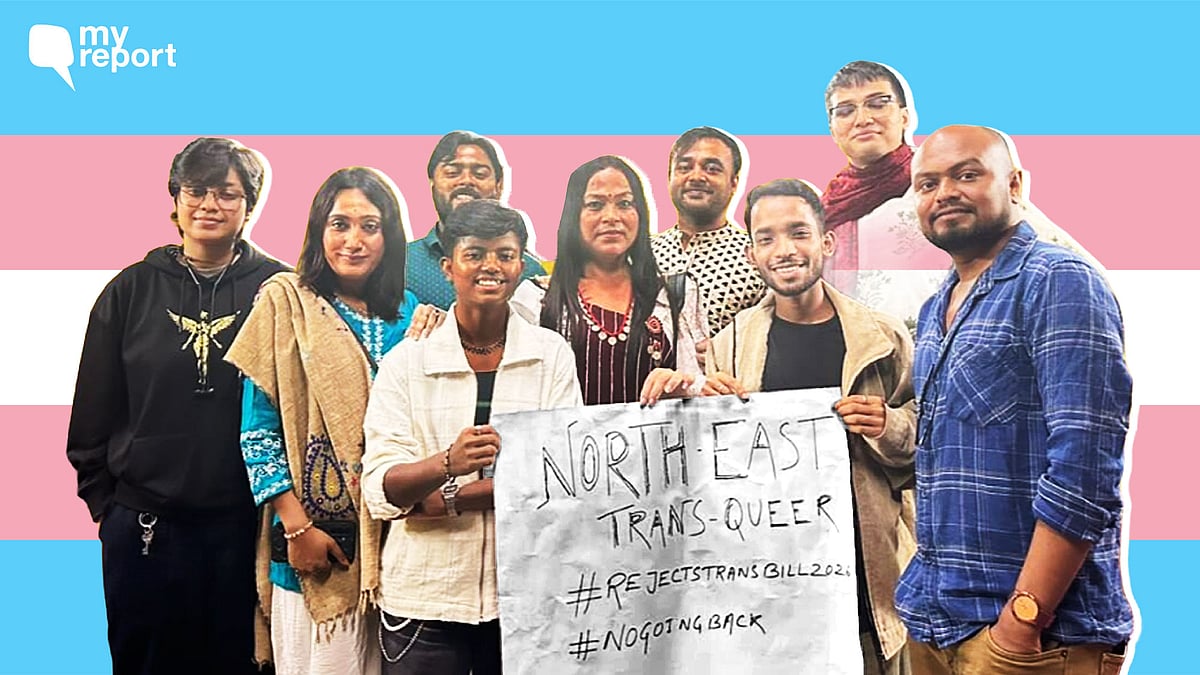
Those scars have been reopened with the Transgender Persons (Protection of Rights) Amendment Act, 2026, seeking to erase the little spaces we have carved out for us for decades.
The law reinforces a rigid majoritarian rule cloaked in tradition, where only Brahminical ideas of gender, caste, and identity matter. It recognises a narrow pan-Indian view of hijra and kinner, and undermines self-identification.
'Do We Even Exist?'
Last year brought me to the Doyang hydroelectric project in Nagaland. Working alongside a local group, I helped draft findings about villagers protesting against the dam along the riverbank.
One quiet evening, with daylight fading behind the ridges, I sat down with Vivek (name altered), a queer person from near the border who lives outside expected norms. His voice dropped low, making me tilt forward just to catch each word.
Their words came slowly:
What Vivek said shut me up completely. Walking through different towns, their words stayed close.
Lucky, a trans man from the Singpho tribe in Assam, spoke in a trembling voice.
Being native to these lands, yet wondering about belonging under the NRC—it gnawed at them. People here still carry that dread fresh. My mind went back to Vivek and Lucky when the Trans Act, 2026 was passed last week. It adds another layer: even if you prove who you are, the state can now demand medical proof that most of us will never be able to access.
As someone who belongs to Tai Ahom community, there is another kind of confusion they are creating for me—am I tribal or not, am I indigenous or not?
Indranee, a community organiser and queer rights activist in Assam, shared, “We are feeling hopeless. We feel that we are not even Indian anymore.”
'A Dangerous Mismatch'
Lucky's Aadhaar says “Trans Man,” yet his voter card and land records still mark him as female. Updating those outdated documents demands a medical board certificate, a thing missing entirely in too many places. You are also stuck in the middle. You are constantly proving you belong to a particular identity, but the requirements keep getting changed by the State.
Out in the Brahmaputra valley, my trans and non-binary friends’ lives follow nearly identical paths. In a Muslim-majority village down in lower Assam, one queer activist said their grandmother was the only link to their citizenship.
When the chance came to file documents, though, their grandmother had already passed away. Years earlier, speaking openly about how gender made their family disown them, with no relative remained willing to sign a paper confirming their roots.
For weeks, they moved across waterlogged land, visiting far-off government buildings—only to learn their paperwork didn’t qualify.
A number of LGBTQ individuals skipped applying altogether when they realised speaking up might label them suspicious. Staying unseen became safer than ending up locked away for not fitting someone’s idea of belonging.
In eastern Assam, I met someone from the Tai community, living as trans, asking quietly, “When my looks and faith make me seem foreign, even if forms say I’m Indian, where’s my shield under this new rule?”
Among the Adi people, there’s Mumbal; among the Galo, they say Mumbar; the Nocte call it Lanchian—each one a real term, alive, shaped around shifting genders, rooted deep in these mountains. This legislation acts as if such things never were.
‘Gender Does Not Fit Typical Lines’
It hits hardest when what you live by starts disappearing. Not long ago, I spoke with someone named Arup, a queer non-binary person connected to a Satra in Assam.
Over time, within that space, people took part in Bhaona—sacred performances where certain roles go to those whose gender does not fit typical lines, mixing strong male traits with gentle, worship-filled gestures usually linked to women.
They told me:
It all gets boiled down to some faceless doctor who’s never set foot inside this sacred space. Talking with Arup started cracking something open within me. Places shaped by tradition, used to welcoming differences in quiet but real ways, now hear loud and clear—your openness won’t fit here, it seems.
While in Guwahati, non-binary activist Prashant talked about past Bhaona performances he saw and stated, “This amendment restricts the definition of ‘transgender’ and excludes all trans men from this definition. Our identities are being excluded from representation; thus, as a non-binary person, it’s a purposeful erasure.”
A senior queer leader living in Assam spoke about family without sharing names. Their mother lives with memory loss, unable or unwilling to recognise that they do not identify as male or female. On the other hand, their father carries constant worry about losing their job.
“I do my best to keep myself together, but it’s extremely difficult; I am between all three—my atheism, asexuality, and agender identity—and their limited awareness of me causes tension between us, so we’re just sort of getting by.”
'Delhi is Too Far'
On 25 March, I saw Rituparna Neog, a prominent queer feminist activist from Assam, step down without shouting. She held a council seat meant for the Northeast's voice on transgender matters. Ignored—that’s how they felt, since each warning vanished into silence. Though their words stayed steady on paper, hurt slipped through between lines.
This is why the Northeastern perspective matters, because here, space isn’t about maps, distance isn’t just about kilometres. Weeks pass with no road in sight—sometimes months go by without seeing a doctor. You live knowing aid from Delhi will arrive late, if ever it comes.
Our cultures aren't folklore; these ways we carry aren’t museum pieces. They’re daily life—and this law wipes them away like chalk marks. Fear isn’t poetic when floods return. It lives inside you.
It's been 200 years since the Treaty of Yandabo—which ended the war between the British East India Company and Burma, and ceded control of Assam, Manipur, and other parts of Northeast India to the British—and 79 years since India's Independence. Yet, the Northeast feels like a territory to control, not voices worth listening to.
Yet, we remain. We will continue to check on each other when the rivers rise. We will share whatever rice and dal we have.
Laws may rise and fall like seasons, yet our presence remains fixed—unchanged by paper rulings.
This land knows us by name, remembers every footstep across its soil. To be seen is not a gift handed down from officials; it grows from how we hold each other through loss, joy, and quiet mornings.
Staying means resisting without shouting, breathing where others tried to erase breath. We deserve recognition not as a favour, but as citizens who love, who grieve, who survive, and who refuse to disappear. Our belonging isn’t debated—it simply is.
(All 'My Report' branded stories are submitted by citizen journalists to The Quint. Though The Quint inquires into the claims/allegations from all parties before publishing, the report and the views expressed above are the citizen journalist's own. The Quint neither endorses nor is responsible for the same.)
- Access to all paywalled content on site
- Ad-free experience across The Quint
- Early previews of our Special Projects
Published: undefined