
‘Right to Self-Identify is Our Only Hope’: Why the Trans Bill Is Sparking Fear
The bill narrows the legal definition of transgender identity by weakening the self-determination framework.
advertisement
Dart (name changed), a non-binary trans person, says that arranging their gender-affirming surgery was a long and challenging process.
"It was difficult for me to access medical transition. I was lucky that I eventually found doctors who supported me, and I could undergo my surgery three weeks ago. But if this Bill passes, I worry that someone else might not be able to access the life-saving care they need," the New Delhi-based media professional adds.
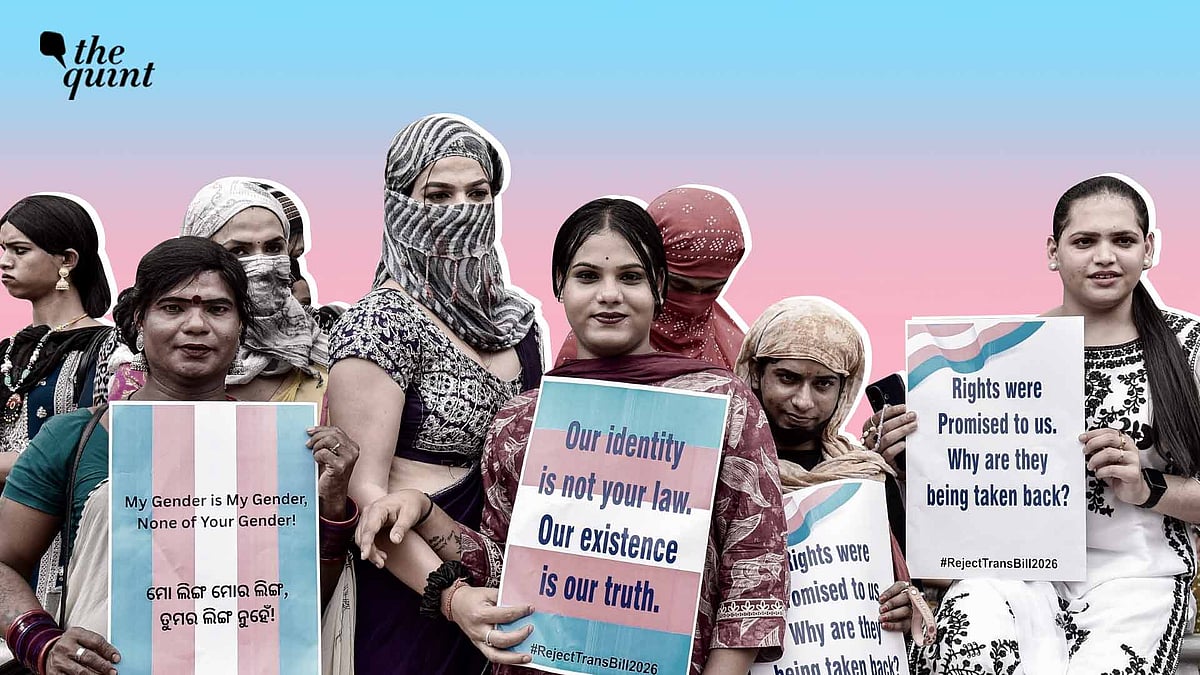
Dart is among the millions of transgender persons in India whose lives are set to be impacted by the contentious Transgender Persons (Protection of Rights) Amendment Bill, 2026. Introduced in the Lok Sabha on 12 March by Union Minister for Social Justice and Empowerment, Dr Virendra Kumar, the Bill has evoked a sharp response from the community at large.
The proposed amendment will be heard in the Lok Sabha from 23 March.
History of Contention
The Transgender Persons (Protection of Rights) Act, 2019—the precursor to the current amendment bill—was itself strongly contested.
Back then, the queer community had protested, alleging that the Act fell short of the NALSA judgment’s vision—and failed to meet several demands from trans communities. But the Act, for the very first time, was able to set up a statutory framework that recognised self-identification, in which a person could declare their gender identity without being compelled to undergo surgery or submit to a medical panel's scrutiny.
The National Council for Transgender Persons (NCTP), which was constituted in 2019 to monitor and evaluate the implementation of the provisions of the Transgender Act, has 10 members serving on the present advisory board, including five experts. At least three members of the board The Quint spoke with said their role was to advise, a process that involved quarterly meetings.
Simultaneously, another advisory committee was constituted following the Jane Kaushik judgment (2025), where the Delhi High Court took note of systemic discrimination faced by a transgender teacher in employment and highlighted the lack of institutional grievance redressal mechanisms.
A meeting of the same advisory committee, with over seven members, formulated under the chairpersonship of Justice Asha Menon, has been called on 20 March to assess the crisis arising from the tabling of the Bill in the Parliament.
Right to Self-Identify Crucial for Empowerment, Safety
The 2026 Bill introduces a medical board and allows the district magistrate to consult medical experts, if deemed necessary, increasing scrutiny in the approval of gender identity certificates. In this case, the definition of medical experts hasn't been mentioned.
Muskan Tibrewala, a human rights lawyer, tells The Quint that this could further impinge on the rights of the transgender community.
The amendment also narrows the legal definition of transgender identity, weakening the self-determination framework embedded in India’s anti-discrimination law for transgender persons. This can allow district magistrates to recognise or reject the identity of a person under the law.
Interestingly, the Bill had no mention of social welfare schemes, benefits, or the longstanding horizontal reservation demands that community organisations have raised for years. With the ID card as the only way for transgender persons to get legal protection and access to welfare schemes, the new Bill risks becoming highly dangerous.
Angan, a lawyer at the Calcutta High Court who identifies as a trans man, says, “We get calls from villages where people are being forced out of their homes because of their identity. Others tell us they cannot be truly themselves within their families. For many, the right to self-identify remains their only hope.’’
Section 7 of the proposed amendment, which aims to replace Section 18 of the 2019 Act, introduces life imprisonment as penalty for forcing a transgender identity on someone through kidnapping, mutilation, or coerced medical procedures.
Trans people share their lived experiences to highlight its potential harms.
Reshma Das (name changed), a trans woman, recalls how a few weeks ago, she had to leave her rented apartment after facing violence. Local media in the region misrepresented her on television, forcing her to vacate her house and threatening her safety.
Vidya Rajput, a transgender rights activist from Bastar, Chhattisgarh, talks about running an organisation since 2009 that works on education, employment, and healthcare. More than 82 police constables and 100 queer-trans people are currently employed in the corporate sector. No consultation took place with the board by the state.
Right To Privacy
The Bill's impact goes beyond the transgender community. Dominic, an intersex transwoman from Assam, recalls her experience of accessing healthcare:
The way the Bill is written clearly reflects how it conflates the definition of a transgender person and an intersex person. "If this continues any longer, we will only see violence with more force on intersex people, with no law at all for our protection," Dominic adds.
A community-led study by Indian transmen and transmasculine individuals at Drexel University in Philadelphia reveals that one in five transgender persons are denied prescription access in healthcare. This is despite the law providing for access to medical care for transgender persons, including gender-affirming healthcare. If these safeguards cease to exist, the already limited access to care could disappear altogether.
This requirement directly challenges the Supreme Court’s ruling in Justice KS Puttaswamy (Retd) vs Union of India (2017), which recognised the right to privacy as a fundamental right under Articles 14, 19, and 21 of the Constitution. Mandatory reporting of gender-affirming procedures to state authorities could be seen as a violation of an individual’s bodily autonomy and privacy, both of which are protected under the judgment.
Previously, the Act only suggested that a person may apply to the district magistrate for a gender-change certificate after surgery. Ironically, the existing numbers in 2020 come with their own flaws. As per the 2023 government report, 15,803 certificates were issued out of 24,115 applications.
Which means, one out of every three applicants failed to receive a certificate.
According to the 2011 Census, 4,87,803 people identified under the ‘other’ gender category, yet only a little over 24,000 individuals have applied for transgender identity certificates, representing less than five percent of those counted in the census. Given that the existing framework is already underperforming, the push for a new amendment raises questions about its necessity.
Lack of Awareness About Gender Diversity
Pinky, who works with queer and trans communities in districts bordering Tinsukia in Assam's Dibrugarh, highlights the persisting lack of awareness about gender diversity, and conservative social attitudes against queer people remaining strong and often adverse.
As a part of the Dibrugarh Pride Committee and the Sotiyona Queer Collective network, Pinky's collective currently supports over 86 queer and trans individuals. With the community people ranging from different castes, races, and geographical diversity, affect of the law could only compound after such policy changes.
With continuous rhetoric around protecting transgender rights and expanding accessibility, the Bill, if passed, risks excluding a large section of the trans community. According to the National Crime Records Bureau 2022 report, 64 transgender persons were kidnapped, of whom 62 were recovered or rescued.
In a press conference organised on 16 March 2026 in New Delhi, the community demanded a complete withdrawal of the entire bill.
A few of the members shared their lived experience accessing spaces like education, workspace or a job in day-to-day life. Kabir Maan, who is a Dalit transmen and an experienced tutor, shared how he got late for a test because the principal in the school didn’t know the meaning of trans. Representation came from across the country, from Kashmir to Odisha.
(Ritwik Dutta is a data journalist from Assam with experience working in gender, sexuality, and climate change.)
- Access to all paywalled content on site
- Ad-free experience across The Quint
- Early previews of our Special Projects
Published: undefined