
'Adoption Made Me a Mom Again, But the Archaic Law Took My Financial Security'
'My salary would be paused hadn't been stated. I was not expecting it either—maternity leave implies paid leave.'
advertisement
The Supreme Court recently extended benefits of paid maternity leave to adoptive mothers. A mother recounts her experience with adoption two years ago—and the challenges she faced under the archaic law.
There’s tremendous power in lines. Some lines are fine and concealed. Others are transformative—and sometimes, may even signal new life. Two such lines on a home pregnancy testing kit are what it takes to change a person’s status into that of ‘parent in the making’.
Having said that, it’s also not the only route that people all over the world are taking, more so in the last decades, to become a parent. There are situations where one simply can’t conceive due to medical reasons of at least one of the partners, and there are times where it’s a conscious choice.
Years ago, my husband and I each made this choice on our own. Then, after our lives collided, it somehow evolved into a mutual decision.
After waiting more than three years (and most of our patience and hope), we were able to welcome a baby into our lives through adoption, completing our family of three: my husband, my son, and me.
'We wanted to welcome a little girl into our lives and call her our own forever, and we did.'
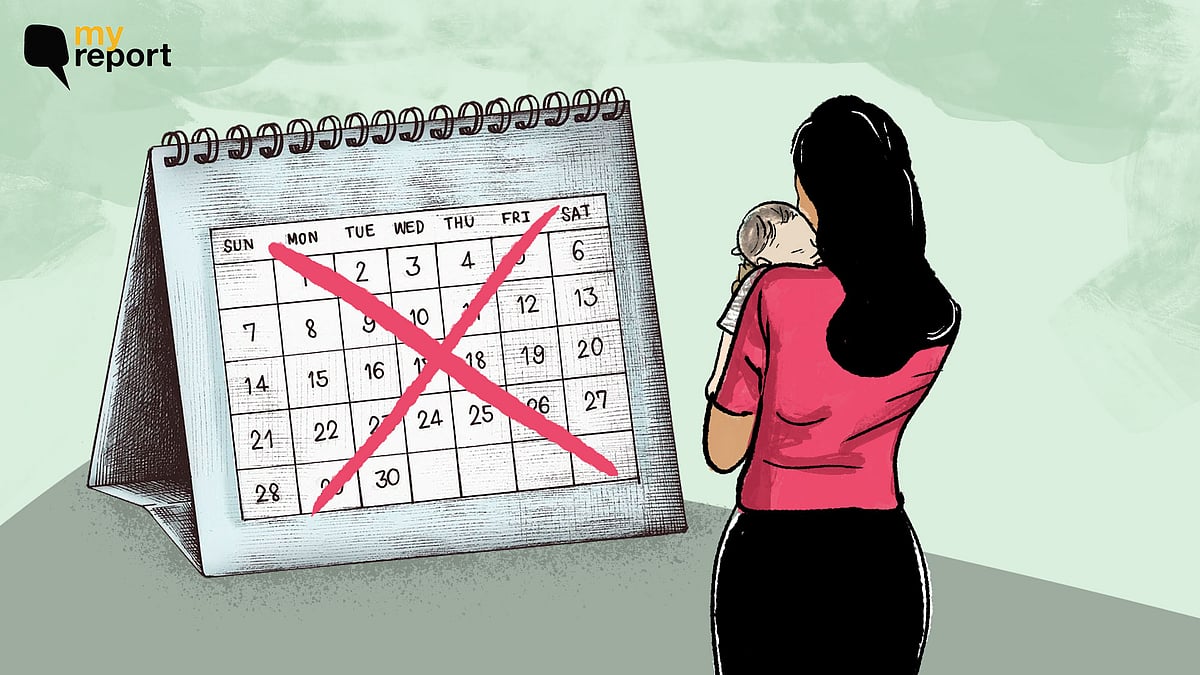
(Illustration: Vibhushita Singh/The Quint)
'Had Kept My Employers in the Loop'
And here’s where the lines get narrower on this less trodden path.
As an educator with a prestigious school in Delhi-NCR, I had kept my employers—and the HR department—in the loop through the entire process. I received ample support from their end through the years, along with the promise that when the time comes, I will get maternity leave to spend time with the baby and embrace the joys of early motherhood.
The words of support I received were a source of comfort, and I remain grateful for them. I've been aware that such support is not obvious for people in similar situations with regard to their workplace, which remain gender-skewed against women.
'Stepping Into a World of Unknowns'
There are moments in life when we can step back, view a situation as an observer, and make informed decisions based on all the information available. Then there are times where you have waited for something for years—three and a half to be precise—and it is finally happening!
It’s like you have been pregnant for THAT WHOLE period! But what’s growing inside you is not a human being increasing in size as the duration of the pregnancy progresses.
But, instead, you find yourself pregnant with hope, carrying the dream of this reality within you, filled with excitement and the nervous energy of stepping into a world of unknowns. You are also filled with a certain sense of calm, for the "best is yet to come".
'I looked forward to spending quality time together—learning to understand one another, picking up non-verbal cues, and sensing each other's needs, at this crucial time of bonding that would intertwine our lives forever.'
(Illustration: Vibhushita Singh/The Quint)
I wondered how prepared one can every be—I thought of counseling our older child for a smooth transition, answering all his questions with honesty about a process hard for a child to grasp, and the list goes on and on—until impatience took over as we waited for that moment to arrive.
And then it came. Cut to the line at airport security on our return, after the thorough process and paperwork that adoption demands, with our baby in our arms, finally heading back home. Full. Complete. Excited. And jittery, with bits and pieces of the larger reality beginning to sink in.
'Got Maternity Leave, But Lost My Pay'
Only after we got through the fag end of the adoption process and brought our baby home is when I applied for leave—and this is where things got interesting.
At this point, it was clarified to me that my organisation follows the Maternity Benefit Act, 1961 (oh my!) and would proceed accordingly. But "nothing to worry about"—I was told to take all the time I needed.
There are a million thoughts and concerns that cross a new mother’s mind—physical healing being the first.
Although we had a verbally agreed timeframe of six months of maternity leave, there was no discussion, however, on remuneration. The fact that it would be paused had not been stated. I was not expecting it either because, to my understanding, maternity leave implied paid leave.
Nor had I expected the pause in benefits for my older child’s school fees—benefits that would normally be covered—simply because this leave wasn't officially termed 'maternity leave', and so, the usual entitlements did not apply.
So, here’s where the lines are dulled from the point of view of fairness.
'The Last-Minute Change Upended Our Plans'
The Maternity Act, 1961 states that if the adopted child is up to the age of three months, the mother is entitled to get a paid maternity leave of up to 120 days. However, the paperwork involved for a child to be put up for adoption takes at least three months, rendering the Act’s provision a fine, thin line of possibility, if at all.
By the time we received our match, the baby was exactly three months and a week old. So, the provision of the Act did not apply to me for a paid maternity leave. Having said that, and privileged as I felt, my organisation arranged a two-month payment towards the latter part of my leave—to be paid after I rejoined—out of the five and a half months of leave that I ended up taking.
Though we were prepared to be parents again in many aspects—mentally, emotionally and physically, as well as financially because we knew that I'd be on 'maternity leave'—we ended up feeling the unease of this last-minute arrangement.
Thankfully, we had financial security from my husband’s workplace. But many adoptive parents in our support groups voiced quite the opposite.
That there are progressive organisations that choose to forego the maternity law specifications for adoptive parents—and simply grant them equal rights and benefits in the form of leave and pay to ensure inclusion in its literal sense towards all employees.
That there are schools that boast of the sanctity and irreplaceability of the bond between mother and child, especially in the initial months and years, but won't part with the law for reasons best known to them.
That the strings binding the power of the people and for the people need a reset, especially when it comes to the lives of those too young to question authority, and whose care and wellbeing should be everyone’s top priority.
(All 'My Report' branded stories are submitted by citizen journalists to The Quint. Though The Quint inquires into the claims/allegations from all parties before publishing, the report and the views expressed above are the citizen journalist's own. The Quint neither endorses nor is responsible for the same.)
- Access to all paywalled content on site
- Ad-free experience across The Quint
- Early previews of our Special Projects
Published: undefined