'Gandhari' Review: Taapsee Pannu's Rage Is Lost in a Shrill, Chaotic Mess
'Gandhari' is a tonal mess that’s lost between gritty crime thriller and heightened action flick.
advertisement
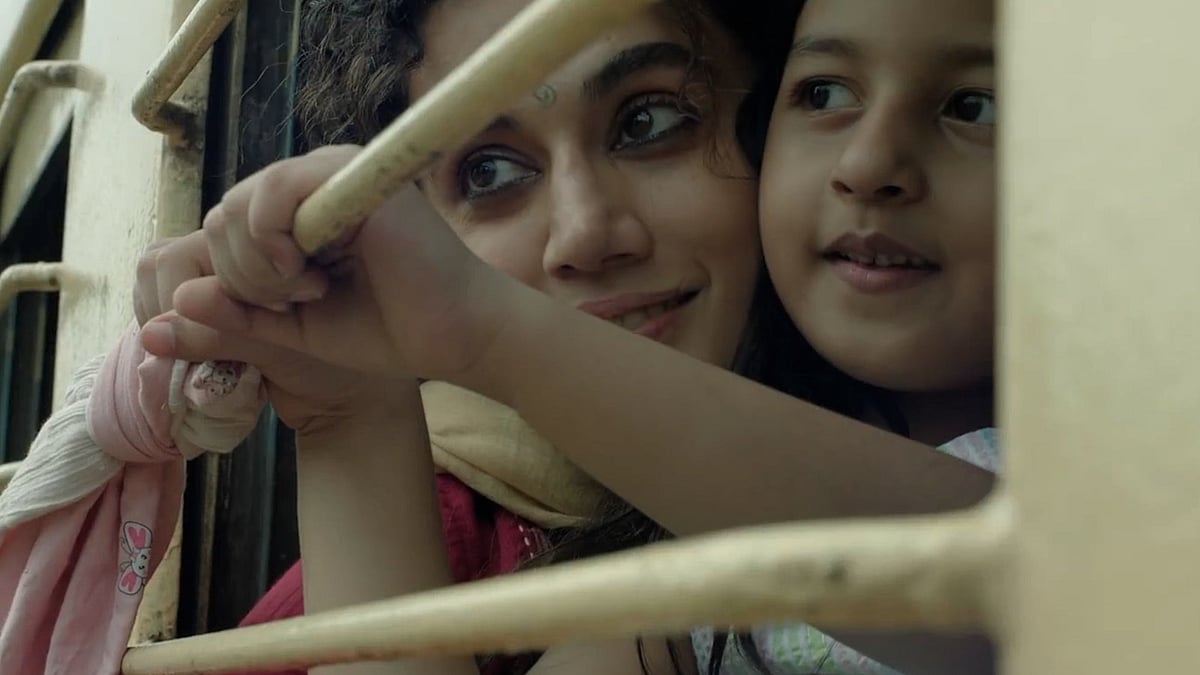
A chirpy couple and their young daughter smile endlessly at each other while sitting in a train compartment, headed for a vacation. But this is a film by Devashish Makhija (Ajji, Bhonsle), so you know darkness and horror lurk around the corner. Right on cue, within minutes, the child is abducted from a platform. While chasing after her, her mother Bani (Taapsee Pannu) is severely injured and left unconscious. Gandhari is an action-heavy revenge thriller following Bani’s crusade to find her daughter and, in the process, uncover and bring down a massive child-trafficking racket.
Forget mustering any sort of meaningful tension, felt emotion or rudimentary atmosphere, Gandhari struggles with the bare basics of storytelling: establishing and communicating who’s who, what’s what, what is happening, why it’s happening, how we got here, where we’re headed and how we get there. Perhaps the most pertinent question is: how is this the final film?
Produced and written by Kanika Dhillon (Haseen Dillruba, Do Patti), Gandhari is set in the fictional town of Joypurra in West Bengal. After two days of sleepless searching and lazy, apathetic cops, just as desperate parents Bani (who’s now temporarily blind after a head injury) and Gokul (Ishwak Singh) begin to lose hope, a random woman from Bani’s past comes out of nowhere to help.
Ishwak Singh in a still from Gandhari.
(Photo Courtesy: YouTube)
Jhunu Amba (Mita Vashisht) is the woman who raised Bani (I think) and who happens to be in the same town after her granddaughter was abducted by the same notorious gang who call themselves ‘Blackhole’—which is also the amount of creativity and conviction this movie has to offer. Jhunu Amba goes on to give Bani a rousing pep talk about how the only way she’ll find her daughter is to start her own personal crusade.
Assault-on-the-Senses Storytelling
A month passes. Bani, now a teacher at the local school, has inexplicably become a pillar of the community and knows everyone. Her eyesight is back, but she’s acting blind so as not to raise suspicions and conduct her own secret investigation. Oh, and she’s now also a creature of the night.
In one of the most absurd training montages committed to screen, Jhunu Amba has been training her to fight, do backflips and hone her senses. Specifically, her hearing, which the film seems to suggest is amplified by her blindness, except she’s no longer blind.
The two women—the fake-blind Bani and the seemingly kind elderly Jhunu Amba—proceed to hide in plain sight and infiltrate shady factories used for child trafficking, systematically killing the men they find. If only it was even remotely as badass as it sounds. Instead, what we get is more dud-Daredevil (Duddevil?)-meets-decaf-Kaabil-meets-unfortunate-Andhadhun.
Oh, also, Gokul is conducting his own parallel investigation, but neither spouse has told the other about their findings, nor does he know that his wife isn’t actually blind anymore. In short, the first 20 minutes of this movie are truly quite something. You’ll have to see it (pun not intended) to believe it.
What you do feel is an ongoing competition between various storytelling elements to outdo each other as the most shrill and jarring. The drunk score goes well beyond composers doing their best to inject a sense of energy and urgency into a misfire, and into all-out, deafening, unhinged territory.
Bafflingly Basic
But it’s the blurry, choppy editing that takes the cake. The attempts to rework and retool the film on the cutting-room floor are entirely evident, but here it comes at the risk of basic coherence. The pacing is on its own trip entirely, racing to establish a barrage of details, rushing past characters, stopping for a scene or two before diving headfirst into the next messy montage.
We get scenes wrapped in montages that got into bed with a flashback that’s secretly its own montage within a montage. Every time you think the film might finally “settle” and click into place as a passable, emotionally charged action saga, we’re given more assault-on-the-senses storytelling. Not to mention a few laughable twists along the way.
Any promising ideas here—parents forced to kidnap other kids to get their own back, or that the entire town is a kidnapping cottage industry— disappear in the narrative’s busy blur.
Taapsee Pannu in a still from Gandhari.
(Photo Courtesy: YouTube)
A Mother’s Rage, Lost in the Noise
Gandhari is equally a tonal mess that’s lost between gritty crime thriller and heightened action flick. This isn’t quite “grounded” action, where Bani just about gets by on the skin of her teeth. Instead, it frequently goes into backflipping ‘super action’ territory. At one point, Bani investigating a shady hospital escalates into full decaf-John Wick territory as she takes on an army.
It sounds glorious, but the execution and emotion of the action sequences are passable at best and aren’t able to deliver aura, swag, stakes or slickness.
Elsewhere, the wider cast is peppered with talented actors who barely register in the chaotic nothingness—a creepy Swastika Mukherjee, a resting-confused-face Jatin Sarna as the one good cop, Panchayat’s Chandan Roy, a sinister Chhaya Kadam. Only Prashant Narayanan manages to save face as the main antagonist because he’s only in it for all of one scene.
I stumbled away from Gandhari left with an image and a quote. The image (which I’ll forever hold dear for all the wrong reasons) is Mita Vashisht’s Jhunu Amba throwing coins at Bani to dodge (?) to help hone her senses because she’s blind, except she’s not blind.
Gandhari releases on Netflix on 3 September.
(Suchin Mehrotra is a critic and film journalist who covers Indian cinema for a range of publications. He's also the host of The Streaming Show podcast on his own YouTube channel. This is an opinion piece, and the views expressed above are the author’s own. The Quint neither endorses nor is responsible for the same.)