
'Peddi': Janhvi Kapoor's Agency Is The Film's Biggest Victim
How can a man who is so self-righteous and morally upright have such a terrible attitude towards his beloved?
advertisement
As I watched Ram Charan and Janhvi Kapoor’s Peddi, I felt that I was being gaslit relentlessly. Let’s begin by first acknowledging that there is something incredibly impressive and noble about a Dalit man using his masculinity and sporting skills to break the shackles of casteism that have plagued his community for decades.
Ram Charan plays Peddi, a skilled sportsman who is a master at cricket, wrestling, and—later in the film—athletics.
The Making Of An Anti-Caste Crusader
The people in this village are not accounted for in the census. The village has no name; its people have no documents to prove they are Indian citizens. They are paid half the wages by their employer at the local jaggery factory. The villagers take a long, tedious, and unsafe route to return home from work due to poor train connectivity.
Peddi has taken it upon himself to use sport as a means to get his village the recognition and dignity it rightfully deserves. How else can the subaltern free themselves from centuries of exclusion except by reclaiming spaces that were never meant for them in the first place?
In his fight against casteism, Peddi aces not one but three sports. His ascent from winning at local akhadas to being an Olympic medalist is impressive, to say the least.
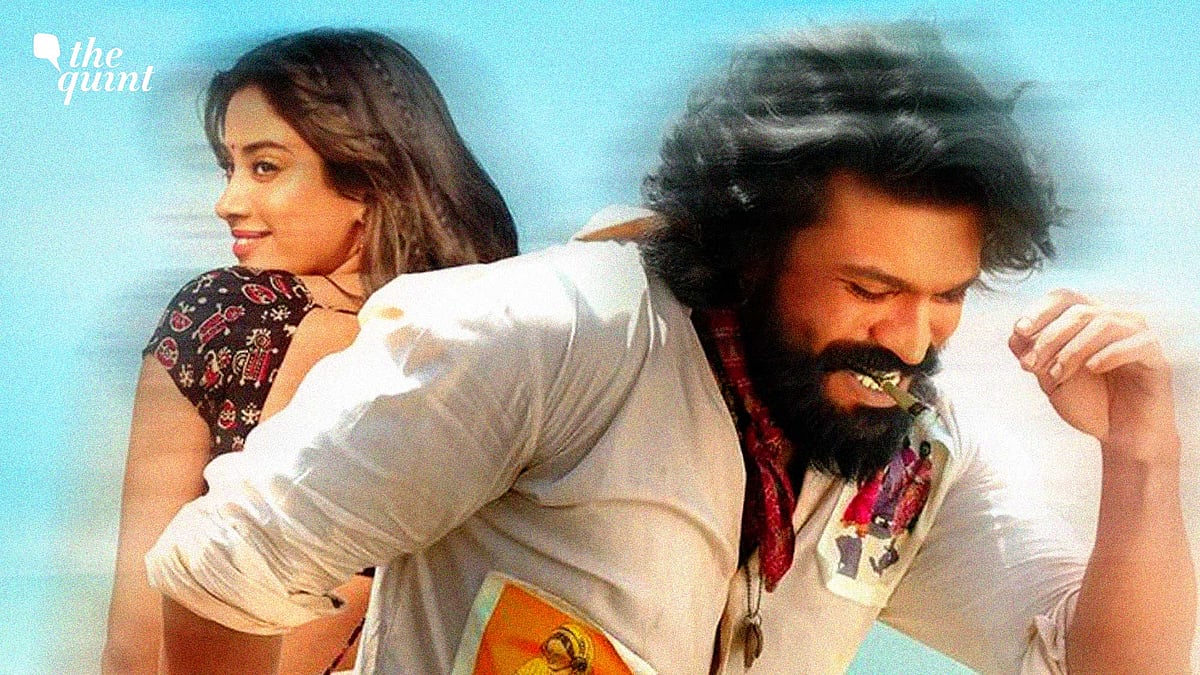
In Peddi, Ram Charan finds a character who embodies both the rage and resilience of a community pushed to the margins. But what happens when this same man is also a lecherous, lustful creep who sexually assaults a woman who he claims he is in love with?
Janhvi Kapoor in a still from Peddi.
(Photo Courtesy: YouTube)
When Progressivism Meets Patriarchy
Janhvi Kapoor plays Achiyamma, who initially comes across as a spirited, bold woman with a go-getter attitude. She is the daughter of a politician—she bribes men with alcohol bottles and women with gifts just before elections to win votes. She has the soul of a hustler: think Rachel from Marty Supreme meets the women from Ocean’s 8.
She is no criminal, but she is skilled at making sure that her father’s party wins maximum votes. A spunky, spirited woman, Achiyamma is, at least initially, given agency to stand her ground.
The camera creepily lingers on Achiyamma’s body when Peddi sees her for the first time. In fact, it is later explained that Peddi never saw Achiyamma’s face, only her navel. He then claims to one of his brethren that he can identify her solely by looking at her navel region.
If you thought we had already witnessed the worst form of objectification, wait till you hear about a scene where Achiyamma is sexually assaulted and the scenario is played for laughs.
Ram Charan in a still from Peddi.
(Photo Courtesy: YouTube)
When Assault Becomes Romance
In a scene set in Achiyamma's living quarters, a power outage plunges the room into darkness, allowing Peddi to forcefully kiss her without her consent. Achiyamma is left visibly distraught. What follows is even more troubling. Shortly after delivering a speech at a political rally, she is publicly humiliated when a member of the opposing party slashes her skirt with a knife, exposing the lower half of her body before a crowd of hundreds.
The scene is meant to establish Peddi as a saviour who ‘saves’ Achiyamma’s dignity, covering her up with a collapsing tent. The best (or maybe the worst) part: Achiyamma thanks Peddi for this, saying: “Izzat bachane ke liye shukriya" (thank you for saving my honour). She thanks the man who had violated her a night before.
Two Peddis, One Film
As someone who has been reviewing films professionally for years, I thought I had seen the worst of toxic masculinity on screen—the Kabir Singhs, the Animals, and Arjun Reddys but Peddi left me aghast not only for its treatment of its key woman character but also because it attempts to make lofty points about caste discrimination while actively discriminating against its women.
Seeing a man who overcomes caste barriers, goes through overwhelmingly difficult challenges, aces three competitive sports, wins an Olympic medal, while mistreating a woman he ‘loves’ causes a cognitive dissonance so severe that I wondered if I was a terrible person for judging this anti-caste crusader.
That is when the gaslighting is at its most intense. It is almost as if Peddi has a split personality. The two aspects of Peddi’s personality are so vehemently opposed to each other that it is hard to digest that these traits belong to the same man.
Why Peddi Sparked A Consent Debate
In fact, the film would arguably become watchable, or at least be far less repulsive, if it wasn’t for the creepy objectification. Were these scenes written, perhaps in an attempt to appeal to Ram Charan’s predominantly male fanbase? That is anyone’s guess.
Janhvi Kapoor liked an Instagram post that called out Peddi's treatment of its female lead.
(Photo Courtesy: Recommendationcommunity/ Instagram)
This critic doesn’t entirely disagree with the statement, as some of the dialogue was so degrading to watch that I wondered—in all honesty—why Kapoor even agreed to film some of the scenes.
The film repeatedly asks viewers to celebrate Peddi as a moral crusader while overlooking behaviour that fundamentally undermines that image. It demands admiration where it should be inviting discomfort. The film’s regressive politics in one area coexist with its seemingly progressive politics in another.
The icing on the cake is when confronted for his problematic behaviour, Peddi doubles down on it and says that this is exactly how ‘pahadiwalas’ (a colloquial name for his community) behave. Ironically, this line paints all the men of Peddi’s community with the same regressive brush, reducing an entire marginalised group to a caricature in its attempt to excuse the behaviour of one man.
A Better Future For Achiyamma
Even if the film didn’t mean to appropriate caste to justify its misogyny, when you walk out of the theatre after watching the 189-minute-long sports actioner, you might just feel uneasy even about its anti-caste stance.
Ironically, Kapoor's recent filmography has been defined by women who push back against patriarchal constraints rather than submit to them.
Janhvi Kapoor in a still from Peddi.
(Photo Courtesy :YouTube)
Perhaps in a parallel universe, Achiyamma would have more agency and follow in her father’s footsteps to become a formidable political figure. One only wishes her spirit and candour were allowed to exist on their own terms, rather than being reduced to a supporting instrument in Peddi’s journey to overcome caste barriers.
One wishes that she would choose to enter politics and work for the upliftment of the Dalit community, instead of donning a mangal-sutra and waiting endlessly for Peddi to win at life, thereby reducing herself to a spectator.
Or, perhaps in another universe, Peddi would be a film about a man who challenges caste hierarchies without embodying the patriarchal ones.
Peddi releases in theatre on 4 June.
(Deepansh Duggal is a film critic based out of New Delhi. His work has appeared in Hindustan Times, OPEN, Outlook, Frontline Magazine and The Economic Times. He has a particular interest in anti-capitalist narratives and films that lie at the intersection of power and ideology. This is an opinion piece, and the views expressed above are the author’s own. The Quint neither endorses nor is responsible for the same.)
- Access to all paywalled content on site
- Ad-free experience across The Quint
- Early previews of our Special Projects
Published: undefined