On 10 February 2026, early in the morning, my father called and said, “Ammachi is gone. Come home.” I did not feel distress. We had already been grieving her in instalments. She had been ill for a while, after suffering a stroke a year earlier that left her unable to speak and almost completely bedridden.
My mother, who is nearing her fifties and was her primary caretaker, was also watching her own health deteriorate. We spent far beyond our budget on her treatment. So I just felt peace, knowing that she was at peace, because sometimes peace is the only honest response when you witness suffering end.
My grandmother Annamma John, like many rural Dalit women of her age, had a tough life. She had 5 children, 11 grandchildren (witnessed the death of 2 among them) and 8 great grandchildren. She left this world without fulfilling most of her painfully modest desires. She wanted to live in a proper house with no leaky roof and with doors which actually close, see me get married, and attend church. None of that happened, but none of it matters anymore. Death replaces unfinished wishes with stillness.
The Social Life of Mourning
When you die, it is your daughter’s duty to buy you a pure white saree to wear for your funeral. For that reason, it was considered bad luck to wear new clothes without washing them first. You were supposed to wash new clothes once before wearing them. In those days, new clothes were very rare and most people received them only when they died. And it is the duty of the son in law to buy coffins.
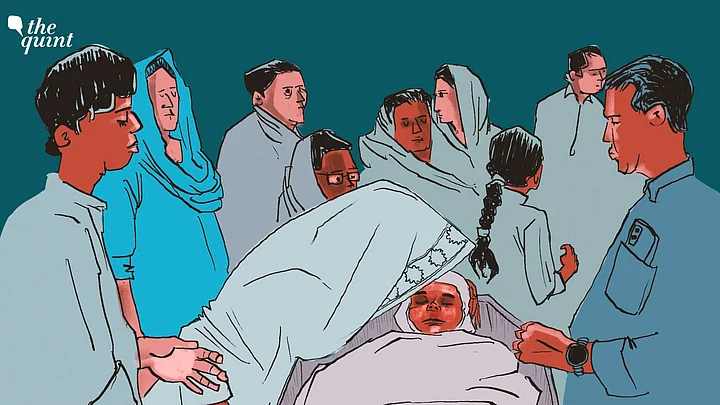
My grandmother had once said she wanted a wooden casket covered in white cloth, with the Bible verse 2 Timothy 4:7—"I have fought the good fight, I have finished the race, I have kept the faith" written on top of it. The next day, we brought her body from the mortuary dressed in a white saree, placed inside a white casket with that verse written across it. It was then that it finally settled in me what “Ammachi is gone” truly meant.
The night before, the whole community gathered at our house and built a tent in our yard for the funeral. Pastors came and went, speaking about the afterlife. Women read Bible verses and sang hymns to comfort the grieving family. A neighbour, to whom my grandmother had been like a mother, agreed to cook the food for the ceremony.
Traditionally, the food served at a funeral is simple and vegetarian. Not to signal purity, but to symbolise mourning. Meat is reserved for celebrations like weddings. In earlier days, families often could not afford to serve a full meal, so the food would simply be a plain bun and black coffee. Because of this, asking an elderly person, “When are you serving bun and coffee?” became a dark but socially acceptable joke.
There is no formal announcement that food is ready. Someone from the family will whisper in your ear that there is food and ask you to please go eat. In most cases, the food is served in a neighbour’s yard. There is no proper seating arranged. People eat sitting wherever they can, or standing awkwardly, as if guilty that they are alive and able to eat, unlike the person who has just passed.
There was a strange knot in my stomach watching her body being brought home through a narrow gap between two buildings. We do not have a proper road or path connecting our house to a public road. It felt like a scene from an anti-caste film. We are wedged between private properties owned by other people. When I posted about it, some people asked if we had been stopped from using the main road. But the truth is, there is no proper road for us to take.
That narrow gap between commercial buildings is how we access the world. It has been the widest wound in our family’s history.
If someone were actively stopping us, we could stand up to them. But this is bureaucratic. It is not one person’s cruelty. It is paperwork, layouts, boundaries, and approvals. That makes it harder to fight.
How Margins Are Made
The irony is uncomfortably funny when we remember that my family, including my grandmother, migrated to this place first and helped build a village out of what was once a remote unforgiving hilly terrain. She lived in a vast openness without rigid boundaries. There was no concept of a private road then. People walked wherever they needed to. Then roads were formalised, walls rose, ownership hardened and we were systematically locked out. The absence of a road is part of a larger, systematic design in which certain communities are consistently left at the margins of infrastructure.
Across India, many Dalit families live in settlements without proper roads, drainage, sanitation, or street lighting. Our land, without a private road, is valued below the standard market rate. Some people in the community whisper that it is because we are Dalits. Even when access exists, land owned by Dalits is rarely valued on par with land owned by Savarnas or dominant OBC communities.
Even today, property is assessed by the social identity of those who live on it. There is an unspoken understanding in many places that if a Dalit family occupies a plot, the surrounding land is considered less desirable. Those who can afford to buy at full market value (often Savarnas, and in many cases dominant OBCs) frequently do not want to live near a Dalit household.
A Life Measured in Labour
At the ceremony, we are expected to publicly offer a testimony about the deceased, their life, and their virtues. Nearly every testimonial, from church pastors to community elders to family members, described her as “hardworking,” “punctual” and willing to do any kind of job.
It is true. She was an agricultural labourer and domestic worker for most of her life, though she had studied up to the fourth form, equivalent to today’s ninth standard and could read and write Malayalam effortlessly. She would proudly say she had never failed a class, because her father warned her he would stop sending her to school if she had to repeat a year.
But after her mother died, she had to stop anyway because the family fell short of one labouring body. She began working at age thirteen, carrying her one-year-old brother tied around her waist as she laboured in the fields. She used to collect large logs from the forest, ferry them across the River Pampa in a boat, break them into firewood, and sell the bundles to hotels and households. It was Rs 30 per bundle.
At that time, hotels did not have grinders, so she would grind flour for them by hand. She worked in rock quarries too, crushing stones into small pieces before technology replaced Dalit women’s bodies there. I remember her carrying a heavy hammer, beating rocks into fragments. Even in her sleep, her hands would involuntarily mimic the motion.
This is why I feel a strange discomfort when I watch the celebrated song “Ezhimala Poonchola,” starring Mohanlal and the iconic Silk Smitha as a quarry worker. Cinema sexualises the labouring bodies of marginalised women long before it grants them dignity. Even in death, the body that broke stone continued to define her, even though it had inspired countless stories and poems, including the titular one of my collection "Silk Route".
The Limits of Feminist Recognition
The language at the funeral was admiring and affectionate. But still her moral worth was articulated through productivity. This is the broader pattern in how Dalit women are memorialised. They are praised for survival and tireless work. Endurance becomes the primary virtue available to them in public memory. In contrast, Savarna women are often remembered through relational roles as a beloved wife, devoted mother, pillar of the family. Feminist discourse rightly critiques such reductions and urges us to focus on what women did rather than whom they belonged to.
But here is the tension. What if what a woman “did” was caste-assigned labour? What if her entire life was structured by work that society devalues yet depends on? When we shift from relational identity to achievement, we assume the existence of choice based on profession and ambition. For many Dalit women, however, “doing” meant cleaning, carrying, harvesting, cooking in others’ homes, taking on odd jobs, and other countless survival work shaped by poverty and caste location.
In this sense, the feminist move from “wife/mother” to “worker” does not automatically liberate Dalit women from reduction. It can simply replace one narrow frame with another, from relational identity to labour identity.
Dalit feminist scholarship has long argued that labour is not a neutral category but a caste-marked one. At her funeral, I witnessed how even praise reproduces this structure. The only time her relational identity surfaced was in the story of her husband, who was disabled and how she chose him. Even this detail functioned less as romantic memory and more as proof of her strength and capacity for sacrifice.
Inheritance, Distance, and Return
Unironically, my grandmother valued hard work above all else. When I was unemployed and looking for a job, she once commented that I should have chosen something like nursing, which guaranteed job security. I told her it was hard work, with exhausting night shifts. My response shocked her. “Life is hard work,” she said.
For the same reason, she often looked down on Savarna women and what she saw as their “fragility”, something that surprises my friends from other communities. She could not understand how someone who worked a desk job during the day could be too tired to do housework in the evening. She had done all of that and more and still found time to weave baskets and mats, raise cattle, and care for her children. What she perceived as a “culture of laziness” was unacceptable to her.
Perhaps that is why, when she called me to learn basket-weaving while I was still in school, I refused. I craved the luxury of being tired after a 9-to-5 job. I wanted to distance myself from the labouring bodies of my mother and grandmother. Refusing to learn basket-weaving was my way of showing it when I had no language to express it.
Like many Dalits of my generation who remember how tough their grandmothers were, I remember mine that way too. Tough grandmothers were perhaps inevitable in order to raise articulate granddaughters. And so, inevitably, living with her was not easy. She was not affectionate or demonstratively warm. I do not remember hugging or kissing her, perhaps she kissed me when I was an infant. The only embrace I truly remember is the one I gave her cold body before we carried her to the cemetery, to be laid beside her husband. Because affection in our family was rarely soft, it was practical and unspectacular.
She was particularly strict about maintaining cleanliness at all times and was meticulous about saving money. She despised idleness and often scolded me for it. She trusted no one, yet somehow trusted everyone too easily. She was central to my imagination and a core force shaping my writing. I could not have mapped the lives of rural Dalit women, their ecosystems, networks, even their transnational trajectories without first witnessing hers. I wanted distance from her labour and yet my life is built upon it.
I may live in language now, but the ground beneath it was cleared by her hands. If there is a road ahead of me, it is because she walked without one.
(Aleena is a poet, writer, and Dalit feminist thinker from Kerala whose work explores themes of gender, sexuality, religion, and caste politics. Her poetry collection "Silk Route"(2021) has won Kerala State Sahitya Akademi Kanakashree Award. This is an opinion piece, and the views expressed above are the author’s own. The Quint neither endorses nor is responsible for the same.)