'Everyone Wants to Be Brahmin': Inside Instagram's Caste Pride Economy
The Quint analyses over a 100 reels from 30 Instagram accounts posting caste-themed content with high engagement.
advertisement
(Caste runs through India's classrooms, workplaces, and even social media. Help us tell more such stories that matter. Become a member and support our coverage.)
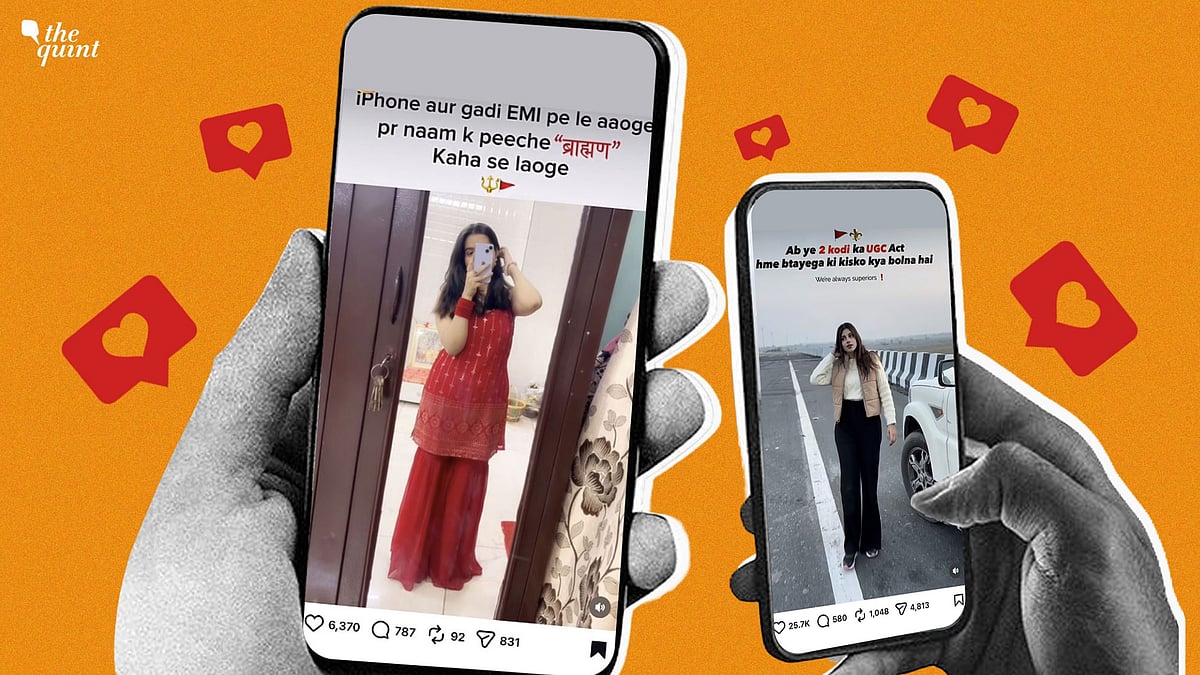
A woman walks from a black Thar towards the camera in slow motion, flipping her hair, Bollywood-style. The audio playing in the background declares, “Brahmin na kabhi jhuka tha, na kabhi jhukega. Brahmin sarvochh tha, sarvochh rahega" (A Brahmin has never bowed, and never will. Brahmins were supreme, and will remain supreme).
The text flashing on the screen reads: “Ab ye 2 kodi ka UGC Act hme btayega ki kisko kya bolna hai. We’re always superior! “(Now this worthless UGC Act will dictate us. We’re always superior!).
25,800 likes.
In another Instagram reel, a young girl records a mirror selfie to a generic trending audio. The text overlay reads, “iPhone aur gadi EMI pe le aaoge pr naam ke peeche ‘brahmin’ kaha seh laaoge." (You can buy an iPhone and a car on EMI, but where will you get a ‘Brahmin’ surname from?)
6,400 likes.
The Quint analysed over a 100 reels from more than 30 Instagram accounts posting caste-themed content with high engagement. Together, they show how dominant-caste superiority is being repackaged for the algorithm age under the label of “pride”.
When Caste Hierarchy Becomes Content
Ayodhya-based Aaru Mishra was 17 when, inspired by reels of other young women, she tried her hands at making "Brahmin content”.
That was two years ago. Now, she posts such content weekly and has 24,000 followers that she calls her online “family." Mishra's reels often feature audios such as “Dabdaba ilake me number one, Brahmin hai jaat bete tagdi faram, chaati pe paon deke kaat denge hum” (In this society our dominance in number one, Brahmin is the caste in its strongest form... we’ll step on your chest and cut you down) and "Barabari? Voh bhi Panditon ki? Mazaak thodi hai" (Equals? With Pandits? It's not a joke) paired with selfies or photo slideshows.
For Mishra, expressing her identity online became a form of purpose. She had plans of studying medicine, but had to drop out of college after her father’s death.
An "uncoventional" choice among women in her village, her Instagram presence still makes some of her relatives uncomfortable but not enough for her to stop, she says. She wants to figure out how to monetise her videos and get brand deals, but ultimately, her dream is just "for people to know her and her content."
When questioned about such content promoting caste hierarchy, she tells The Quint,
“I don’t target people who respect me. I target those who don't,” she adds. “I just want to continue to make Brahmin content for my Brahmin family online who support me.”
Ravikant Kisana, professor and author of Meet the Savarnas: Indian Millennials Whose Mediocrity Broke Everything, tells The Quint, “Many of these creators are women from smaller towns for whom this is an assertion, an act of rebellion to use a phone, Instagram, and make videos."
However, he questions, "So how is it that a person who is asserting and pushing back in other ways, automatically takes such a position on caste? Why are these 18-year-olds kept in such social segregation that this comes so naturally for them?"
Caste as Status
In such reels, caste shows up in many forms—sometimes as light humour, sometimes as open claims of dominance. Yet, the common thread is clear: caste is status.
Sociologist Satish Deshpande tells The Quint such expressions must be read alongside broader economic anxieties.
"We are in a situation globally—but more so in India—where prospects are bleak because of lack of jobs. It's a crisis of confidence, especially for young people from small towns. They begin to think caste identity is the only thing they have that sets them apart,” Deshpande explains.
So, is digital caste pride simply a new medium for an old structure, or does social media actually transform how caste operates?
"A bit of both,” says Deshpande. “These are available feelings waiting to be expressed, but the velocity of circulation has increased."
Many of the creators analysed by The Quint post content almost exclusively centred on their caste identity, while occasionally participating in broader Instagram trends. Most appear to be students or young women based in smaller towns; some identify as housewives, while a few mention working in government or corporate jobs.
In January, the proposed UGC regulations also became a recurring theme. Several reels criticised the move as unfair or targeting Brahmins, while others celebrated reports of its withdrawal.
Many videos repeated nearly identical captions, suggesting a pattern of copycat trends.
Some videos declared, “Category so powerful that the government needs to pass a law like UGC to control us”. Others claimed, “UGC or any Act cannot change the fact that Brahmins and Rajputs are and always will be superior.”
Pride vs Supremacy
Creators frequently defend their reels as harmless expressions of identity. But where does caste pride end and caste hierarchy begin, especially in a system that relies on some castes being placed below others?
"It is very hard to have caste pride without claims of superiority over other castes. That is the natural content of caste pride," says Deshpande.
Scholars have long argued that caste pride, from dominant castes, is an assertion of hierarchy. Expressions of dominant caste pride tend to draw legitimacy from historical privilege, and the "cultural pride" in these cases is not separable from the social order that places some groups above the other.
In an article for DD Kosambi Research Foundation, activist and scholar Anand Teltumbde writes, "Caste pride, rooted in historical privileges and hierarchies, continues to shape Indian society in profound ways. While marginalised groups’ assertion of identity seeks justice and dignity, dominant caste pride perpetuates inequalities. Bridging this divide requires dismantling caste as a social and cultural construct, fostering a shared commitment to equality, and empowering the oppressed to rise beyond the boundaries of caste."
The Soundtrack of Caste Superiority
While most reels use generic trending audio tracks, a striking pattern across reels sometimes is the repeated use of a set of audio clips that themselves explicitly assert caste dominance.
The audio, "Baap dada mar gaye brahman ki gulami karat karat. Aur betwa story pe lagawat raha, dabdaba hai dabdaba rahega. Bhak!" (The father and grandfather died as our slaves. And the son is posting on his story that their influence is here to stay. Get lost!"), has been used in over 2,000 reels on Instagram. The track was created by Manish Pandit, an Instagram user who frequently posts content centred on Brahmin pride.
His bio reads: “Par ek baat saaf hai, hum pandit sabke baap hain." (But one thing is clear: We Pandits are above everyone else).
Meanwhile, a segment from the song ‘Pandat Paapi’—“Saari bole Pandit ji, Pandit poora VIP”—has appeared in over 61,000 reels. These audio clips function as readymade identity templates: creators simply insert themselves into a pre-existing narrative of caste prestige.
Another type of audio tracks often used original sounds by creators, such as this one by Varsha Sharma from Ghaziabad with 165k followers: "Humara toh naam hi naam ni, surname bhi aag lagate. Aur sun, Pandit hi kehde." (Not just our name, our surname fires things up too. Pandit.)
Another example is this reel by Vishi Pandit, a Meerut-based creator with over 98.5k followers: "Kaun rokega Brahmin ko? Koi nahi. Kaun rok sakta Brahmin ko? Koi nahi." (Who will stop Brahmin? No one. Who can stop Brahmin? No one.)
Romance, Purity, and the 'Right' Partner
Many reels appear to be more playful in nature but romanticise caste endogamy.
One widely used audio comes from Instagram creator Raja Choudhary. He asks, “Sabse zyada cute ladkiyan kaunsi caste ki hoti hain?” (The cutest girls are from which caste?) to which the girl replies, “Sabse zyada cute ladkiyan, I think, Brahmin." (Most cute girls are Brahmin). The clip then cuts to the song, “Saare bole Panditji, Pandit poora VIP”.
The clip has been used in over 10,000 reels, often with text overlays such as “Proud to be a Brahmin girl” and “Obviously Brahmin.”
In another reel, creator Vishi Pandit says, “Bhai, pandit ke saath panditaain hi jachti hai. Bhed bakriya nahi" (Only a Brahmin woman looks appropriate with a Brahmin man, not sheep and goats.) The video has 14,700 likes, with comments filled with affirmation emojis and replies such as “Sahi baat boli sister" (You're right, sister).
Among the thousands of comments praising the reel and the father’s reaction, one is, “Yeh hui na mardo waali baat” (Now that’s what a real man’s response looks like) (3,000 likes), and another, “That’s called Royal Blood” (9,330 likes).
A few rare comments criticised it, though, with one user commenting, “These are the reasons why India is still under-developed, their so-called caste system.” Honour killings linked to inter-caste relationships are a documented reality in India, often driven by family or community pressure to maintain caste boundaries.
Jaagriti, a 25-year-old who works a corporate job, makes reels about Brahmin identity during her office breaks. Most of her content has a fixed pattern, revolving around finding the “ideal Brahmin partner,” with captions such as “Dear company, hire Brahmin boys or I’ll resign", or “Kitne bhi advanced ho jao, ladka mujhe brahmin hi chahiye." (No matter how modern things get, I want a Brahmin boy only.)
Jaagriti tells The Quint that a reel she made while experimenting with content around three months ago, "Pandeyji nahi mil rahe hai” (Can't find Pandeyji) went viral, after which people DMed her asking to make more such videos for different Brahmin surnames such as Pandeyji, Tiwariji, etc.
“If I think my small family (followers) wants content on Rajputs, I'll start doing that," she adds. "Identity is a sensitive thing, but people see that my content is respectful, and not going against anyone, while a lot of other creators are controversial."
The Moderation Blindspot
Meta’s community guidelines prohibit content that promotes hate or discrimination and list caste among protected characteristics, along with race, ethnicity, disability, sexual orientation, etc.
But content promoting caste-based hierarchies often slips through moderation because it is framed as pride or culture, rather than hate or discrimination. The Quint reached out to Meta for comment. This story will be updated as and when Meta responds.
On online moderation, Kisana says, “How do you implement it? Who will be the human element to examine the report, the police case, or even other Indian laws on caste? The law can't do anything if people running the machinery don't view it as a violation. Caste-based atrocities are typically recognised only in cases of extreme hyper-visible violence. Any sort of Savarna identity assertion, when challenged, creates a massive backlash. This is not a society that is built for sober reflection.”
At first glance, many of these reels resemble harmless cultural pride. But caste hierarchy has historically reproduced itself through repetitions such as surnames, marriage rules, and rituals.
Reels may simply be the latest vehicle.