
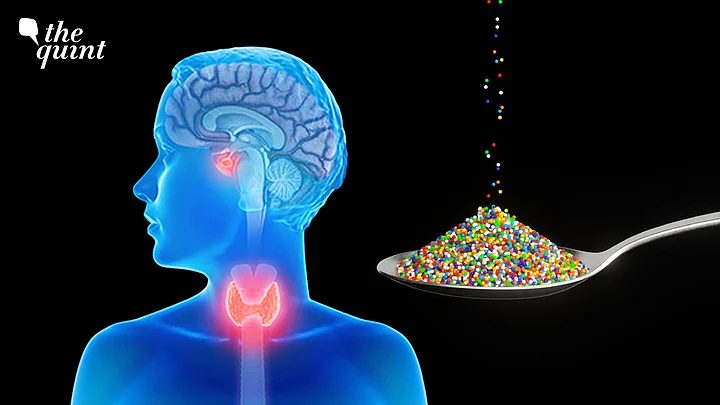
Diabetes, obesity and several other hormonal disorders are becoming more common, often appearing at younger ages. Calorie-dense food, limited physical activity, inadequate sleep, chronic stress, and genetic susceptibility are all known contributors. Yet, these factors may not explain the entire picture.
Could something else in our environment also be influencing metabolism and hormonal health?
More recently, researchers have also begun looking at microplastics: tiny plastic particles now found in food, water, air and also in several human tissues, as a potential cause.
Plastic has become difficult to separate from daily life. Water comes in plastic bottles, hot food arrives in plastic containers, milk is packed in plastic pouches, and leftovers are stored and reheated in plastic boxes. Synthetic clothes and household furnishings release plastic fibres into indoor air. Even dust inside our homes may contain them.
Could this constant exposure be affecting the thyroid, fertility, body weight, and blood glucose? The answer is still being worked out, but the question is no longer easy to dismiss.
This question has brought attention to endocrine-disrupting chemicals—substances that can imitate, block, or alter the action of hormones. Many are used in plastics.
What Exactly are Microplastics?
Plastic does not disappear when it is thrown away. Over time, sunlight, heat, friction, and weathering break it into smaller pieces. Particles measuring less than five millimetres are called microplastics. Still smaller particles, generally below one micrometre, are often called nanoplastics.
Some microplastics are deliberately manufactured in tiny sizes. Others form when bottles, containers, tyres, paint, packaging, and synthetic fabrics gradually wear down. They can enter crops, seafood, salt, and drinking water or remain suspended in the air.
We are, therefore, exposed to them mainly by swallowing and inhaling them. Larger particles may pass through the intestine, but smaller particles may be able to cross biological barriers and enter the circulation. Researchers have reported microplastics in human blood, lungs, placenta, breast milk, and even semen.
Finding a particle in the body does not prove that it has caused disease. However, it confirms that exposure has occurred and that at least some particles can travel beyond the gut.
There is another complication. Plastic is not made from just polymers. Chemicals are added to make it soft, strong, colourful, transparent or resistant to heat. These include bisphenols, phthalates, flame retardants and ultraviolet stabilisers. Some of these are known or suspected endocrine disruptors.
Microplastics may affect the body in two ways. The particle itself may trigger inflammation or oxidative stress, while chemicals released from or carried on its surface may interfere with hormone signalling.
The Endocrine Society of India’s National White Paper on Endocrine Disrupting Chemicals, published early this year, identifies plastics as an important source of phthalates, bisphenols, PFAS and flame retardants—chemicals that can interfere with hormonal signalling.
Can Microplastics Disturb Thyroid?
The thyroid is a small gland with a big job. Its hormones regulate energy use, body temperature, heart function, growth, and brain development. Thyroid hormone production and activity depend on a tightly controlled exchange of signals between the brain, pituitary gland, and thyroid.
Animal and laboratory studies suggest that microplastics may disturb this system. Researchers have reported changes in thyroid tissue, altered thyroid hormone levels, and disruption of genes involved in hormone production.
Oxidative stress and inflammation may damage thyroid cells, while some plastic-associated chemicals can interfere with thyroid hormone receptors or transport proteins.
This is particularly relevant during pregnancy and early childhood, when thyroid hormones are essential for the development of the brain.
However, it must be noted that the human evidence is not yet strong enough to conclude definitively that microplastics cause hypothyroidism, hyperthyroidism, or autoimmune thyroid disease. Thyroid tests are influenced by iodine intake, pregnancy, medicines, illness, and several other factors. These are difficult to separate from plastic exposure in observational studies.
There is, therefore, no reason to start checking thyroid function simply because someone drinks bottled water or uses plastic containers. The concern is scientifically valid, but it has not yet translated into a new screening recommendation.
Reproductive System May be More Vulnerable
Reproduction depends on some of the most finely timed hormonal signals in the body. Ovarian follicle development, ovulation, testosterone production, and sperm formation can all be affected when endocrine signalling is disturbed.
In animal studies, exposure to microplastics has been associated with ovarian inflammation, damage to developing follicles, altered reproductive hormones, and reduced fertility.
In males, researchers have described oxidative damage in the testes, changes in testosterone, and poorer sperm quality.
Microplastics have now been detected in human semen. Some observational studies have also found associations between particular plastic particles and reduced sperm motility.
These studies are small and cannot prove that the particles caused the abnormalities. Smoking, obesity, air pollution, heat exposure, and other environmental chemicals may all affect sperm quality.
The effects may not come from particles alone. Bisphenols can interact with oestrogen pathways, while some phthalates have anti-androgenic effects and may reduce testosterone production. These chemicals can leach from plastic, especially when it is old, scratched or heated.
PCOS also deserves attention in this discussion. Insulin resistance, excess androgen action, and disturbed ovarian function are central to PCOS.
Environmental endocrine disruptors could plausibly influence these pathways, but it would be premature to describe microplastics as a proven cause.
PCOS results from an interaction between genetic susceptibility, body weight, metabolic factors, and the environment. Plastic exposure may eventually prove to be one small piece of that larger picture.
Could Plastics Contribute to Obesity and Diabetes?
Obesity is often discussed as if it is simply the result of eating too much and moving too little. That explanation is incomplete. Sleep, stress, medicines, genetics, early-life and fetal development, and the environment can all influence appetite, fat storage and insulin action.
Some chemicals used in plastics have been described as “obesogens”. They may encourage precursor cells to develop into fat cells, alter appetite pathways, or change the way energy is stored. Bisphenols and phthalates have also been studied for possible effects on pancreatic beta cells and insulin sensitivity.
Microplastic particles may add another route. In experimental studies, they can alter gut bacteria, weaken the intestinal barrier and promote inflammation. They may also disturb mitochondrial function in the liver, muscle and fat. These processes are closely connected with insulin resistance.
Animal experiments have reported weight gain, abnormal glucose regulation, and changes in lipid metabolism following exposure to certain microplastics. Cell studies have also identified impairment of insulin-signalling pathways.
But the leap from these experiments to human diabetes is a large one. Laboratory animals are sometimes exposed to doses and types of particles that do not reflect ordinary life. Human studies are still too limited to establish that microplastics independently cause obesity or diabetes.
Could the Effects Begin Before Birth?
Perhaps the most important concern is not what plastic exposure does to us today, but what it might do during early development.
Microplastics have been detected in the human placenta. The placenta is not merely a barrier between mother and fetus. It produces hormones, controls nutrient transfer and helps regulate fetal growth. If plastic particles or their chemicals alter placental inflammation or hormone production, the effects could extend beyond pregnancy.
Animal studies suggest that exposure during pregnancy may influence the offspring’s metabolism, reproductive development and hormone regulation.
Some experiments have also reported changes in gene expression and epigenetic regulation—the molecular switches that determine how genes behave.
This raises the possibility of an intergenerational effect. A mother’s exposure could influence her child’s later susceptibility to obesity, diabetes or reproductive dysfunction. Because developing eggs and sperm may also be affected, scientists are investigating whether some effects could extend further.
At present, this has not been established in humans. Demonstrating a true transgenerational effect requires following families over several generations while accounting for shared genes, diet, lifestyle and environment. Establishing this with strong evidence, however, will take time.
Still, pregnancy, infancy, and puberty are reasonable periods for additional caution because hormonal systems are developing and may be more sensitive to disruption.
No Clear Answers Yet
You may have noticed this point come up several times: clear evidence establishing a direct link between microplastics and their impact on human health has yet to be established.
This is because studying microplastics is surprisingly difficult. Plastic fibres are everywhere, including in laboratory air, clothes, collection tubes, and equipment, and contamination can occur while collecting or processing a sample.
There is also no single standard method to study them. One laboratory may count particles under a microscope, while another measures the mass of a polymer after chemically breaking down the tissue. Some methods detect only larger microplastics and miss nanoplastics altogether. Comparing studies can therefore be difficult.
Microplastics are not one substance. A smooth polystyrene bead, a polyester fibre, and a weathered fragment of food packaging differ in size, shape, and chemical content. Their biological effects may also differ.
Regulatory agencies consequently remain cautious. The US Food and Drug Administration states that current evidence does not demonstrate that the levels found in food and water pose a proven risk to human health. The World Health Organization has also emphasised the need for better measurement and long-term human studies.
This does not mean that microplastics are harmless. It means that science has not yet identified which particles are most important, what level of exposure becomes harmful or which people are most vulnerable.
A Few Sensible Changes—Without Panic
Completely avoiding plastic is, of course, unrealistic. Fortunately, reducing avoidable exposure does not require turning the kitchen upside down.
The simplest rule is to avoid heating food in plastic.
Glass, ceramic, or stainless-steel containers are preferable for hot food and drinks.
Takeaway food can be transferred out of plastic packaging soon after it arrives.
Old, scratched, or cloudy plastic containers should be replaced.
Disposable water bottles should not be repeatedly reused, or stored in a hot car.
Loose-leaf tea or paper tea bags can be chosen instead of plastic mesh bags.
Reducing heavily packaged and ultra-processed foods may lower plastic contact while improving diet quality.
Regular wet dusting and ventilation can help reduce plastic-containing indoor dust and fibres.
Where tap water is safe, an appropriate household filter and a reusable steel or glass bottle can help reduce routine dependence on bottled water. However, reducing plastic exposure should never come at the cost of drinking unsafe water. Packaged water remains the safer choice where other sources may be contaminated.
There is no proven 'detox' for microplastic. Special supplements, restrictive diets, sauna routines and commercial microplastic tests have not been shown to prevent endocrine disease.
Individual precautions help, but they cannot solve the larger problem. Better waste management, reduced open burning, safer food packaging, clearer disclosure of plastic additives and standardised monitoring of food, water, and air will matter far more.
The bottom line is that the rise in diabetes, obesity, PCOS, hypothyroidism, and other endocrine disorders cannot be blamed on one environmental exposure, however, microplastics and the chemicals associated with them are credible candidates in the wider environmental picture.
Microplastics should expand our view of metabolic and endocrine risk, not replace what is already known.
We do not need to panic about every plastic bottle. But we should stop treating plastic as if it were completely inert. What holds our food and water may also be interacting, quietly and repeatedly, with the hormonal systems that hold our health together.
(Dr Saptarshi Bhattacharya is the Secretary of the Endocrine Society of Delhi, and a Senior Consultant in the Department of Endocrinology at Indraprastha Apollo Hospitals, New Delhi.)

