
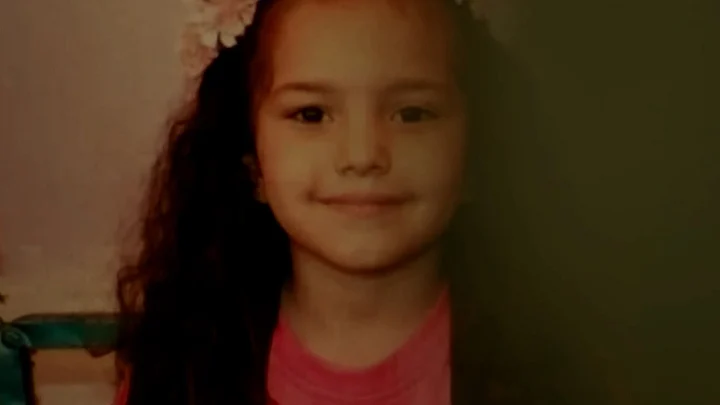
On 29 January 2024, a six-year-old Palestinian girl named Hind Rajab was fleeing her neighbourhood in Gaza with six members of her family—all civilians—to escape Israeli bombardment. Israeli tanks opened fire on their car.
Hind survived the initial assault, trapped inside the vehicle with the dead bodies of her relatives. She managed to call the Palestine Red Crescent Society (PRCS) and begged for help.
For over three hours, PRCS workers in Ramallah stayed on the line with her as they tried to secure permission from the Israeli army to send an ambulance. When approval finally came, the PRCS dispatched two paramedics. But just as the ambulance was about to reach Hind, it lost contact with the team.
Twelve days later, the ambulance was found destroyed. The paramedics were dead. Hind, along with her family, lay dead in the car, which had been fired upon with 335 rounds.
This is the subject of Tunisian filmmaker Kaouther Ben Hania’s The Voice of Hind Rajab, an 89-minute docu-fiction drama built around the real audio of those phone calls with Hind.
Since its premiere at the Venice Film Festival in 2025—where it received a 23-minute standing ovation and won the Grand Jury Prize—the film has travelled widely, earning critical acclaim and an Academy Award nomination for Best International Feature Film.
This is a story Indian audiences are not being allowed to watch.
Censor Board Wall
The Voice of Hind Rajab’s theatrical release in India has been blocked by the Central Board of Film Certification (CBFC). According to report in Variety, the CBFC declined to clear it because it was “very sensitive.”
The film’s Indian distributor, Manoj Nandwana, recounted that he was told by a CBFC member that releasing it could “break up the India-Israel relationship.”
This claim rings absurd. The Voice of Hind Rajab has already been released in countries with close strategic and diplomatic ties to Israel, including the US, the UK, France, and Italy.
Blocking this film in India signals a broader willingness to pre-emptively align cultural expression with State power. This is a form of anticipatory censorship, in which the state (or bodies acting on its behalf) suppresses narratives that might disturb an allied government, even in the absence of any real diplomatic risk.
In this sense, blocking The Voice of Hind Rajab is less about foreign policy sensitivity and more about political deference: an eagerness to mirror and protect Israel’s narrative position, rather than tolerate dissenting or critical perspectives within India’s own public sphere.
A Microcosm for Israel’s Ongoing Genocide
The Voice of Hind Rajab treats Hind’s story as a microcosm for Israel’s ongoing genocide in Gaza, in which well over 75,000 people have been killed, at least 20,000 of them children. Reflect on these statistics for a moment.
What gives this film its force is how it resists abstraction: instead of numbers, it anchors us in the unmistakably human texture of Hind’s voice—hesitations, fear, repetition—so that she cannot be reduced to a statistic. She is a little girl. A daughter.
Built around real phone recordings and realistic reenactments, the film unfolds almost in real time, with disarming restraint. When Omar first answers the phone at the PRCS, a teenage girl, Layan, is on the line. Her voice trembles: “They are firing at us; the tank is beside me.” Moments later, the line goes dead. When her cousin Hind comes on, her voice sounds smaller, more fragile: “I’m so scared… please come.”
Much of the action remains in the PRCS office. We are told early on that Hind’s vehicle is only minutes away. Yet, those minutes stretch into hours as permission from the Israeli army is requested, delayed, and negotiated, portraying the unfathomable constraints placed on the PRCS workers by the Israeli occupation.
The film’s final sequence is devastating precisely because it withholds resolution. After hours of waiting, permission is finally granted. For a brief moment, relief feels possible. Then contact with the ambulance is lost, and the screen cuts to black before giving way to images of the destroyed vehicle.
By refusing spectacle or closure, Ben Hania turns Hind’s story into something larger than a singular tragedy: a record, an unshakeable public testimony, and an indictment of Israel’s war crimes. The film compels us to feel the weight of what is happening right now, countering the broader dehumanisation of Palestinian people by insisting on their irreducible humanity.
India’s Shifting Relationship With Israel
"I grew up loving India,” Ben Hania wrote on Instagram shortly after the CBFC decided to block her film. “Is the honeymoon between the ‘world’s largest democracy’ and the ‘only democracy in the Middle East’ so fragile that a film could break it?”
India’s “honeymoon” with Israel is a stark departure from its historic foreign policy stance.
For decades after Independence, India publicly positioned itself as a supporter of Palestinian self-determination. It voted against the 1947 UN partition plan, recognised the Palestine Liberation Organisation in 1974, and formally recognised the State of Palestine in 1988.
This stance reflected India’s role as a leader of the anti-colonial Non-Aligned Movement, even as it maintained quiet strategic ties with Israel, particularly in defence and intelligence, well before establishing full diplomatic relations in 1992.
What has changed since 2014 is not India’s stated position—officially, it still supports a two-state solution—but the weight of its actions, rhetoric, and diplomatic signalling. Narendra Modi’s 2017 visit to Israel, the first ever by an Indian prime minister, was deliberately “de-hyphenated,” breaking with decades of practice by not pairing it with a visit to Palestine.
Within hours of Hamas’ 7 October 2023 attack, PM Modi posted on social media that India “stands in solidarity with Israel at this difficult hour.” This was one of the earliest and most unequivocal statements of support for Israel by any Global South leader.
Shortly after, India abstained on a UN General Assembly resolution calling for a humanitarian ceasefire in Gaza, departing from its long-standing voting pattern.
Even as civilian casualties in Gaza rose dramatically, there was no equivalent high-level statement expressing solidarity with Palestinians or directly criticising Israeli military actions. In fact, during his second official visit last month, PM Modi said, “India stands with Israel, firmly, with full conviction, in this moment and beyond.” He once again condemned the 7 October attacks as “barbaric”—and said nothing of Israel’s carnage in Gaza.
In his 2023 book Hostile Homelands, journalist Azad Essa has argued that India’s deepening ties with Israel do not merely indicate a pragmatic alignment, but an “ideological kinship” between Hindutva and Zionism. Both frame the nation as a civilisational homeland under threat, both position minorities—Muslims in India, Palestinians in Israel—as suspect or conditional citizens, and both justify expansive security apparatuses in the name of that threat.
This is precisely why a film like The Voice of Hind Rajab might be threatening. By centring a child’s voice trapped under relentless gunfire, it disrupts the framing of these securitisation narratives, shifting attention away from “terrorism” or “security threats” toward the human cost of unchecked state violence.
India’s Climate of Censorship
India’s silencing of The Voice of Hind Rajab is ultimately part of a larger pattern of cutting, delaying, and blocking narratives that foreground State violence, social hierarchies, or minority experiences. In other words, anything that challenges the Bharatiya Janata Party (BJP) or its Hindutva ideology.
Recent cases help illustrate this pattern. Honey Trehan’s Punjab ’95, based on the life of Sikh activist Jaswant Singh Khalra, was subjected to an extraordinary number of cuts, including the removal of names, places, and even verified figures related to extrajudicial killings. The film remains unreleased in India.
Sandhya Suri’s Santosh, a British production and the UK’s official entry for the 2025 Academy Awards, deals with police brutality, casteism, sexism, and Islamophobia. The CBFC demanded such extensive cuts that its release became effectively untenable.
Even films that obtain permission for release end up with several cuts.
For Phule, a biopic of anti-caste reformers Jyotirao and Savitribai Phule, filmmaker Anant Mahadevan was asked to mute references to caste and historical oppression. Dharma’s recent anti-caste films, like Dhadak 2 and Homebound, had to soften their portrayals of discrimination and violence due to the CBFC directives.
Such cuts, and the climate of censorship that produces them, systematically strip films of the ability to name power. By neutering their language and imagery, they flatten political cinema into safer, sanitised, less confrontational content.
The Voice of Hind Rajab does not rely on spectacle or polemic. It asks that we listen to a child’s voice—and bear witness to the literally unseeable injustice inflicted on thousands like her.
The real reason for blocking this film may not necessarily be fear that it will “break up the India-Israel relationship.” The Voice of Hind Rajab risks exposing Indians to the unspeakable scale of Israel’s genocide in Gaza—and to India’s complicity within it.
(Kaashif Hajee is a writer and film critic from Mumbai, currently based in London. He is the Assistant Culture Editor of The Polis Project. This is an opinion piece and the views expressed above are the author’s own. The Quint neither endorses nor is responsible for the same.)
