
Rahul Gandhi’s Foreign Policy Ideas Akin to BJP's but With a Twist of Opposition
In Chicago, Rahul sought to project himself as a national leader with a broader policy vision, writes Manoj Joshi.
advertisement
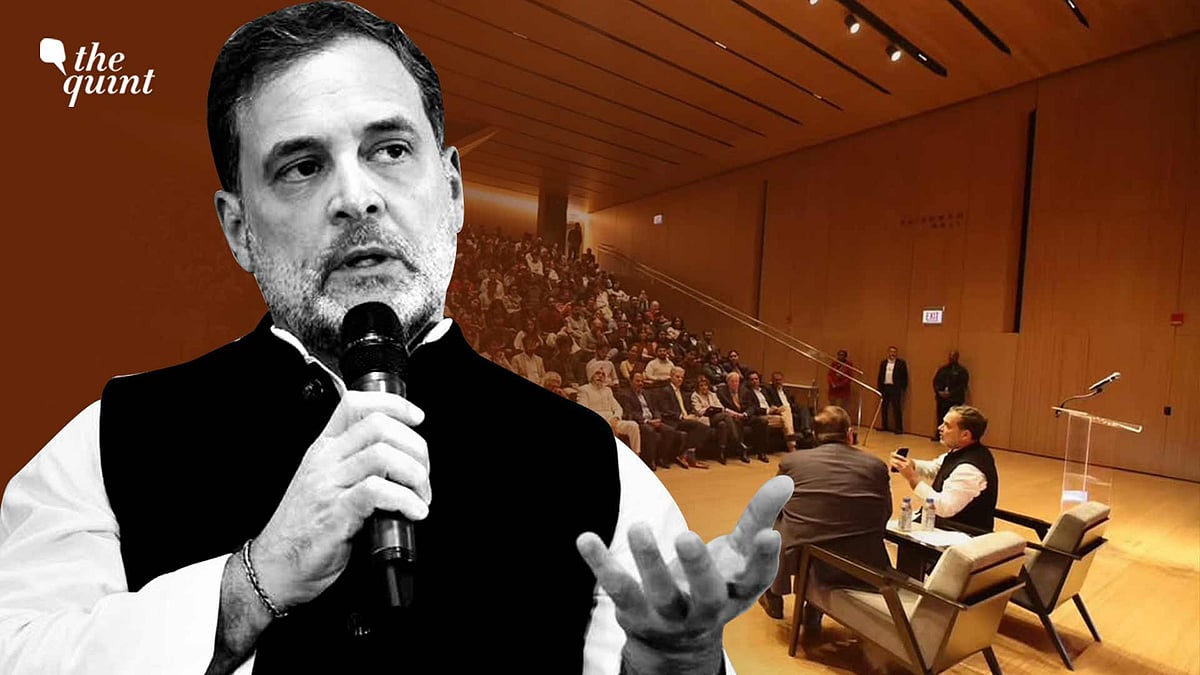
There has been considerable commentary on Rahul Gandhi’s views on Pakistan and Israel following his wide-ranging interview with Prof Robert Pape in Chicago. Rahul was invited by the Chicago Project on Security and Threats (CPOST) for a conversation on “The Iran War and India’s Role in the World.”
The first impression that emerges from the nearly one-and-a-half-hour interview is that Rahul is orthodox on ends and oppositional on execution. This is hardly surprising for an Indian Opposition leader.
His views on arms ties with Israel, conditional talks with Pakistan, a strong partnership with the US, and wariness of China are not fundamentally different from those of the Bharatiya Janata Party (BJP) government.
His criticism of Narendra Modi is essentially about competence and the conduct of foreign policy, rather than its broad direction. His charge is that foreign policy has “collapsed” after Operation Sindoor, that it has been reduced to hugs and photo-ops, and that Modi “will do whatever America and Israel say.”
He argues that Delhi has withdrawn from the international game and links this to the erosion of democracy at home. This is an Opposition critique of performance, not an attempt to lay out a fundamentally new direction for Indian foreign policy.
One might wonder why the University chose to invite Rahul Gandhi. As Prof Pape pointed out, Rahul has been the Leader of the Opposition in India and an MP since 2004, and is widely seen as Modi’s principal challenger. Pape also acknowledged the role played in arranging the interaction by Sam Pitroda, a Chicago native.
On Pakistan and Terrorism
During the interaction, Rahul was asked by a Pakistani student whether there was still “room for India and Pakistan to move beyond the blame game and work together for mutual benefits”.
Rahul was blunt.
“There is room,” he said, but added that there was a “big problem”: Pakistan's support and encouragement of terrorism in India. Taking a position not very different from that of the Modi government, he said it was simply not possible to have a conversation with Pakistan while innocent Indians were being murdered by Pakistani terrorists.
On Israel
Rahul's position on Israel, too, was orthodox: India should continue military cooperation with Israel and maintain strong strategic ties despite the international outrage over Gaza.
In his view, India has strategic reasons to maintain military ties with Israel—and New Delhi must be free to obtain the weapons it considers best for its armed forces rather than allow its foreign policy to be dictated by the priorities of others.
While condemning Israel's actions in Gaza, Rahul also criticised the 7 October Hamas attack, saying that the killing of civilians was simply unacceptable.
His position is significant because it separates the question of India's strategic relationship with Israel from its assessment of Israeli conduct in Gaza. In this respect, too, there is little departure from the broad approach of the present government.
The Iran War
On the principal theme of the interaction, the Iran war, Rahul made relatively general observations. His point was that Indians were already suffering from rising inequality and the decline of small and medium businesses, and that the war had added to the country's economic difficulties. “It raised prices, created inflation,” he observed.
He said he was shocked that Pakistan was negotiating with both Iran and the US while “India is just looking”. Despite having relationships across the globe, “we have sort of stepped back and suddenly decided we are not going to be players on the stage, right?”
This is perhaps his sharpest criticism of the Modi government's foreign policy. It is also an interesting one because Rahul simultaneously advocates a strong partnership with the US while arguing that India must retain the ability to engage independently with different power centres. His concern, therefore, is less about the partnerships India has cultivated and more about its apparent inability to translate them into diplomatic influence.
Rahul's Larger Worldview
Rahul's larger worldview emerged when he spoke about the international security architecture. He noted that the existing system had been built in the aftermath of World War II and was essentially the creation of “one civilisation”. The next security architecture, he argued, would not be built in the same way but would involve multiple civilisations. It would be shaped by the US and the West, China, India, the Middle East, and Russia.
He acknowledged that the US, given its strength, would continue to play a major role. But such an architecture could not be built through words alone. It would require the ability to listen to the other side.
Rahul positioned India as an important player in this emerging order because of its ability to manage complexity, absorb different ideas, and understand different cultures. In this context, he invoked Mahatma Gandhi's philosophy of non-violence as something that could make a significant contribution to the new security architecture. He also referred to his father Rajiv Gandhi's Action Plan for Nuclear Disarmament, presented at the United Nations in 1986.
Whether such ideas can be translated into practical diplomatic influence is another matter, but they provide an indication of how Rahul sees India's place in the emerging international order.
A National Leader With a Broader Vision
Running like a thread through the interview was Rahul's conviction that votes have been stolen from him and his party since the 2014 election. His “vote chori” campaign has acquired a new edge.
The Chicago interaction was, therefore, about more than just his views on Pakistan, Israel, or the Iran war. It was also an opportunity to present himself as a potential alternative to Modi, with a foreign policy approach that, while broadly retaining India's existing strategic preferences, would be different in its conduct and execution.
In Prof Pape's assessment, Rahul came across as an “inspired, optimistic and clear-eyed” leader. That was perhaps the impression Rahul was seeking to create.
(Manoj Joshi is a Distinguished Fellow, Observer Research Foundation, New Delhi. This is an opinion piece and the views expressed above are the author’s own. The Quint neither endorses nor is responsible for the same.)
- Access to all paywalled content on site
- Ad-free experience across The Quint
- Early previews of our Special Projects
Published: undefined