
India’s Israel Embrace Comes With Moral Blind Spots
Given the record of the Netanyahu government, India’s enthusiasm for Israel seems misplaced at this juncture.
advertisement
Going by the metrics of a foreign visit, Prime Minister Narendra Modi’s visit to Israel was fairly standard course. There was the usual list of MoUs on issues ranging from geophysical exploration to cooperation on Artificial Intelligence. The relationship was promoted to a Special Strategic partnership and the two countries sought to boost their technology partnership in areas from agriculture to defence.
As Modi pointed out, “technology lies at the heart of our future partnership.” The Prime Minister also became the first-ever recipient of the “Speaker of the Knesset (Israeli parliament) Medal” on the occasion of his visit.
It could well be misconstrued as an act of solidarity considering that Israel is today isolated and reviled around the world for what many have termed its “genocidal” war in Gaza. On the other hand, it could simply be a straightforward visit to a friendly country by an ever-peripatetic leader.
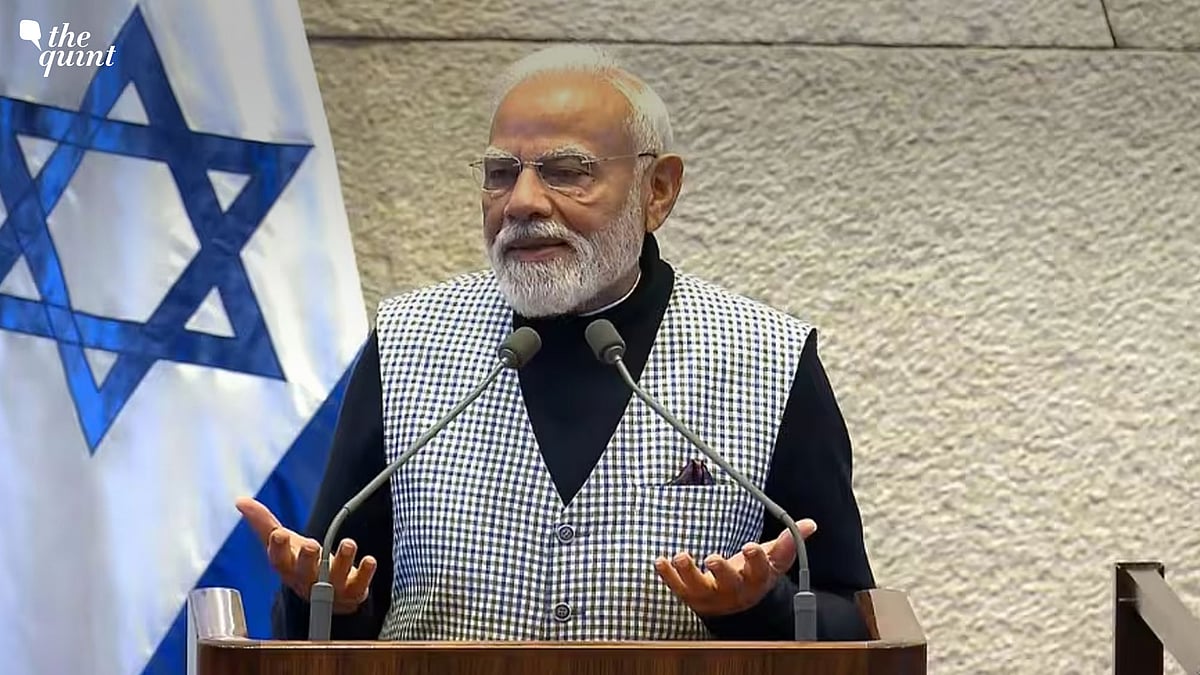
Modi in the Knesset
Speaking to the Knesset Parliament, on Wednesday, Prime Minister Narendra Modi referred to the Hamas massacre of 7 October 2022 and rightly declared that “no cause can justify the murder of civilians. Nothing can justify terrorism.”
But surely, he could not have missed the irony of that statement in the Parliament of a country that has, by its own acknowledgement, killed more than 70,000 Palestinians in the last three years in response to the Hamas attack that led to over a thousand Israelis killed and some 250 taken hostage.
Israel had the world’s sympathy and support in the wake of the massacre of its civilians and the taking of hostages by Hamas on 7 October. But its retaliatory campaign, which has involved relentless bombardment that has reduced 80 per cent of Gaza to rubble and killed tens of thousands, mainly civilians has led to widespread condemnation across the world.
In his remarks on Wednesday, Modi endorsed the Gaza peace plan endorsed by the UN Security Council, saying that India believed it held “the promise of a just and durable peace for all the people of the region, including by addressing the Palestine Issue.”
The issue is especially salient for India which has long supported the rights of Palestinian and their right to a state of their own. But under the current government, a change seems to be underway.
Sangh Meets Zion
Modi and Benjamin Netanyahu both speak of collaboration between two ancient civilisations. But the reality is that the state of Israel was created through a UN resolution 181 of November 1947, and peopled largely by refugees of from Europe. That state is now basing its claim on its holy book and seeking to rid the region of its original inhabitants.
There is the defence alignment where India accounts for 34 percent of Israel’s defence exports with $8.6 billion of trade in 2026 alone. Israeli high-tech equipment fills a void in India’s force posture in the area of smart bombs, drones, rockets, and electronic equipment. In future, New Delhi is hoping to acquire Israeli anti-missile systems as well. But New Delhi should be warned that the US has, and often exercises a veto on Israeli defence exports.
There is also a counter-terrorism element wherein India has begun copying aggressive Israeli tactics to counter terror, though the reality is the Israelis have not been particularly successful in ending Palestinian protest. Police in different parts of India have adopted the illegal policy of destroying homes of alleged terrorists, never-mind if the main occupants are innocent relatives of the person concerned.
The Israeli policy has only enhanced the virulence of the Palestinian response as was evidenced by the Hamas terror attack, but it would be a foolhardy person who thinks that the brutal Israeli response has doused the Palestinian resentment and anger.
India's Shifting Stance on Palestine
Modi actually went out of his way initially, perhaps to appear balanced. He followed his 2017 Israel visit, the first ever by an Indian Prime Minister, with an invitation to the Palestinian President Mahmoud Abbas to New Delhi and reiterated support for a two-state solution that could see “a sovereign, independent, united and viable Palestine co-existing peacefully with Israel.”
In 2018, India supported a vote in the UN General Assembly, opposing the unilateral declaration of Jerusalem as Israel’s capital. That year he also visited Ramallah in the occupied West Bank and in 2020 condemned the expansion of Israeli settlements there.
But there has been a shift since then. One manifestation of this was the delay in India signing up to a statement on 18 February at the UN, signed by over 100 countries and international organisations criticising Israel’s violation of international law through its plans to expand its control over more territories in the occupied West Bank.
Likewise, Aligarh Muslim University students in Aligarh were booked for a solidarity march. In Bihar, even Palestinian flags are banned items and Chief Ministers like Uttar Pradesh's Yogi Adityanath have ordered the social media to be monitored for pro-Palestinian posts. Even anti-terrorism laws have been invoked in the country to deal with the situation. Yogi, of course, has been an eager advocate of “bulldozer justice” pioneered by Israel.
But the shift is not, as often believed, on account of the 7 October incident, as horrible as it was, but more part of a larger change occasioned by India getting closer to the US and UAE, two of Israel’s close friends in the region. The US is, of course, Israel’s mentor in the region, having largely underwritten its policies since 1967. UAE has, since the Abraham Accords of 2026, become a key regional partner of Israel with strong ties of trade and defence.
Strategic Partnership
India and Israel are also linked through the India Middle East Economic Corridor (IMEC) mooted in 2023 and the earlier I2U2 grouping (India-US-UAE-Israel) founded in 2022. Modi has played a significant role in promoting the Indo-UAE partnership having visited it seven times in his tenure so far.
Looking at the Palestine issue, India cannot ignore the fact that the Arab kinsmen of the Palestinians now studiously ignore their plight. Countries like UAE, Bahrain, Sudan and Morocco are linked to Israel through the Abraham Accords and the US is also trying to get the Saudis to sign the arrangement.
Certainly India needs to foreground its national interests. But there is always a moral dimension to foreign policy that should not be given the go by. Given the record of the Netanyahu government, India’s enthusiasm for Israel seems misplaced at this juncture.
The country could be better served by caution and a strong effort in the area of humanitarian assistance to a region devastated by war.
(The writer is a Distinguished Fellow, Observer Research Foundation, New Delhi. This is an opinion piece and views expressed are the author's own. The Quint does not endorse or is responsible for them.)
- Access to all paywalled content on site
- Ad-free experience across The Quint
- Early previews of our Special Projects
Published: undefined