
The Trump-Xi-Putin Trilateral: What Should India Make of It?
The Declaration toward Peace is promising, but formal deals remain unconfirmed. The signalling outweighs substance.
advertisement
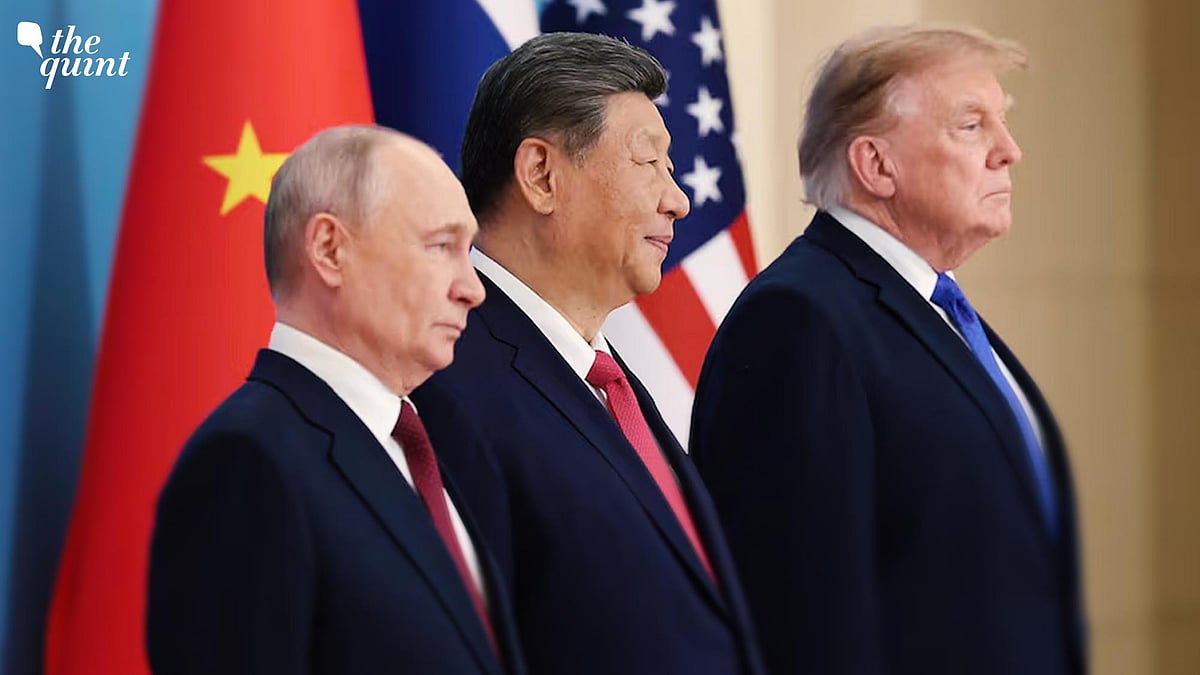
The trilateral meeting between US President Donald Trump and his Chinese and Russian counterparts—Xi Jinping and Vladimir Putin—on the margins of the Asia-Pacific Economic Cooperation (APEC) summit in Shenzhen, China on 19 November attracted worldwide attention.
Its results were not expected to be earth shattering though some in the US and Europe thought that the three leaders would seek to define spheres of influence.
An answer to that question must seek to address this query: why did Trump wish to meet his Chinese and Russian counterparts trilaterally especially when he had met them bilaterally in the past and did so again on the margins of this summit too before he met the two in a trilateral format? Indeed, Putin and Trump have now met fifty times. And, why did Putin and Xi Jinping agree to meet Trump trilaterally?
Spheres of Influence
Trump was badly mauled in the US midterm election. The Republican party has lost both the Senate and the House of Representatives by decisive margins. It was necessary for Trump to show domestically and externally that he is not only in charge of US foreign policy but can act in innovative ways—and the trilateral was certainly that—to seek answers to some pressing international issues.
He has also a penchant for staging dramatic encounters and what could be more so than a trilateral meeting with Putin and Xi Jinping? This was especially when Putin is showing no indication to end the Ukraine war and no respect for the concerns of US’s European allies.
The partnership between Xi Jinping and Putin is firm. China has been Russia’s mainstay since the beginning of the Ukraine war. It has been principally responsible for ensuring that Russia has been able to stave off the difficulties caused by the US and European sanctions on it. On its part, Russia has demonstrated no apprehensions either about China’s rising global ambitions and its actions in the South China sea and the wider Indo-Pacific region.
The two countries’ worldview is also now in sync. They are no longer willing to let the G7—and within it primarily the US—set the rules of the world order. Hence, the trilateral was a signal to the advanced world and the Global South that the consequential countries now are China and Russia along with the US.
Reluctant Peacekeepers
The three countries issued a short joint “Declaration toward Peace” after the trilateral meeting. Its opening paragraph is ironic. It notes “The three heads of state had an in-depth exchange of views on the current international situation and committed to maintaining strategic stability and international security.”
As permanent members of the United Nations Security Council (UNSC) the three countries have a special responsibility for the maintenance of international peace and security. Russia and the US have violated this responsibility by respectively undertaking the Ukraine and Iran wars.
Instead of pursuing the path of diplomacy the resort to violence was an abdication of their global duty. On its part China’s constant threats of resorting to violence to achieve its objective on Taiwan also undercuts its position as a P5 member. Thus, the commitment of the three leaders to peace is really hollow.
The three leaders committed themselves to reform the United Nations so that it “can respond more effectively to global challenges and conform to its fundamental mission of international peace and security.” This formulation indicates that the three states favour a reform of the UNSC because within the UN system it is this body which has the responsibility for maintaining international peace and security.
In any event the three will want to keep the interests of their allies in mind and this will make it difficult for them to come to an understanding. In view of these complexities prudence demands that this point in the Declaration be considered for now as meant to generate goodwill for the three powers in countries like India, which aspire for a permanent membership of the UNSC, and also generally among UN member states, rather than a priority issue for the three countries.
The second point of the Declaration reaffirmed the need for stable energy flows. These were primarily disrupted by the US's invasion of Iran even if Iran’s action to close the Strait of Hormuz be considered illegitimate. It is important that refined products are available so that fuel prices can be lowered. That is in the interests of all countries even if the Europeans would continue to be unhappy at Russia being allowed to sell its refined oil products. As it is the US is effectively not effectively trying to prevent the sale of Russian oil crude.
Why India Can Welcome the Dialogue
No major country, including India, has accepted the jurisdiction of the International Criminal Court (ICC). There was a time when the US encouraged its activities against so-called rogue leaders like Serbia’s Milasovic from behind the scenes. However, when ICC prosecutors began to spread their wings to consider the validity of some of the actions of US forces in overseas operations the US was outraged.
It was also angry that the ICC issued warrants against Israeli Prime Minister Benjamin Netanyahu. On its part Russia condemned the warrants against Putin. All in all this point of the Declaration will find greater acceptance among the major powers even if the Europeans will be upset at Putin getting another pass from Trump.
At some stage there may be a push that non-NPT states which have nuclear weapons give them up but they would know that these countries would never do so. Hence, this is a possibility about which India should have no worries but it should welcome an arms control dialogue between the three countries.
Finally, two points:
One, it remains to be seen if this meeting was one-off or will it bring about a process to further some of the points mentioned in the Declaration. At least at diplomatic levels such follow up meetings may be required. Indian diplomats would have to carefully monitor these developments for they will have a bearing on India’s interests.
Two, will this trilateral have any bearing on ending the Ukraine war? The answer to that is ‘unlikely.’ Will Russia and China press Iran to be more reasonable on the Strait of Hormuz and its nuclear stockpile? The answer to that is ‘possibly so’.
(Vivek Katju is a former Secretary [West], Ministry of External Affairs. He can be reached @VivekKatju. This is an opinion piece, and the views expressed above are the author’s own. The Quint neither endorses nor is responsible for the same.)
- Access to all paywalled content on site
- Ad-free experience across The Quint
- Early previews of our Special Projects
Published: undefined