
When SC Calls Plea on Police Brutality 'Waste of Time', Who Protects Protesters?
Should the Supreme Court have considered safeguards governing the policing of protests before the next hearing?
advertisement
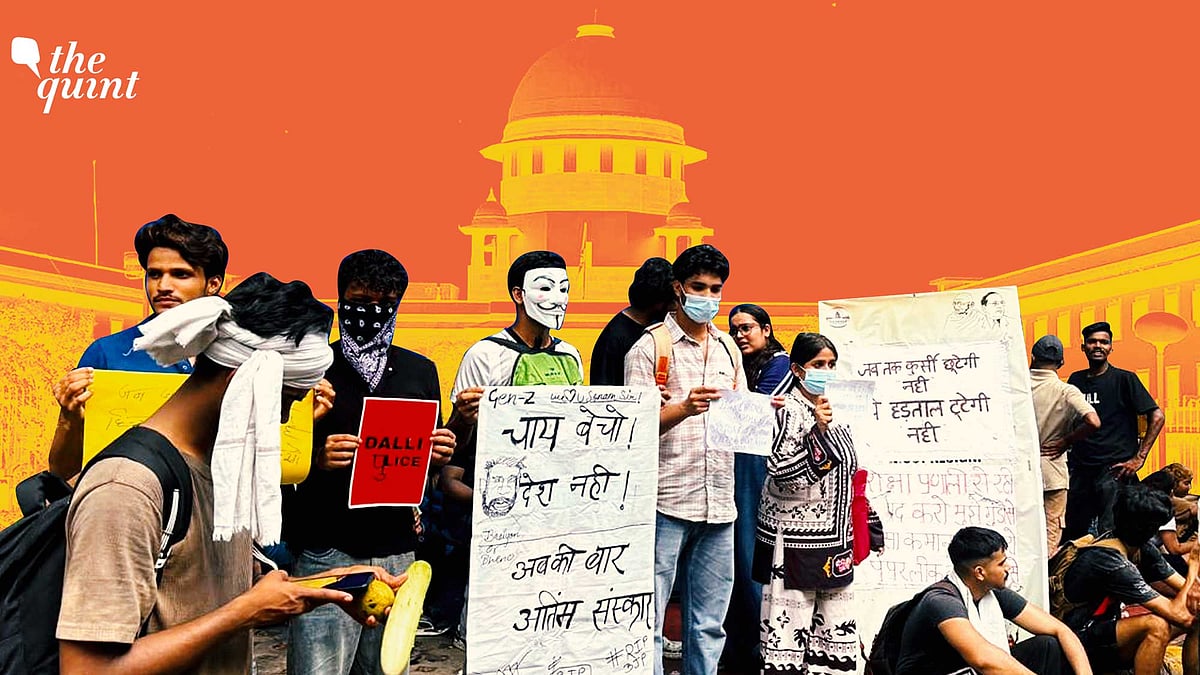
On 22 July, advocate Narendra Mishra mentioned before the Supreme Court a letter petition concerning the alleged use of excessive force by Delhi Police against students during the Cockroach Janta Party’s (CJP) “Sansad Chalo” march and sought its urgent listing.
The Chief Justice of India, Surya Kant, reportedly told him, “Don’t waste our time, and don’t waste your time.” When Mishra referred to videos allegedly showing police excess, the Chief Justice responded: “We are not interested in videos; we don’t have time to watch.”
This was an exchange during mentioning, not an adjudication on the merits. The top court made no finding on the authenticity of the recordings, the legality of the police action, or the merits of the allegations. Related petitions were pending before the Delhi High Court and were taken up later that day.
During the hearing, the Bench also questioned the State’s attempt to reduce the allegations to isolated private complaints—and referred to the availability of public-law remedies for police excess.
The preservation direction was necessary. Recordings can be overwritten, operational documents may become unavailable, and competing accounts can harden before a court reconstructs what happened.
But the protest had not ended. Students continued to assemble, and the police force accused of excessive action remained responsible for managing the gatherings that followed.
Four Weeks Not the Problem
Delhi Police has alleged stone-pelting, vandalism and injuries to its personnel. Protesters and their lawyers have alleged indiscriminate baton attacks, tear gas fired into the gathering, assaults upon women, blows against persons retreating or already on the ground, and the participation of personnel without visible identification.
These competing claims cannot responsibly be treated as established at the first hearing.
The police and the Union government are entitled to respond. Videos require authentication and context. The court could not immediately determine which protesters committed violence, which officers used force, or whether each act was necessary. The court gave the State four weeks to file its counter-affidavits. Calculated from 22 July, that period would expire on 19 August. The matter was listed for further hearing on 11 September.
The problem is not that the State received time to answer serious allegations. It is that the reported operative order contained no prospective safeguards governing the policing of subsequent protests before the next hearing.
Preservation and protection perform different constitutional functions.
That does not mean settled precedent compelled the court to impose a particular crowd-control protocol at the first hearing. Interim relief remains discretionary, particularly before the State has answered serious allegations.
The Law Was Not Silent
The Constitution does not confer an unrestricted right to march through every barricade. Parliament is a high-security institution. The State may regulate routes, enforce lawful restrictions, protect public property and arrest those committing offences. But public-order power is not legally unstructured.
Articles 19(1)(a) and 19(1)(b) protect speech and the right to assemble peaceably and without arms. Article 21 protects life, personal liberty and bodily integrity.
An assembly that ceases to be peaceful may lose the protection of Article 19(1)(b). But that does not place every person present outside Articles 14 and 21. Nor does violence by some participants release the police from the requirements of legality, necessity, and proportionality.
In Mazdoor Kisan Shakti Sangathan v Union of India, which concerned protests at Jantar Mantar, the Supreme Court recognised peaceful protest as integral to democratic participation while also acknowledging the rights of residents and other users of public space. The constitutional task is to reconcile competing rights rather than extinguish one entirely in favour of another.
The limits governing police force were made clearer in Anita Thakur v Government of Jammu and Kashmir. The Supreme Court accepted that some protesters had resorted to violence and that police intervention had become necessary. It nevertheless found constitutional excess because officers continued beating protesters after they had been overpowered and the danger had subsided.
The operational standards discussed in Anita Thakur, and the Delhi Police rules and standing orders scrutinised in In Re: Ramlila Maidan Incident, were also concrete. They contemplated progressive escalation, clear warnings where circumstances permitted, avoidance of blows to vulnerable parts, assistance to injured persons and proper recording of police action.
These operational safeguards are not necessarily freestanding constitutional commandments applicable in identical terms to every police force and every emergency. But the Supreme Court treated compliance with such standards as relevant to determining whether an operation remained lawful, necessary and proportionate.
The distinction is important.
A lawful dispersal operation is directed towards restoring order and ending the danger, violence or obstruction that justifies intervention. Punitive violence is directed towards teaching citizens a lesson. The authority to disperse is not an authority to punish.
Ramlila Maidan Asked Questions That Matter
The significance of In Re: Ramlila Maidan Incident judgment lies not merely in its affirmation of peaceful assembly. The Supreme Court examined how Delhi Police planned and executed a crowd-control operation. It considered whether adequate announcements were made, whether the gathering was given a meaningful opportunity to comply, whether the operation was properly videographed, whether minimum force was used and whether personnel continued using force when it was no longer necessary.
The court examined CCTV footage and official records, found deficiencies in compliance with the applicable standing order and identified instances in which police personnel used force when it was not called for. It also noted that tear-smoke shells should ordinarily be fired away from a crowd rather than into it, taking account of distance, wind and the physical nature of the site.
The judgment did not excuse protesters who attacked police personnel. Its constitutional lesson was more demanding: misconduct by members of a gathering does not release the State from law.
Force must remain connected to the lawful purpose of dispersal and to the violence, danger or obstruction being addressed.
Public order may justify dispersal. It cannot justify retaliation.
Constitutional Wrong or Institutional Folly?
The State argued before the High Court that persons alleging assault could file complaints and approach a magistrate. That remedy is important. Individual officers who commit criminal offences are not immune merely because they acted during a crowd-control operation.
But an individual complaint does not necessarily answer an allegation concerning the planning and command of a police operation. An individual complaint asks which officer struck which protester.
A systemic inquiry must also ask the following questions:
Who planned the deployment?
What instructions were issued?
Were warnings given?
Who authorised escalation?
Were officers identifiable?
What equipment was deployed?
Was force stopped after the danger passed?
Were injured persons given medical assistance?
Was the operation documented completely?
A constitutional wrong may be suffered individually while being produced institutionally.
This is why fragmented complaints cannot always replace scrutiny under Article 226. The alleged wrong may lie not only in the baton used by one officer, but also in the command decisions and operational conditions that permitted force to be used across a gathering.
Once the High Court recognised during the hearing that the petitions alleged something wider than isolated assaults, the continuing protest presented a prospective question as well: did the situation require temporary safeguards while the court awaited the State’s response?
The Court Did Not Need to Invent a New Code
A limited interim direction would not have required the High Court to declare the police guilty or administratively supervise every deployment from the Bench. Nor would it have prevented lawful action against protesters who engaged in violence.
The continuing circumstances could, however, have led the court to consider whether standards already recognised as relevant to lawful crowd control required temporary, situation-specific directions.
Injured protesters and officers should receive prompt medical assistance. Official videography should record warnings, crowd conduct and police action alike.
Where persons in civilian clothing were alleged to have used force, the State could have been required to disclose whether they were authorised personnel, under whose command they acted and how responsibility for their conduct could be determined.
The issue is not that every officer performing a lawful function in plain clothes necessarily acts illegally. Nor does the absence of a visible nameplate automatically decide the legality of an entire operation.
Such directions would not have decided the truth of the allegations concerning 20 July. They would have placed the next exercise of State force within standards already treated by constitutional courts as relevant to legality and proportionality.
Evidence Must Work in Both Directions
The High Court’s preservation order is also significant because of an evidentiary asymmetry. Delhi Police has reportedly used extensive video footage to identify protesters suspected of violence and vandalism. That is a legitimate investigative function, subject to law.
What would be difficult to defend is a system in which visual evidence becomes an effective investigative tool when it implicates citizens but is treated principally as unreliable online material when it appears to implicate State officials. Videos are not self-proving. But neither should their evidentiary value depend upon whom they appear to incriminate.
Indian courts have previously examined recordings precisely because official and protester accounts conflicted.
In Medha Patkar vs State of Madhya Pradesh, the Madhya Pradesh High Court examined recordings produced by both sides, rejected important elements of the official account concerning the arrests, and held that the resulting arrests and detention violated Articles 19 and 21.
The case illustrates that visual evidence is neither conclusive by itself nor irrelevant merely because it contradicts the State’s account.
Much of the potentially decisive official evidence in the present controversy—official CCTV footage, police videography, deployment records and command communications—is held or controlled by the police and other public authorities.
The issue is not that the police can never retain custody of official records. It is that preservation must be independently verifiable.
An inventory identifying the recordings available, the periods covered, their custodians and any missing material would have made the High Court’s direction more effective. Videos are not a substitute for adjudication. Neither are official affidavits.
Judicial Language Also Matters
The Supreme Court was not obliged to examine disputed recordings during mentioning. It could reasonably have declined urgent listing or directed counsel to the Delhi High Court, where related petitions were already pending.
But that procedural result could have been communicated without language that risked conveying that an allegation of violence by State officials was unworthy of judicial time.
Constitutional courts are not encountered only through their final judgments. Citizens also encounter them through the seriousness with which claims of injury are received.
The Supreme Court Bar Association and the Supreme Court Advocates-on-Record Association called for an independent inquiry and stressed restraint, accountability, and the protection of constitutional rights. Their resolutions do not establish police guilt. They do, however, show that leading bodies within the legal profession considered the allegations sufficiently serious to require independent scrutiny.
The question is not whether judges must agree with protesters or respond emotionally to every disturbing recording.
It is whether citizens alleging violence by armed agents of the State leave a constitutional court understanding that urgent intervention was procedurally unavailable—or believing that their injury itself was unworthy of attention.
Is Preserving the Evidence Enough?
The Delhi High Court was right to preserve the records and seek the State’s response. Those directions protected the possibility of later accountability, but left unresolved the distinct question of protection before the next hearing.
The judicial responsibility is narrower but indispensable: whatever citizens demand, and however difficult a gathering becomes to manage, the State must police them constitutionally.
The question is therefore not why the High Court failed to invent new law. It is whether the continuing protest should have led the Court to consider limited protective directions grounded in the law already declared.
A Constitution is not tested only by whether courts can later determine that force crossed legal limits. It is also tested by whether those limits are made effective while citizens remain exposed to State power.
The footage of 20 July should remain preserved when the matter returns to Court on 11 September.
Must students return with another set of videos before constitutional courts translate the law already declared into protection for the next protest?
(Sahil Hussain Choudhury is an advocate and constitutional law researcher based in New Delhi. This is an opinion piece and the views expressed are personal. The Quint does not endorse or is responsible for them.)
- Access to all paywalled content on site
- Ad-free experience across The Quint
- Early previews of our Special Projects
Published: undefined