
Ken-Betwa to CJP Protests: What Remains of the Right to Dissent in India?
Dissenting against the government, in many ways, is the real test of a democracy.
advertisement
George Orwell’s 1984 demonstrates how parties in power disillusion their people, often by rejecting or ignoring the evidence of dissent, or performing accountability, selectively.
Ideally, the government is expected to respond to the dissatisfactions of its people by initiating a dialogue with the stakeholders. The government, however, continues to either ignore or suppress people’s right to dissent or disagree with its policies and actions.
From Delhi to Assam
The Bharatiya Janata Party (BJP)-led government, at both the Centre and several states across the country, has consciously suppressed dissent across ranks.
As thousands swelled up at New Delhi's Jantar Mantar to stage a protest this week, Abhijeet Dipke, the founder of the Cockroach Janata Party (CJP), accused the Delhi Police of restricting access to water, food, and washrooms to the protesters. Aishe Ghosh, former President of the Jawaharlal Nehru University Student Union, also filed a petition before the Delhi High Court, arguing that the Delhi Police have been taking photos and videos of protestors, thereby creating an "intimidating" atmosphere.
The arrest and detention of five indigenous human rights defenders—Pranab Doley, Rajib Pegu, Brijit Kutum, Amit Nag and Bhaskar Saikia—in Assam a few days ago is one of many such instances. Doley and others have been protesting against the acquisition of tribal lands for building luxury hotels and resorts near the Kaziranga National Park.
A file photo of Pranab Doley.
(Photo: The Quint)
Condemning such arrests, a group of UN experts called it "a danger to civic spaces", adding that such actions can discourage others from questioning abuse. A question that lingers on is whether the people in India have the freedom to express their disagreements with state policies, to question the government’s action or inactions, and to demand accountability.
In 2014, the BJP had returned to power on the back of the anti-incumbency movement, launched by Anna Hazare and allegedly orchestrated by the Rashtriya Swayamsevak Sangh (RSS) and the BJP, that invoked the same democratic rights which the party and its allies have since continued to suppress and, in many instances, criminalise.
Suppression Dressed as Accountability
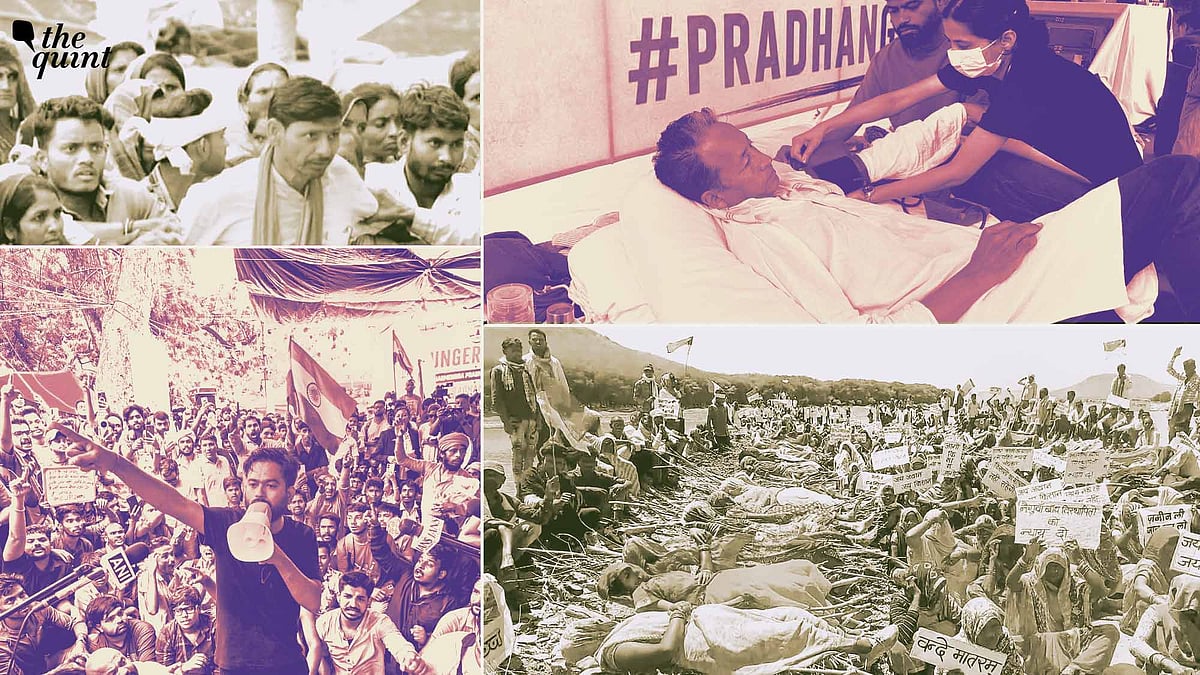
There have been several instances where the BJP and its allies have actively dismantled democratic dissent in India. From the anti-Citizenship Amendment Act (CAA) protests, farmers’ protests, Manipur protests, and wrestlers’ protests to the ongoing protests against the NEET paper leak, student suicides, and other issues related to the Indian education system, the government has left no stone unturned to crush it all.
Other than outrightly cancelling or ignoring dissent, the government has also often resorted to performative accountability.
The ongoing protests by the tribal and farmer communities against the Ken-Betwa Link Project in Madhya Pradesh’s Bundelkhand region is a recent testament to such performance. The project has raised significant ecological concerns and forced displacement of the affected tribal families who have been protesting since April 2026 regarding their rehabilitation and fair compensation.
The protestors in Madhya Pradesh resumed their protests in July, demanding fair compensation and relief packages. The government, yet again, resorted to its usual strategies—filing false cases, carrying out illegal evictions and power outages, demolishing schools to create fear amongst the people. On 19 July, the MP Police then forcefully removed the protestors and dismantled the protest site, citing safety reasons.
More than 150 protestors, including Amit Bhatnagar who was leading the protests, were detained. Most of these protestors are homeless, stranded, their houses demolished, and are left without proper rehabilitation and compensation. Whose ‘safety’ would have been at stake with their protest?
A file photo of protests against the Ken-Betwa river linking project.
(Photo: Rashmi Mishra)
Back in the national capital, the Delhi Police on 18 July forcefully removed Sonam Wangchuk from the protest site on the pretext of providing essential medical care. The police claim their action was in compliance with the order of the Delhi High Court, which had directed regular monitoring of the medical condition of Wangchuk and, if required, to take necessary medical intervention.
Did Wangchuk need such ‘necessary medical intervention' that required his forced removal from the protest site?
On 19 July, Wangchuk’s wife Gitanjali Angmo moved the Delhi High Court, accusing the Safdurjung Hospital of not being transparent in their treatment of Wangchuk and seeking his transfer to a hospital of their choice. She also alleged that Wangchuk is being held in illegal detention at the Safdurjung Hospital. The Delhi High Court, however, refused to grant any relief.
Force Dressed as 'Accountability'
These instances, to be sure, are not the least or only cases of the BJP using state machinery and brute force to quell dissent. The wrestlers' protest demanding justice for sexual violence saw a similar end in May 2023 when protesters were forcibly detained by the Delhi Police, allegedy for creating a "riot-like situation".
A file photo of the wrestlers' protest in New Delhi.
(Photo: PTI)
During the anti-CAA protests of December 2019, which eventually culminated in several arrests, the Delhi Police stormed the Jamia Millia Islamia campus, allegedly assaulting students and detaining several in the name of curbing "violent" and "stone-pelting mob" that had taken shelter on the university grounds.
Dissenting against the government, in many ways, is the real test of a democracy, and using unlawful force to dismantle disagreements brings us a step closer to an authoritarian rule. A government that refuses its people their own narrative in order to retain power creates a totalitarian system where justice and progress often takes a backseat.
(Abhinandita Biswas and Ashwani Kumar Singh are Assistant Professors (Law) at Vinayaka Mission's Law School, VMRF(DU), Chennai. This is an opinion piece and the views expressed are the author's own The Quint does not endorse or is responsible for them.)
- Access to all paywalled content on site
- Ad-free experience across The Quint
- Early previews of our Special Projects
Published: undefined