
'We Were Hoping India Will Accept...': Voices From Bangladesh Amid Fresh Turmoil
The murder of Sharif Osman Hadi has exposed the fault lines between Delhi and Dhaka yet again, stakeholders say.
advertisement
The flames ignited by the death on 18 December of Sharif Osman Hadi, convener of the Dhaka-based Inquilab Mancha and a prominent student leader, have engulfed the fabric of India-Bangladesh ties over the last few days.
Tensions were further compounded by the lynching of a Hindu man named Dipu Chandra Das in the country's Mymensingh earlier this week for alleged blasphemy, and the gunning down of yet another student leader, Motaleb Sikder of the National Citizen Party (NCP), on Monday, 22 December.
Amid the spate of political violence ahead of the February 2026 elections, a number of Bangladeshi stakeholders have raised allegations of India's backing of the attackers, who they say are from Sheikh Hasina's Awami League. However, there are several measured voices as well which have called for caution and the toning down of venomous rhetoric between New Delhi and Dhaka.
'We Reject Foreign Interference'
Fahim Abdullah was one of Hadi's closest associates at the Inquilab Mancha. The 23-year-old, who holds the post of the organisation's Publication Secretary, claims that the student leader's killing was carried out at the behest of "actors" who do not want the 2026 elections to take place.
"These are forces both inside and outside the country," he says while speaking to The Quint. "Hadi himself was a potential candidate in the polls, and eliminating him could help delay or destabilise the electoral process."
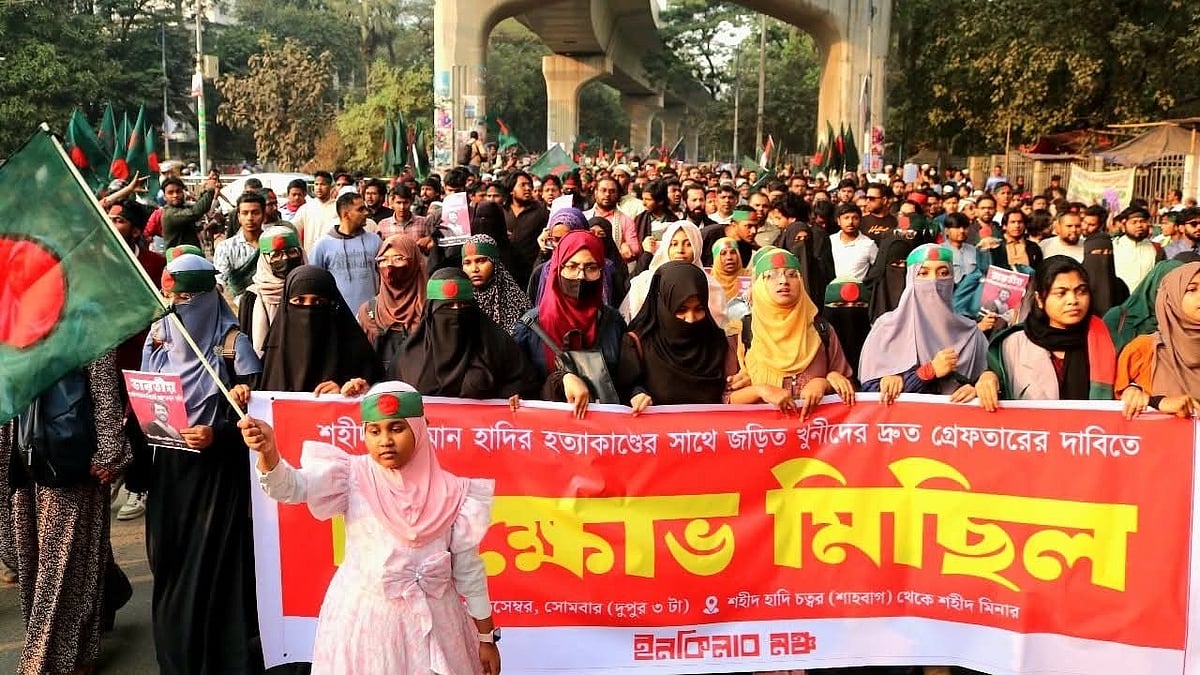
Protests being held in Dhaka on Monday, 22 December, against the killing of Sharif Osman Hadi.
(Photo: Accessed by The Quint)
"We reject interference from any foreign country. If you look at the past 15 years of Hasina's rule, India's role has become very clear," he alleges.
Abdullah's view isn't an isolated one.
Shafkat Mahmood (name changed on request), a senior leader of the NCP, says that anti-India sentiment is on the rise in Bangladesh—and Hadi's killing has only accelerated its spread.
The student leader says that due to its unwavering support towards the Awami League over the years, India has become a "casualty" in the opposition towards her rule.
"We were hoping that India will accept the new reality of Bangladesh and reorient its approach towards us. Earlier, people-to-people ties were limited only between India and the Awami League," he says, adding:
"It is widely believed that because India supported Hasina, her government was able to rule with an iron hand."
The opposition towards India played out in several forms over the last few days, incuding miscreants hurling stones at the Assistant Indian High Commissioner's residence in Chattogram on Thursday, 18 December.
Statements issued by some youth leaders also inflamed the situation. For instance, local media quoted NCP leader Sarjis Alam as alleging that Hadi's assassins had fled to neighbouring India.
"Until India returns assassins of Hadi bhai, the Indian High Commission in Bangladesh will remain closed. Now or Never. We are at war," he purportedly said during a press briefing.
However, notwithstanding their opposition towards India, the Inquilab Mancha and other sections of the NCP say that they do not support the vandalism which took place—indicating that even within political platforms, there are voices at odds with each other.
Mushfiq Us Salehin, Joint Member Secretary of the NCP, tells The Quint,
'Hindus Living in Environment of Fear'
Other sections of Bangladeshi society allege that because of the rise of extremist forces like the Jamaat-e-Islami (JeI), minorities have been feeling insecure now more than ever.
"There's no doubt that Bangladeshi Hindus have been living in an environment of fear," a Dhaka-based journalist tells The Quint, requesting anonymity.
He says that Hindus are increasingly being targeted for a variety of reasons.
Pinak Ranjan Chakravarty, former Indian High Commissioner to Bangladesh, agrees. He says that the prevailing situation in Bangladesh has "cast a shadow" over bilateral ties.
"Current Bangladeshi politics has been hijacked by the pro-Pakistani Jamaat-e-Islami and other Islamist outfits with encouragment and help from external actors. They are stoking anti-India sentiments to serve Pakistan's agenda and deflect attention from poor governance and breakdown in law and order," he tells The Quint.
According to a number of opinion polls, the JeI's influence, which had been stemmed to a great extent during Hasina's tenure, has been on a steady rise in Bangladesh over the last few months.
A survey conducted by the US-based International Republican Institute this month stated that 53 percent of Bangladeshis had a favourable opinion of the JeI and 30 percent of the Khaleda Zia-led Bangladesh Nationalist Party (BNP), another bitter India critic.
Further, a recent opinion poll by the Prothom Alo newspaper stated that 66 percent of respondents felt that the BNP would win the highest number of seats in the 2026 elections. The JeI ranked second, with 26 percent in their corner.
"India continues to make mistakes in Bangladesh. After putting all its eggs in the Awami League’s basket for long, it has been slow to recalibrate its policy towards Bangladesh. India stays in denial that a revolution took place in that country, with suggestions that it was just regime-change," opines senior journalist Bharat Bhushan in an article for The Quint.
However, not all are in agreement that the interim government, led by Muhammad Yunus, is ceding space to extremists.
"There's no question of extremist forces directing the government," a senior NCP leader said while speaking to The Quint. "The interim government's formation is such that there are several stakeholders. This ensures an automatic balance. Also, given Dr Yunus' track record, he will certainly not endorse any extremist thought."
He, however, conceded that there are some reactionary political stakeholders spewing malicious statements, and attributed the rise of such forces in the mainstream discourse to the rise of the Bharatiya Janata Party (BJP) in India.
'Far Easier To Target Hindus As...'
Meanwhile, The Quint spoke to a number of Indians and members of the minority Hindu community living in Bangladesh regarding their fears after the lynching of Dipu Chandra Das last week.
While some say that they do not fear for their personal safety, they argue that an atmosphere of gloom has been created because of the happenings of the last few days.
"I don't fear for my life here, but neither do I see a positive future for myself in this country," says Jatin (name changed on request), a Bangladeshi Hindu living in Dhaka.
Jatin says that while the recent attacks weren't particularly targeted against Hindus as such, the community is far more vulnerable than other sections of society.
Sahil (name changed on request), an Indian student pursuing BTech in Dhaka, agrees.
"While we do feel safe in the capital, there's always this fear hovering over us that until a proper government comes to power, this lack of stability will continue," he tells The Quint.
Sahil also drew paralells to the recent dispute between India and the Maldives, where the Mohamed Muizzu government won a thumping majority in 2023 on the basis of his 'India Out' election plank.
Meanwhile, several members of the West Bengal BJP, led by Leader of the Opposition in the state Assembly Suvendu Adhikari, held protests in front of the Bangladesh Deputy High Commission in Kolkata on Monday, 22 December, against Das' lynching.
Suvendu Adhikari and other BJP leaders staging a protest outside the Bangladesh Deputy High Commission in Kolkata on Monday, 22 December.
(Photo: PTI)
Protests were also held by members of the Vishwa Hindu Parishad and Bajrang Dal in front of the Bangladesh High Commission in New Delhi on Tuesday, 23 December.
Police officials stop VHP and Bajrang Dal members during a protest outside the Bangladesh High Commission on 23 December.
(Photo: PTI)
In the wake of the attacks, the governments of both India and Bangladesh exchanged terse public statements, calling for the safety and security of diplomatic staff stationed in their respective countries.
Taking to social media, India's Ministry of External Affairs (MEA) on 21 December slammed what it called "misleading propaganda" in sections of Bangladeshi media regarding an alleged protest held in front of the country's High Commission in New Delhi.
MEA spokesperson Randhir Jaiswal denied reports that there had been a breach of security or threats against the staff, adding that only a small group of people had assembled in front of the mission.
"There was no attempt to breach the fence or create a security situation at any time. The police stationed at the spot dispersed the group after a few minutes. Visual evidence of these events is available publicly for all to see," he said.
Hours later, Bangladesh's Ministry of Foreign Affairs (MFA) put out a statement rejecting New Delhi's claim of "misleading propaganda"
"The miscreants were allowed to carry out their activities right outside the perimeter of the High Commission, creating panic among the personnel inside the complex," the statement read.
Meanwhile, in a tit-for-tat move, Bangladesh on Monday, 22 December announced the temporary suspension of all consular and visa services at its High Commission in New Delhi and other locations in India. This decision came a day after India suspended visa operations at its Visa Application Centre in Chittagong, citing security concerns.
- Access to all paywalled content on site
- Ad-free experience across The Quint
- Early previews of our Special Projects
Published: undefined