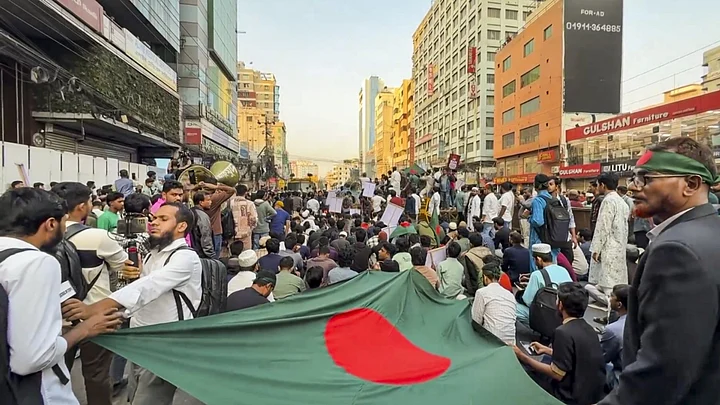
The political situation in Bangladesh is increasingly unpredictable as some are using the violence following the assassination of youth leader Sharif Osman Hadi as an argument to stall the general election due in February 2026.
Protestors near Dhaka’s famous Shahbagh intersection called for the formation of a “revolutionary government”. Bangladeshi political observers feel that resurgent Islamist forces in the country do not want an election, arguing that the country needs to be “repaired” before elections are held.
This development underscores the fragility of Bangladesh’s interim government and the potential for escalation of the ongoing political unrest.
Echoes of the Rise of Muslim Brotherhood
Observers believe that this resembles the pattern of agitation by which the Muslim Brotherhood rose to power in Egypt and later in Sudan, ideologically sponsored by Turkey and financially backed by Qatar. Their influence was countered in both countries by Saudi Arabia and the UAE.
How plausible is it that Turkey and Qatar may be facilitating the rise of Islamist forces in Bangladesh? Or is this merely the argument of regional rivals—India, Saudi Arabia and the UAE? What are the dots that observers seem to be connecting?
One of the most trenchant critics of Sheikh Hasina and her Awami League was Mahmudur Rahman, editor of Amar Desh newspaper. After persecution under Hasina, he spent five years exiled in Turkey and Malaysia and returned to a hero’s welcome in 2024. He has come to represent the core ideological voice of the Islamist forces in Bangladesh but has no party organisation behind him.
He has restarted the publication of Amar Desh and addressed the gathering at Hadi’s funeral. He may be likely, some say, to head the so-called “revolutionary government” should it indeed be formed. Yunus in the event could be kicked upstairs as President. This may come to pass if the Yunus government is unable to control the ongoing political protests.
The post-Hasina transition period has opened new avenues for Turkey’s outreach. It is setting up defence industrial complexes for Bangladesh at Chittagong and Narayanganj, signalling deeper strategic engagement.
In addition, reports suggest that Turkey is also working with Jamaat-e-Islami to boost Islamist influence and with Pakistan’s agencies to undermine India’s strategic interests. Turkey has also become the favoured destination of anti-Hasina critics—the latest being social media influencer and activist Pinaki Bhattacharya who was in exile in France but has now moved to Turkey.
Qatar’s role appears more indirect so far, following from a broader Organisation of the Islamic Cooperation (OIC) diplomacy and solidarity. Its financial and media networks have tended to amplify Islamist narratives across South Asia. However, its support for Islamist movements in Egypt and Sudan raises suspicions that it could play a similar role in Bangladesh.
Elections in the Crosshair as Yunus Govt Balks
The interim government of Muhammad Yunus has not openly endorsed Islamist politics but its entire structure rests on youth activists, many of whom have strong Islamist views. Also, the political vacuum which emerged after Hasina’s ouster created an unprecedented opportunity for the Islamist groups to mobilise and expand.
What is evident, however, is that Islamist forces in Bangladesh want to destroy its liberal and pluralist image.
This is evident from the arson targeting two of the most influential liberal newspapers—The Daily Star and Prothom Alo—and the offices of old cultural organisations like Chayanaut (it pre-dates the creation of Bangladesh) and Udichi Shilpigosthi. They are seen as symbols of secular, progressive and anti-communal values and had nothing to do with Hadi’s death. The idea was to strike at the heart of Bangladesh’s secular identity and intimidate civil society.
The Jamaat-e-Islami has benefited the most from the ongoing instability as a settled elected government could impose institutional checks on it, limiting street-level mobilisation.
As it is, the absence of the Awami League from the proposed elections of February 2026 has provided the Jamaat unusual visibility with mass rallies and polls showing it second only to the Bangladesh Nationalist Party (BNP).
Opinion polls show that Islamist influence in the public is growing in Bangladesh. A survey by the International Republican Institute in December this year found that 53 percent of Bangladeshi hold a favourable view of Jamaat-e-Islami compared to 30 percent for the BNP. That there is a historical cultural receptivity for Islamicist politics is also indicated by a 2013 Pew Research survey which found that 82 percent of Bangladeshi Muslims supported making Sharia the official law.
Whether this receptivity to Islamist ideology makes way for electoral gains depends on how well the BNP and other secular parties mobilise themselves in the run-up to the elections. The latest opinion poll by Prothom Alo published on 9 December showed that 66 percent of the respondents thought that the BNP would win the most seats in the February 2026 election. The Jamaat ranked second, with 26 percent saying that the country would fare better under Jamaat, showing unprecedented traction for the Islamicist party.
What might change the atmosphere in favour of the BNP is the return of Begum Khalida Zia’s son Tarique Rahman to Bangladesh from political exile in the UK on 25 December. Rahman, the acting chairperson of the BNP, is widely seen as the party’s prime ministerial candidate. His presence in the country is likely to energise BNP cadres, unifying them around a single leader.
India Needs to Read the Signs
India continues to make mistakes in Bangladesh. After putting all its eggs in the Awami League’s basket for long, it has been slow to recalibrate its policy towards Bangladesh. India stays in denial that a revolution took place in that country, with suggestions that it was just regime-change.
India also continues to carry the negative baggage of the much-hated Awami league regime and Sheikh Hasina, who is currently sheltered in India. While Bangladeshis might even understand India giving asylum to an old friend, it is beyond their comprehension why more than 1,200 Awami League leaders are in Kolkata, directing the protests by their cadres in Bangladesh.
India also seems to be underestimating the growing Islamist influence in Bangladesh as evidenced in the anti-India slogans being raised in mass rallies and being projected as the enemy of Bangladesh’s “Islamic identity”. Attacks on India’s consular offices in Bangladesh and threats by Bangladeshi politicians like Hasnat Abdullah of “isolating India’s northeastern states” underline how public diplomacy has been abandoned by India in Bangladesh’s transition period.
Today India stands isolated and lacking grassroots goodwill in Bangladesh. India’s reactive rather than proactive engagement and its inability to control its Bangladesh narrative, shaped in the public domain by retired diplomats caught in a time-warp, may ultimately result in high strategic costs.
(The writer is a senior journalist based in Delhi. This is an opinion piece and the views expressed are the author’s own. The Quint neither endorses nor is responsible for them.)