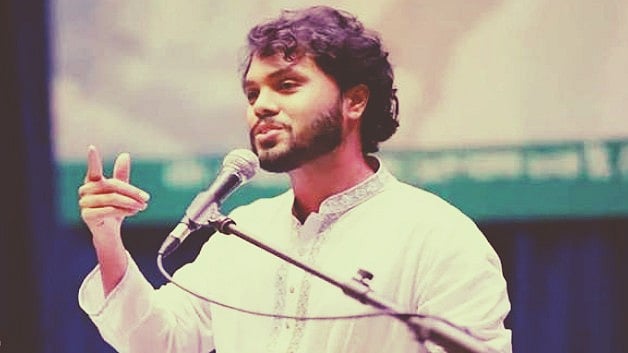
'Face of Bangladesh Uprising': Who Was Slain Youth Leader Sharif Osman Hadi?
Hadi was a spokesperson for the Inqilab Mancha that emerged from student-led protests in Bangladesh in July 2024.
advertisement
Sharif Osman Hadi, a prominent leader of the July Uprising in Bangladesh, died on 18 December 2025, after being shot by unidentified assailants on 12 December. His death has triggered significant unrest across the country, with protests erupting in various cities, particularly in Dhaka.
Hadi was a spokesperson for the Inqilab Mancha, a political platform that emerged from the student-led protests in July 2024, which ultimately led to the ousting of former Prime Minister Sheikh Hasina. His activism and leadership during this period made him a significant figure in Bangladeshi politics, as reported by Deccan Herald.
Following his shooting, Hadi was initially treated at Dhaka Medical College Hospital before being airlifted to Singapore for advanced medical care. Unfortunately, he succumbed to his injuries after six days in intensive care, prompting widespread mourning and protests, as outlined in the report by The Hindu.
In the wake of Hadi's death, protests erupted in Dhaka, with supporters demanding justice and accountability for the attack that claimed his life. Demonstrators accused the government of failing to protect Hadi and called for the arrest of his assailants, as reported earlier by Indian Express.
Hadi's political career began in his hometown of Nalchity, Jhalakathi, where he was born to a madrasa teacher. He later studied Political Science at Dhaka University and became a lecturer at the University of Scholars. His activism was marked by a strong opposition to the Awami League and its policies, which he believed were detrimental to the democratic process in Bangladesh, the publication said in its report.
His role in the July Uprising was pivotal, as he helped organise protests and articulate the demands of student groups. The Inqilab Mancha, under his leadership, gained significant influence and challenged the political status quo, as noted in the report by Deccan Herald.
In the aftermath of his death, the interim government declared a day of mourning, with national flags flown at half-mast. Chief Adviser Yunus promised that the perpetrators would be brought to justice, stating, “We will not show any leniency towards the perpetrators of this heinous crime,” as the report noted.
Protests intensified, with demonstrators vandalising media offices, including those of Prothom Alo and Daily Star, in response to Hadi's death. The unrest has raised concerns about the stability of the interim government and the upcoming elections scheduled for February 2026, according to the report further said.
Hadi's death has also sparked anti-India sentiments, with some protesters alleging that his assailants fled to India after the attack. This has led to calls for the closure of the Indian High Commission in Dhaka until the suspects are returned, as stated in the report by The Hindu.
As Bangladesh navigates this turbulent period, the legacy of Sharif Osman Hadi as a leader and activist will likely continue to influence the political landscape. His commitment to democratic values and social justice has resonated with many, and his untimely death has become a rallying point for those seeking change in the country, the publication reiterated.
Note: This article is produced using AI-assisted tools and is based on publicly available information. It has been reviewed by The Quint's editorial team before publishing.