'As a Mother Fighting for Clean Air, I Took Delhi's Pollution Crisis to COP31'
From Delhi to COP31, mothers are demanding climate action that puts kids's health first, writes Bhavreen Kandhari.
advertisement
The Quint is telling the full story of how climate change is reshaping lives. Help us do more. Become a member.
I left Delhi on the morning of Diwali, 8 November, with a head full of questions and a rather heavy heart. The city was celebrating, but for those of us who have spent years campaigning for clean air, there was little to celebrate.
We were once again watching pollution readings, tracking monitoring stations going silent, questioning discrepancies in air quality data, and wondering what Delhi-NCR's children would face in the days ahead.
There were familiar television debates, competing claims and official assurances. But behind all the numbers was a question that wouldn't go away: were we even measuring the full extent of what people were breathing?
As I boarded my flight to Antalya, Türkiye, for COP31 as part of the global parent delegation with Our Kids' Climate (OKC), I wondered how I would explain Delhi's reality to mothers from other parts of the world. I did not have to explain much.
But in Delhi, even something as fundamental as breathing has become a daily concern. Summers bring relentless heat; winters bring toxic air. Pregnant women, newborns, and children are left negotiating conditions they did little to create and cannot escape.
'Mothers Who Needed No Explanation'
In Antalya, I joined mothers from Australia, Brazil, Indonesia, South Africa, the UK, and the US. We came from different countries, cultures, and circumstances, yet our anxieties were remarkably similar.
We were not climate negotiators or government representatives.
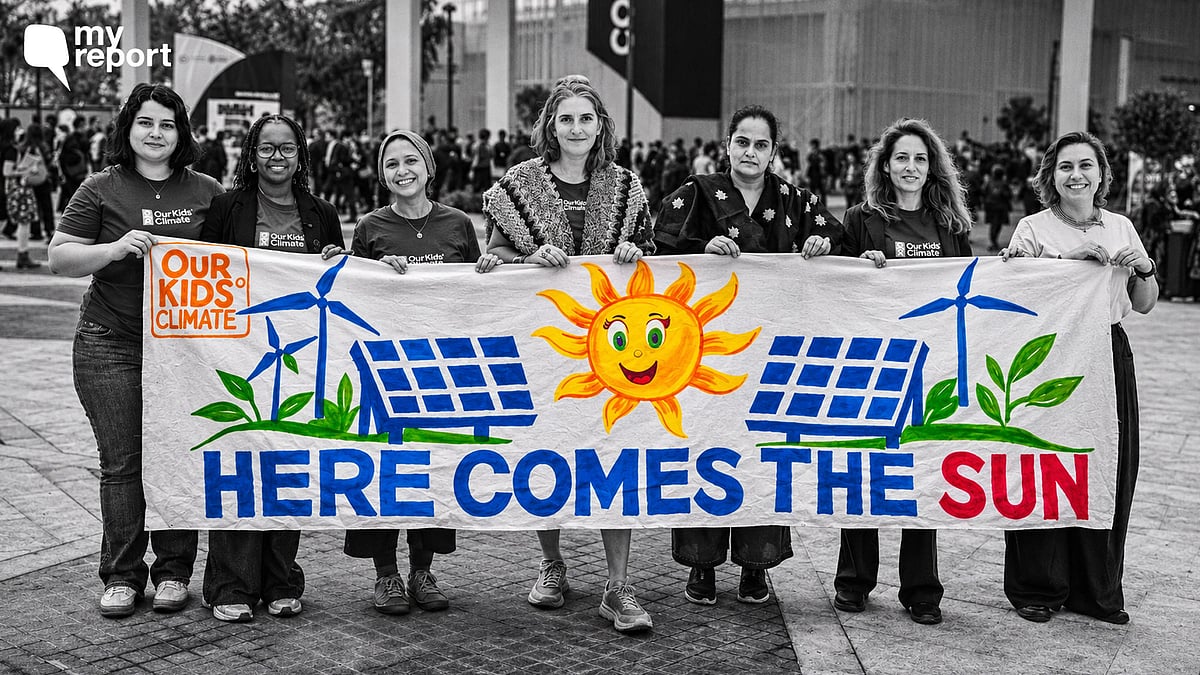
Mothers from seven countries marched at COP31 in Antalya, calling for climate action to protect children's health.
(Photo Courtesy: Bhavreen Kandhari)
Chloe Watfern from Australia spoke about being pregnant during the catastrophic "Black Summer" bushfires. The uncertainty of carrying a child while surrounded by smoke and extreme conditions is an experience that stays with a mother.
Xoli Fuyani from South Africa spoke about polluted playgrounds and how children in marginalised communities face greater exposure to air pollution than those in more affluent neighbourhoods.
Maya Mailer from the UK described how parents had mobilised around heatwaves and children's health, and spoke of the unimaginable, unbearable heatwave London witnessed this year. Catarina Nefertari from Brazil brought the voices of Amazon communities and the connection between forest protection and the air we breathe.
Members of the mothers' delegation addressing the media at a press conference during COP31 in Antalya, Türkiye.
(Photo Courtesy: Bhavreen Kandhari)
'A Movement Built Over Successive COPs'
This solidarity did not begin at COP31. It has been building over several climate summits.
At COP26 in Glasgow in 2021, mothers delivered a letter signed by 488 parent groups from 44 countries to the then COP26 President, calling for an end to the financing of new fossil fuels.
Among those leading the delegation was a mother whose daughter died following severe asthma linked to air pollution. The sound of a child having an asthma attack was played in the room. It was not an abstract climate argument. It was a child's struggle to breathe.
At the UN's Stockholm+50 environment meeting in 2022, mothers met the COP26 President again, alongside a senior WHO health expert, to demand that children's health and rights be placed at the centre of climate negotiations.
At COP27, the message became "put children first". At COP28 in Dubai, I stood alongside a mother from the Solomon Islands who travelled to the summit while pregnant with her fifth child, her community facing rising seas. COP28 finally included an explicit call to transition away from fossil fuels, something parents had demanded for years.
Mothers from across the world participated in a march at COP31, demanding a healthier and safer future for children.
(Photo Courtesy: Bhavreen Kandhari)
Now, at COP31, the conversation has moved towards recognising climate change as a maternal, newborn and child health crisis. The OKC delegation of mothers from seven countries called for a rapid and just transition to clean, renewable energy.
A senior WHO health expert and the UN Special Rapporteur on the human right to a healthy environment stood with us, reinforcing that clean air and a healthy environment are fundamental human rights, especially for our children.
'Heat, Air And The Health Of Mothers And Children'
The science is increasingly difficult to ignore. Climate change doubled the number of dangerously hot days for pregnant women in 90 percent of countries between 2020 and 2024.
A recent study associated a single heatwave with more than 10,000 additional preterm births across India, Bangladesh and the Philippines.
For India, the intersection of heat and air pollution is particularly urgent. We are a country where millions of women experience extreme temperatures, work outdoors, live in poorly ventilated homes and are exposed to polluted ambient and household air.
A pregnant woman does not experience a heatwave in one compartment and air pollution in another. She experiences both while trying to protect herself and the child she is carrying.
We have heat action plans on one side and air pollution action plans on the other, but where is the integrated approach that recognises the combined risks to pregnant women, newborns and children? We cannot keep treating maternal and child health as an afterthought in climate policy.
'A COP That Ended Without An Agreement'
As we stood outside the negotiating rooms at COP31 making this appeal, the talks moved in a deeply uncertain direction. The first draft had called for accelerated action to phase out fossil fuels. The revised draft removed every explicit reference to them, including the COP28 commitment to transition away from them.
It also dropped the $120 billion annual adaptation finance target for 2035 that developing countries had sought. The revised text kept a call to at least triple adaptation finance by 2035, but set no clear baseline to measure progress.
References to gender and some provisions on climate-related health impacts were also weakened or removed.
We cannot tell pregnant women to protect themselves from extreme heat while deferring the transition away from the fuels driving climate change. We cannot speak of protecting children's lungs while weakening commitments on the sources of air pollution.
And we cannot ask vulnerable communities to adapt indefinitely without ensuring that the finance reaches them.
India's demand for climate justice, predictable finance, technology transfer and recognition of historical responsibility is legitimate. Developing countries cannot be expected to shoulder an unequal burden for a crisis they did not create.
But climate justice must also mean protection for people at home. We cannot speak of energy security and development without asking what our energy choices cost our health.
The proposed global electrification target of 35 percent of final energy consumption by 2035 shows why.
Back In Delhi: Data Gaps and Opaque Reporting
On 19 November, while we were still in Antalya, Union Environment Minister Bhupender Yadav virtually reviewed Delhi-NCR's pollution situation and directed civic bodies to strengthen enforcement and adopt zero tolerance towards open burning.
These are necessary directions. But Delhi has heard many directions over the years. The real test is whether they translate into sustained action on the ground.
What struck us was the timing. The Indian Express later found that 45 of the city's 59 monitoring stations had missing hourly readings for at least one pollutant on Diwali night.
There is another thought I carry back from Antalya. Our children may never know what was negotiated in those conference halls. They will, however, live with the consequences.
(All 'My Report' branded stories are submitted by citizen journalists to The Quint. Though The Quint inquires into the claims/allegations from all parties before publishing, the report and the views expressed above are the citizen journalist's own. The Quint neither endorses nor is responsible for the same.)