
'Online Classes Can't Replace Real Learning. They Only Add Strain on Families'
What began as an emergency response during the COVID pandemic has now become the norm, writes a Noida-based mother.
advertisement
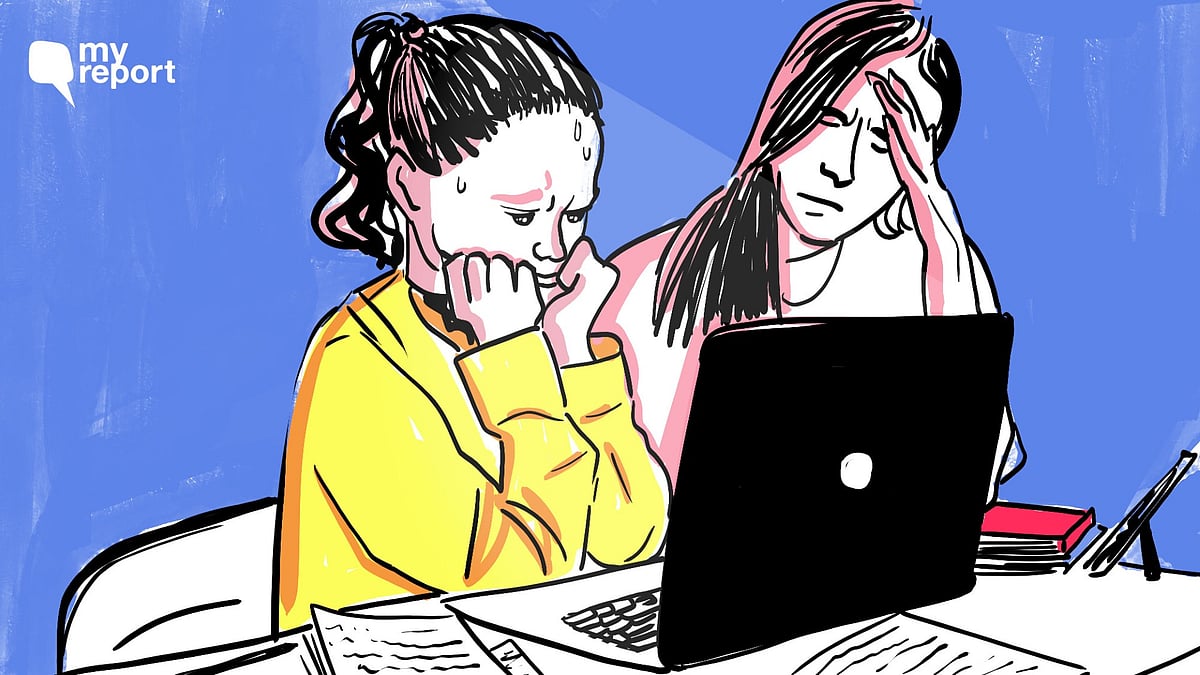
As a Noida-based parent, mother of two, and a child-counselling psychologist, I cannot begin to list the detrimental effects that prolonged and repeated online schooling has had on children and families alike.
Schools in Noida reopened for physical classes on 19 January. But the larger issue remains unresolved: online schooling has quietly become a convenient fallback—invoked at the slightest disruption—without adequately considering the logistical, developmental, emotional, and social costs borne by students and parents.
'Online Classes Overlook Families Where Both Parents Work'
From a practical standpoint, intermittent online classes place an unfair burden on families.
Not all parents can supervise their children throughout the day. Many households in Noida have more than one child, two working parents, neurodivergent children, or are single-parent families struggling not only logistically but emotionally as well.
“Online classes don’t account for households where both parents work full-time. We are expected to be employees and teachers at the same time, unable to do justice to either,” Rafat, a full-time working mother, tells me.
Many homes also lack quiet study spaces, reliable internet connections, or multiple devices when there is more than one child.
“We have children in different grades. On days of online school, one child needs supervision while the other faces connectivity issues. It’s chaotic and unsustainable,” says Shikha, a parent of three.
“I am a single parent working full-time. On online school days, I am forced to choose between my child’s education and my job,” adds Mehek, another parent from Noida.
'Online Schooling Hits Neurodivergent Families Harder'
For families with neurodivergent children, the impact of sudden shifts to online schooling is even more severe.
"Online classes eliminate that completely. Even the special education support provided by schools does not function online. As a mother, it is impossible to depend on this system for my child’s growth," she adds.
Another parent, whose child studies in an IB school in the region, raises a financial concern many families share. “It feels deeply unfair to pay premium fees for state-of-the-art, temperature-controlled school infrastructure when our children are pushed into online classes and cannot access any of it. Schools save on operational costs but continue charging full fees. Why are blanket closure orders passed without considering school infrastructure?” the parent asks.
Beyond logistics, the deeper concern is what repeated disruptions to physical schooling do to children’s emotional well-being and social development. Even short-term shifts back to online learning leave long-lasting effects.
'Are Children Actually Earning?'
Without in-person interaction, children miss out on learning essential social skills such as empathy, conflict resolution, cooperation, and emotional regulation. A developing brain needs real-world social input to build resilience and problem-solving abilities—something screen-based learning cannot replicate.
Young children already have limited attention spans. Focus is a skill learned through consistent, in-person guidance. Online classes make distraction effortless.
“My child has become defiant when I ask him to correct his posture or pay attention in class instead of playing games online,” another mother shares.
Every household is grappling with its own constraints—family structure, lack of domestic help, emotional burnout, rising anxiety, and strained parent-child and spousal relationships.
Children are growing up without consistency, developing defiance towards parents, losing interest in academics, and missing meaningful peer interaction. A crucial yet overlooked issue is retention. As adults, how much digital content do we truly retain? Are children actually learning, or merely being promoted on paper?
'How Long Will Classrooms Stay Open?'
Now that schools in Noida have reopened, there is relief—but it is fragile. Parents are left wondering how long physical classes will last before another closure due to pollution, extreme weather, or administrative decisions. Should the frequency of school shutdowns in NCR not be reviewed and compared with other developing nations? Should arbitrary, blanket closure orders not be reconsidered?
The impact of this uncertainty on children from economically weaker sections is even more worrying, but addressing that deserves a separate discussion altogether.
As a parent from Noida, I urge the government and education authorities to look beyond short-term, reactive measures, and work towards a long-term, sustainable solution to prevent frequent school closures. Children’s education cannot be placed in a perpetual state of uncertainty, swinging between physical classrooms and online screens every few weeks.
Policies must balance environmental and public health concerns with children’s developmental needs, parental realities, and the right to quality education.
(All 'My Report' branded stories are submitted by citizen journalists to The Quint. Though The Quint inquires into the claims/allegations from all parties before publishing, the report and the views expressed above are the citizen journalist's own. The Quint neither endorses, nor is responsible for the same.)
- Access to all paywalled content on site
- Ad-free experience across The Quint
- Early previews of our Special Projects
Published: undefined