
Britain's Extreme Heat Reveals Why No Country Is Above Climate Adaptation
Ironically, a climate event focused on extreme heat was recently cancelled due to the extreme heat in London.
advertisement
The Quint is telling the full story of how climate change is reshaping lives. Help us do more. Become a member.
The exit of six prime ministers in the last decade may have made the British populace impervious to the effects of political heat. But, amid the revolving door of prime ministers, residents seem to be still grappling with the impact of the unprecedented heatwave that swept across the country last week.
As the mercury soared (both inside and outside 10 Downing Street), with the "feels like" temperature touching 40°C or more in parts of England, it won’t be an exaggeration to say that much of the country's infrastructure was in disarray.
A red warning for extreme heat—which indicates a risk to life—was in force across parts of the UK for at least three days. For much of the rest of the country, an amber warning—indicating a potential health impact—was in place through the week.
On Wednesday, 24 June, the country recorded its hottest June day ever at 36.1°C in Hampshire. That record was broken the very next day as the temperature soared to 36.7°C. By Friday, it had been broken yet again, with the mercury hitting 37.3°C in Suffolk.
A climate event focused on extreme heat, scheduled as part of the climate week, was cancelled due to the extreme heat in London.
(Photo Courtesy: London Climate Action Week)
The Ground Reality
On ground, the reality is bleaker.
As much of the country’s built environment is designed for cold weather—trapping and retaining heat—the same design is unable to withstand the soaring temperatures. The demand for air conditioners—or air-cons, as they are called in this part of the world—has surged, leaving them in short supply. The Guardian estimates that 4 million homes in the UK now have air-cons, double the figure from three years ago.
Apart from households, every aspect of public and business infrastructure struggle to cope as well.
Last week, train services were either cancelled or faced disruptions and over 800 schools were shut down, with regular advisories for people to stay indoors and avoid non-essential travel. On Instagram, bus drivers complained about the stress of working in extreme heat; influencers posted reels listing air-conditioned spots across London that can be accessed for free; and journalists shared tips on which underground trains (or tubes) to avoid during the heatwave.
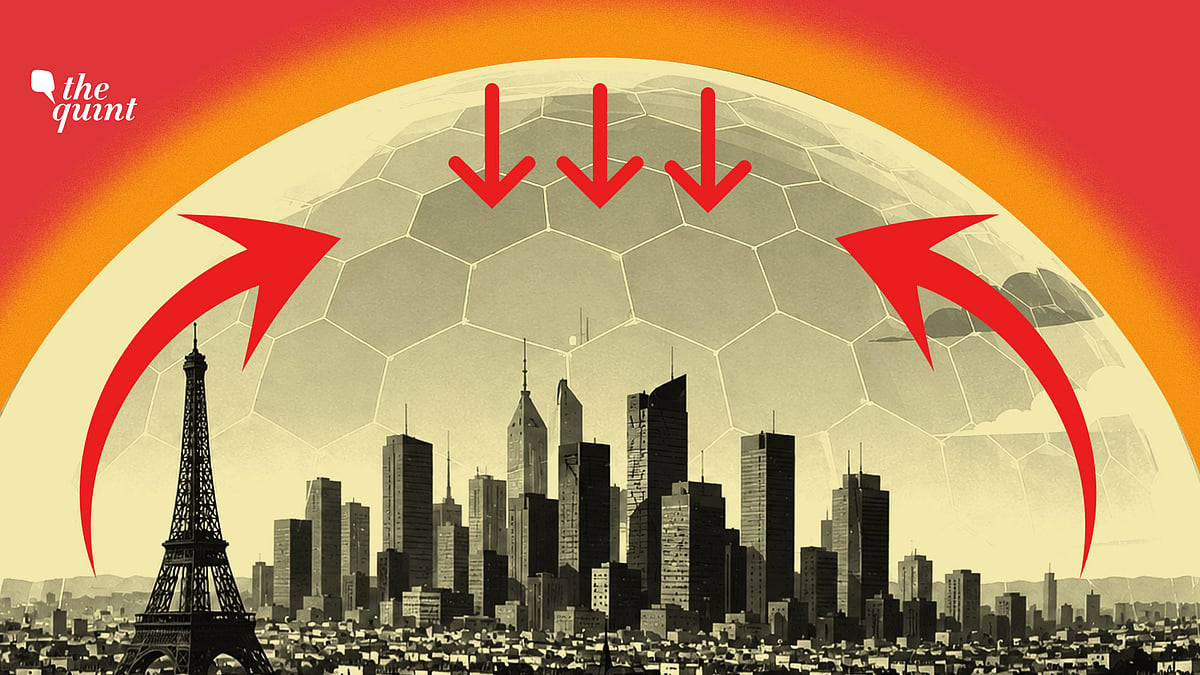
This year, however, the heatwave has been exacerbated due to a specific weather phenomenon—called the 'heat dome'—affecting parts of the UK as well as several countries in Europe.
Essentially, a 'heat dome' acts like a strong lid creating a high-pressure pattern over an area. As the air beneath this metaphorical lid sinks, it compresses and warms further, thus intensifying the heat.
France and Spain, too, are also currently under the 'heat dome', with France recording its hottest June day ever. Other European countries, including Portugal, Switzerland, and Germany, are expected to see temperatures rise 10-15°C above normal.
Climate Change to Blame
A new study by the World Weather Attribution (WWA), an international scientific collaboration that analyses the possible influence of climate change on extreme weather events, released on Friday, 26 June has found that climate change is "unequivocally to blame" for the record-shattering European heatwave.
"This summer shows that at 1.4°C of global warming, extreme heat is already reaching the limits of our societies’ ability to cope," the study noted, adding:
However, as a May 2026 report by the Climate Change Committee, an independent adviser to the UK government, pointed out, there are glaring gaps in the UK's adaptation efforts.
As one scientist told The Independent, the July 2022 record-breaking temperature "was supposed to be a wake-up call, but clearly someone hit snooze." Even before July 2022 was the catastrophic 2003 European heatwave which claimed a staggering 71,000 lives in six weeks in the continent.
A year after the 2003 extreme climate event, the UK government introduced the Heatwave Plan for England as its main policy to tackle heatwaves and improve the health sector's response to extreme heat. Fifteen years later, a 2019 review by the Policy Innovation and Evaluation Research Unit at the London School of Hygiene and Tropical Medicine found little evidence that the Heatwave Plan had helped reduce heat-related mortality or hospital admissions.
In 2023, the Heatwave Plan was replaced by the Adverse Weather and Health Plan to bring multiple weather-related hazards under a single umbrella.
A scientific paper, albeit published soon after it was introduced, noted that although the upgraded plan delivered well on "addressing short-term heat risks through early warning systems and appropriate institutional arrangements, there is a gap in strategically responding to long-term threats through climate adaptation and resilience-building."
The Unequal Burden of Climate Adaptation
If anything, the European heatwave makes it clear that no country is immune to the realities of the climate crisis. But that's only part of the story.
The bigger question is: If affluent countries don't take adaptation at home seriously, does that help explain a general lack of urgency and empathy among developed nations when it comes to climate adaptation?
Developing countries need adaptation finance of anywhere between $310 billion and $365 billion per year by 2035. The adaptation finance is 12-14 times less than what's needed, according to the data compiled by the UN Environment Programme (UNEP) ahead of COP30 last year.
At the recently concluded Bonn climate talks, adaptation finance was again a sticking point in the negotiations on the Global Goal on Adaptation (GGA), a goal that has been under negotiation for over a decade.
At Bonn in June 2026, developing countries demanded the inclusion of the COP30 agreement, to triple adaptation finance by 2035, in the GGA, but this was opposed by developed countries.
Climate change may not discriminate, but its impacts are far from equitable. Heatwaves, as well as floods and droughts, do not hit all countries as well communities equally. In addition to cutting greenhouse gas emissions, adaptation finance is crucial to equip nations with the infrastructure needed to withstand the impacts of climate change so that those who are the least responsible for this crisis do not bear the heaviest costs—from lost lives to destroyed homes and livelihoods.
Climate adaptation is a lifeline, and a widening adaptation gap means future loss and damage, especially of vulnerable lives. The United Nations estimates predict that by 2030, climate change could push more than 120 million people into poverty, leading to a modern-age "apartheid" and increased inequality.
As Emmanuel Raju, Director of the Copenhagen Center for Disaster Research and one of the authors of the WWA study, told The Quint,
As far as the UK goes, Andy Burnham is currently the sole candidate for the 2026 Labour Party leadership election to succeed Keir Starmer as the next prime minister. Burnham is known for his "green" initiatives as Mayor of Manchester.
Whether the new government, should he lead it, would take note of the creeping temperatures outside is anyone's guess. But for the people of England facing the consequences of climate change, the mercury has already crossed its boiling point. And the lesson on adaptation is yet to be learned.
- Access to all paywalled content on site
- Ad-free experience across The Quint
- Early previews of our Special Projects
Published: undefined