‘Bandar’ Review: Bobby Deol Anchors Anurag Kashyap’s Strongest Film in Years
Bobby Deol, in the performance of his career, has simply never been this good or this exposed and defenseless.
advertisement
It's rare for a Hindi filmmaker today to command the calendar Anurag Kashyap has this year: two films—Kennedy and Bandar—arriving months apart, alongside the re-release of Dev.D (2009), the cult film that imprinted his signature on Hindi cinema.
It's a fitting moment to take stock given that Kashyap occupies a complicated place in our cinema. He is among the handful of storytellers who rewired its grammar. Yet, lately his own reputation has begun to precede him. The recent output has been prolific, but also a slow bleed of the edge that once made him essential. Think a boomer cosplaying Gen Z (Almost Pyaar with DJ Mohabbat), or a raconteur sifting through his greatest hits (Nishaanchi).
A Filmmaker at Crossroads
Every new Kashyap release then, has become an act of bracing: for something that lands between underwhelming and frustrating. His latest, Bandar, which he co-directs with Sakshi Mehta Lau, is the first film in a while that feels like Kashyap might be finding his way back to his singular voice.
Co-written by Sudip Sharma and Abhishek Banerjee (Paatal Lok), Bandar had its world premiere at the Toronto International Film Festival (TIFF) last year.
The plot, after all, turns on Samar (Bobby Deol), a fading pop star arrested under Section 376 after a woman (Sapna Pabbi) he met on a dating app, and promptly ghosted, accuses him of rape. For its first hour, it appears to be travelling in precisely that direction, gathering into a story about the cruelty of a false accusation and the loopholes a corrupt legal system pries open to devour the lives of some men.
The Film It Refuses to Become
If Bandar were that film, it wouldn't necessarily be a dishonest story to tell. But that choice would inevitably land it among the features in which wounded masculinity transforms into grievance aka the testosterone-soaked self-pity that found such a comfortable home in Kabir Singh (2019) and Animal (2023).
As it turns out, Bandar is not really a film about guilt or innocence so much as about the machinery into which both disappear. In an age when neither label attaches cleanly to anyone, what the legal system metes out with ease is not justice but punishment.
The film is interested in playing as a character study: an anatomy of male entitlement, of sexual repression, of the grey zones of romantic violence that carry no legal recourse, of the psyche of men whose lives drain away in prison without trial, of the lies they begin to tell themselves, and whether it is possible for anyone, at all, to sift through these shifting accounts.
Sapna Pabbi in a still from Bandar.
(Photo Courtesy: YouTube)
Beyond Innocence and Guilt
The film’s most fascinating quality is a screenplay that refuses to take sides even when its plotting seems to. It lays Samar bare without flattering him: a 50-year-old pop star, broke and self-important, dating a younger woman (Saba Azad) he means to keep on a leash, and who he craves all the more because she refuses to be controlled.
But in his own telling, Samar is the wronged party. He is also a man whose entitlement will not let him accept the consequences of anything, which is why, even after his arrest, he protests his innocence without a flicker of doubt, recasting the accusation as a stalker's vendetta when the truth sits at a far more uncomfortable angle.
The Stories Men Tell Themselves
"Each one believes their actions were justified," Samar says at one point, a line that lands like the film's thesis: at a moment when everyone arrives armed with a justification, is it even possible to always tell right from wrong—and might right itself carry shades of wrong, and wrong of right?
These are intriguing, brutal questions for a film to wrestle with, and Bandar's co-writers and co-directors approach them with a curiosity that holds reality up against its perception without rushing toward an answer. The film doubles as a prison thriller, and a sharp one at that.
Shaaz Rizvi's camera turns close and airless the moment Samar reaches the police station (Jitendra Joshi is a standout as a corrupt cop), and finally, an overcrowded prison. He is aided by Aarti Bajaj, whose cutting lets the timeline slip and double back, so that the truth always seems to arrive a beat late, if it arrives at all.
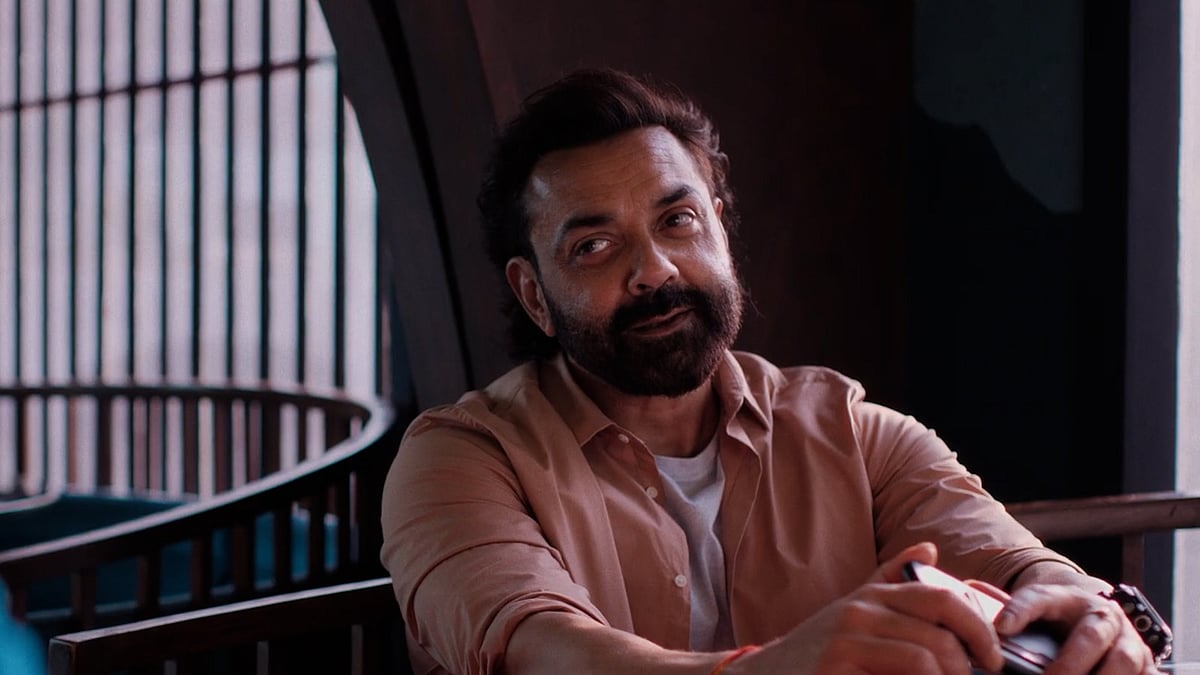
Bobby Deol in a still from Bandar.
(Photo Courtesy: YouTube)
The Women Left Standing
And almost at once, the women orbiting Samar emerge as the film's most clear-eyed presence. Sanya Malhotra is superb as his sister, saddled with the particular exhaustion of loving a man she suspects is capable of real harm.
Azad's Khushi becomes the film's other reluctant conscience: the moment she senses the truth might be murkier than Samar admits, she declines to stand by him. Both women travel from fury and concern to fear and a bone-deep weariness with a system that grinds everyone down. And if there is a misstep, it is the curiously offhand construction of Pabbi's character.
When Bandar played at TIFF, critics noted that it closed on a slate of statistics: the number of false rape cases filed in India, set beside figures on the undertrials who languish for years awaiting a first hearing. Those numbers framed everything that came before as a story of men wronged by women, and a system built to believe them.
In the Indian release, that slate is gone. Without those numbers, Bandar culminates in a film that stops arguing and starts observing. It is no longer about false accusations but rather about a man still performing his own innocence to the very end.
That Bandar ends up wiser than its own starting point hints at something I'd nearly stopped expecting: Kashyap willing to be challenged again. It's been long overdue.
Bandar releases in theatres on 5 June.
(Poulomi Das is a film critic, journalist, and programmer based in Goa. Her writing on film has appeared in national and international publications including MUBI Notebook, Vulture, Polis Project, Hyperallergic, Mint Lounge, India Today Magazine and The Hollywood Reporter India among others. This is an opinion piece, and the views expressed above are the author’s own. The Quint neither endorses nor is responsible for the same.)