Cookstoves and Carbon Credits: Inside Bengaluru's Carbon Market Boom
Poorly designed projects where households are pushed towards technology actually increase emissions, say experts.
advertisement
The Quint is telling the full story of how climate change is reshaping our lives. Help us do more. Become a member.
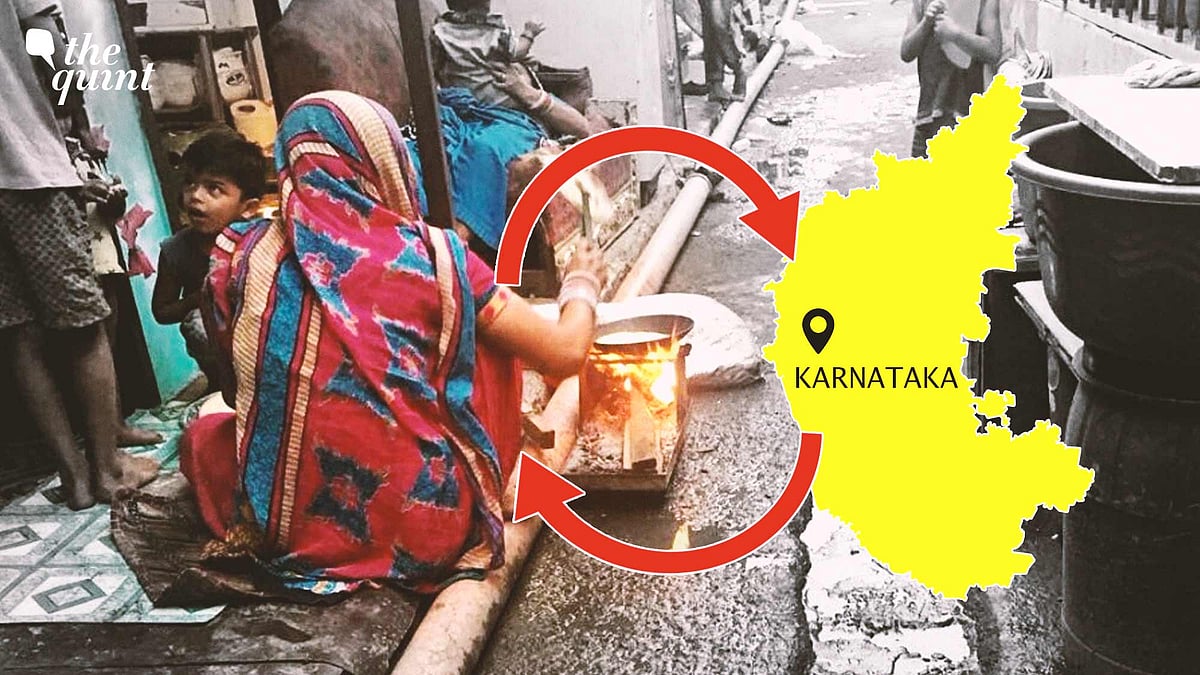
In parts of Karnataka, "improved" cookstove projects were rolled out as climate interventions designed to reduce emissions and generate carbon credits. On paper, they promised cleaner cooking and measurable climate benefits. On the ground, the story was far less convincing.
A Centre for Science and Environment (CSE) study found that households were often made to pay for the cookstoves themselves. Many were unaware that these projects were part of carbon credit schemes—and no financial returns reached them.
In 2022, Jyoti Shital Chavan from Yarnaal village in Belagavi district was introduced to "improved" cookstoves at a meeting organised by Shri Kshethra Dharmasthala Rural Development Project, a charitable trust supporting rural communities in Karnataka through micro-credit and infrastructure initiatives.
Manufactured by Mumbai-based Greenway Grameen Infra, the stoves were promoted as a way to reduce fuelwood use and cut COP2 emissions. Before this, Chavan already used both an LPG connection and a traditional mud chulha.
Under another cookstove project implemented by EKI Energy Services, Shakarya Kalacharantimath from Belagavi's Bidi village received an "improved" cookstove from her daughter three years ago. But she uses it only once a month, continuing to rely mainly on traditional mud chulha and LPG cylinders.
“An improved cookstove with a single burner is not practical for a large family,” she told Down to Earth-CSE.
Trishant Dev, Deputy Programme Manager at CSE, explains:
“Many of them were also not using the cookstoves… in a way, you were encouraging communities to shift back to wood-based cooking,” he adds.
India’s Carbon Market Moment
India is rapidly positioning itself as a global hub for carbon markets. According to Grand View Research, the carbon credit market in the country generated a revenue of roughly $4 million in 2023. It is projected to cross $49 million by 2030.
There are two kinds of carbon credit markets—compliance market and voluntary market. Compliance markets are formed and regulated by regional, national, or international government bodies. They set up legal targets for regulated entities (industries/sectors) to cap emissions.
Voluntary markets are national and international markets, where individuals and companies choose to offset emissions by buying credits from projects like biogas plants and improved cookstoves that reduce emissions.
But even as the market expands, fundamental questions remain about what it actually delivers.
“The voluntary carbon market is not meant to reduce emissions,” Dev says. “It offsets emissions. So the question of how much emissions it has reduced… I don’t think arises.”
He further alleges:
For instance, he says, “By promoting poorly designed projects where farmers or households are pushed towards technologies or practices that actually increase emissions (such as cookstove schemes that encourage a shift back to wood-based cooking even when people already have gas connections), while overstating emission reduction claims and failing to deliver real, on‑ground changes.”
As of 2023, In India, more than 1,400 carbon projects are registered in the two major crediting systems—Verra and Gold Standard. A 2023 investigation by The Guardian revealed that more than 90 percent of Verra’s rainforest carbon offsets are worthless.
Bengaluru: The Carbon Market Hub
At the center of this expanding ecosystem is Bengaluru—now home to a growing cluster of carbon market startups, registries, and climate-tech firms. For industry players, the value proposition is clear: make climate action financially viable.
“One of the biggest gaps we saw was that companies were doing sustainability work without understanding the financial upside,” says Archana Pai, founder of CostMos, a carbon-credit company based in Bengaluru.
Technology, experts argue, is solving the credibility problem.
“Traditionally, carbon credits rely on periodic verification cycles that may happen once in one to three years,” says Abhimanyu Rathi, CEO of RenewCred. “What we are building is continuous monitoring using real-time data. Every credit is linked to a verifiable chain of data that captures project performance over time.”
But even within the industry, there is acknowledgment that the system is far from perfect.
“The voluntary carbon market is still relatively unregulated, leading to varying levels of quality and pricing,” Pai of CostMos says.
She adds:
What is the cost of carbon credits? In the first quarter of 2024, the price of carbon credit was Rs 194 per tonne of CO2 on an average.
According to CostMos, it could be anywhere between Rs 200 and Rs 400 per tonne now. And once the compliance market is in place it could rise to Rs 1,200 to Rs 2,000 per tonne.
Farmers Left Out of the Carbon Economy
While Bengaluru builds the infrastructure of carbon markets, farmers on the ground remain largely excluded from its benefits. Across multiple case studies, the CSE study found that payments promised to farmers either did not materialise or were too small to sustain the required practices.
Farmer activist Chukki Nanjundaswamy describes a deeper disconnect. “Farmers have little to no understanding of carbon credits. There is no transparency in pricing or profit-sharing, and in many cases there are delays of more than two years without any payment or communication,” she says.
She adds that the system reinforces dependency.
When Climate Finance Undermines Climate Work
For organisations working on the ground, the issue is not just inefficiency—it is harm.
ActionAid Association is an NGO based in Bengaluru that works across climate justice and children and women rights. Dipali Sharma, Director – Partnerships at Action Aid, calls carbon offsets “false solutions” and “dangerous diversions” that fail to address the climate crisis.
“This risks undermining grassroots work centred on ecological justice,” she adds.
Local Communities Bear the Cost
On the ground, the impacts are more tangible. Carbon offset projects, like afforestation and conservation in Indian forests, have restricted community access to lands and forests, even landscapes that have long been governed and used collectively.
“Plantation-style afforestation, sometimes linked to carbon finance, has restricted access to common lands and forest produce, undermining both livelihoods and community forest governance. In such contexts, commons have effectively been reclassified as managed carbon assets, with decision-making shifting away from gram sabhas,” Sharma says.
“There is the question of measurement and overestimation,” she notes, adding:
The carbon market in India rapidly expanded in the 2000s and declined after 2012. It is now being restructured into a domestic framework. “The market has evolved from a relatively technocratic, energy-focused mechanism to a far more financialised and land-intensive system,” she notes.
The result is a form of what scholars describe as “green grabbing”—the appropriation or re-regulation of land and forests in the name of environmental goals.
GRAIN, an international non-profit organisation that works to support small-scale farmers, have recorded 46 carbon credit projects that involve large-scale tree or crop planting. A total of 17.53 lakh acres will be used for this.
Ecological Damage and Farmers' Struggle
Carbon credit projects, those linked to conservation and agriculture, hold ecological concerns.
Farmer activist Nanjundaswamy says, “Farmers are pushed towards species-specific plantations or monocultures that prioritise carbon capture over ecological balance."
She points out that even institutions like NABARD, which have begun outreach around carbon credits, have not provided farmers with clear or accessible information about what these projects entail.
She says,
In this vacuum, private companies step in to shape on-ground practices. “Farmers are being encouraged to shift toward plantation-based models that neither support biodiversity nor guarantee stable income,” she adds.
NABARD initiated a pilot project with 3,500 mango farmers in Koppal district. However, farmers have reported limited and unclear information from the body. There is also a lack of transparency in pricing and payment systems.
In Karnataka, over 1.5 lakh hectares are under mango cultivation and more than 2.8 lakh mango farmers depend on it. Mango farmers in Karnataka are already facing crashing prices and rising vulnerability.
Sharma underscores that the structural design of carbon markets allows firms to offset emissions instead of reducing them at source.
“Even if offsets did work (which they largely do not), using them to justify continued emissions in a world heading toward severe warming is “indefensible,” she says. This underscores how offsets can function as a substitute for, rather than a complement to, real decarbonisation.
Why These Gaps Persist
The problems in carbon markets are not new—and not accidental.
“The issue stems from the design of the system,” Dev says. “Companies partake in that system and kind of reap benefits of the loopholes that exist.”
A key factor is the absence of regulation. He explains:
But the issue runs deeper than policy.
“The market has continued to function with very little scrutiny over the years,” he says. “That's because of the opacity and complexity of the market itself. If it’s not easy to understand, people are not going to question it.”
This complexity creates an uneven playing field.
“Corporations, intermediaries, and certifiers have far more information than communities or even regulators,” Sharma points out. “This knowledge asymmetry structures power, value, and control in carbon credit systems.”
Sharma of Action Aid says that the carbon markets become vehicles for greenwashing as carbon credits are often used to avoid real emissions reductions because they frequently do not represent real, additional or permanent climate benefits.
Lack of Transparency
“While there are several credible and high-integrity players in the carbon market, there are also gaps in accountability," says Pai.
Sharma flags a deeper issue—a lack of transparency not just in the carbon market, but within the state itself.
“Recent amendments to the Right to Information Act, 2005 have already weakened the architecture of transparency,” she says. “This has raised concerns about the independence of the information regime and, more broadly, signals a shrinking space for public scrutiny.”
This makes carbon credit projects in India more difficult to evaluate. Measurements and technical methodologies such as baselines and carbon accounting protocols are controlled mostly by developers and third-party auditors.
“This reflects broader governance challenges where communities are positioned as passive participants rather than rights-bearing decision-makers,” Sharma notes.
Put together, in a context where even formal transparency mechanisms are being weakened, carbon credit projects risk turning into opaque systems with little accountability—making it hard to assess both their climate claims and their social impact.
Can the System Be Fixed?
Despite the criticism, experts agree that carbon markets are not beyond repair—but only with significant changes.
For Dev, the starting point is transparency. “If I am taking a flight and I am paying to offset my emissions, do I not have a right to know where that offset has come from?” he asks. “Was a tree planted somewhere? That sort of transparency has to come.”
He argues that accountability will follow. “If you are claiming a public good—reducing emissions, working on climate action—then your activities cannot remain private,” he says. “There has to be public recognition and public scrutiny. Transparency laws like the RTI Act should enable such scrutiny.”
Another critical issue is fair compensation.
“The carbon credit has to pay for the actual change,” Dev says. “The money has to flow into the hands of people who are actually doing the work, rather than being eaten up by a host of intermediaries.”
Industry players, too, acknowledge the need for reform.
“We always emphasise a ‘reduce first, offset later’ approach,” Pai says, adding:
Community rights, consent and leadership must be the priority, experts argue. “Free, Prior and Informed Consent (FPIC) must be made legally binding, not procedural,” Sharma says. “Communities must be decision-makers, not carbon suppliers.”
Sharma suggests that carbon credits should be approached as an additional mechanism for emission reduction and not as a substitute.
The share of offsets a company can use should be limited and time-bound scientific emission targets should be mandated. She said that the projects that restrict livelihoods or enclose commons must be stopped and projects should be designed incorporating gender and equity safeguards.
She says public climate finance must be prioritised and the reliance on market mechanisms for essential climate action must be reduced.
But even that comes with a caveat.
“Addressing these challenges will require stronger governance, harmonisation of standards, and greater transparency across the value chain,” Pai adds.
Bengaluru is building the future of carbon markets—digital, data-driven, and scalable. But that future rests on a system that, on the ground, remains deeply uneven.
“The market in its current form has a long way to go before it can make real change,” Dev says. As carbon markets expand, the question is no longer whether they can generate value. It is whether that value reflects real climate action, or just the appearance of it.
(The reporters reached out to the Ministry of Environment, Forest and Climate Change (MoEFCC) multiple times for their comments, but received no response. They also reached out to NABARD. This article will be updated with their responses as and then they revert.)
This story was developed and produced under an arrangement with Internews’ Earth Journalism Network.
(Suhail Bhat is a Delhi-based freelance multimedia journalist and filmmaker. His work primarily focuses on gender, minorities, human rights, the environment and politics. Gangadharan B is a freelance multimedia journalist and a Laadli Media Award recipient. He reports on civic issues, climate and the environment, health, gender, queer lives, and marginalised communities.)