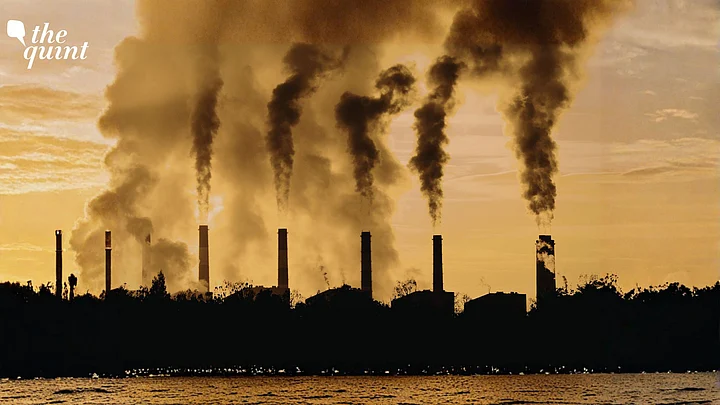
India, on Wednesday, 25 March unveiled its updated climate pledge—nearly six months after missing the September deadline. The Union Cabinet approved the much-anticipated nationally determined contributions (NDCs) for 2031–2035, stating that the new targets build upon India's earlier commitments submitted in 2015, and align with the long-term goals of the Paris Agreement.
In the NDCs submitted in 2015, India set targets of 33-35 percent reduction in the emissions intensity of the gross domestic product (GDP), and 40 percent share of non-fossil-resources-based electric power installed capacity by 2030.
In a statement, the government said both these pledges were met 11 years and nine years ahead of the committed timelines, respectively.
The revised climate goal for 2035 is a reduction in emissions intensity of the GDP by almost half from 2005 levels.
The new NDC framework sets out a roadmap for 2031-2035 guided by the vision of Viksit Bharat 2047, and the goal of achieving net-zero by 2070, the statement said.
What are NDCs—and how do experts view India's new climate goals? The Quint explains.
India’s New Climate Goals: Experts Decode 47% Emissions Intensity Cut by 2035
1. What Are NDCs?
The 2015 Paris Agreement saw the speeding up of climate action with countries agreeing to submit new, more ambitious plans every five years. NDCs, as they are called, break down what each country is doing to take action on climate change—including emissions reduction—and adapt to its impacts.
"Instead of prescribing targets for only the developed countries, the 2015 Paris Agreement urged all countries to define their own NDCs," one expert earlier told The Quint.
2025 was a critical year as the deadline for countries to submit their updated climate pledges, or NDC 3.0, to the United Nations Framework Convention on Climate Change for 2035.
The deadline was 10 February, which, according to a Carbon Brief analysis, 95 percent of countries failed to meet. The deadline was then set for September 2025 by which time around one-third of countries had announced or submitted their NDCs. That number rose to over 100 countries by the time of the COP30 climate summit in Brazil in November 2025.
Expand2. What are India's 2035 Climate Targets?
India's climate commitments were framed based on consultations and research by 10 NITI Aayog working groups, including ministries, experts, industry, and civil society. The three major updated commitments and their deadlines are:
Emissions intensity of the GDP to be cut by 47 percent by 2035 from 2005 levels
India has raised its ambition to mitigate greenhouse gas emissions by announcing a reduction in emissions intensity to 47 percent to be achieved by 2025. According to the statement, India's emissions intensity reduced by 36 percent during 2005 to 2020.
However, Labanya Jena, Director, Climate and Sustainability Initiative, says the goal isn't "very optimistic" from the mitigation perspective, adding that:
"Taking into account India’s current technical and financial capacities and its reliance on imported technologies, the government is likely being cautious about these commitments."
60 percent of installed electric power capacity from non-fossil fuel sources by 2035
By forging partnerships at international levels through initiatives such as the International Solar Alliance and the Coalition for Disaster Resilient Infrastructure, among others, India has set out to increase the share of non-fossil fuel energy resources in installed electric power capacity.
"A targeted 60 percent share of non-fossil electricity capacity in 2035 suggests that while India has raised its ambition to decarbonise the power sector, it is also doubling down on energy security and affordability for hundreds of millions of its citizens," Dr Arunabha Ghosh, CEO, Council on Energy, Environment and Water (CEEW), opines.
As per the government, India has achieved 52.57 percent non-fossil capacity by February 2026—a goal that was met five years in advance.
A carbon sink of 3.5-4 billion tonnes of CO₂ equivalent through expanded forest and tree cover
India has also announced enhancing the ambition of creating carbon sink through forest and tree cover to 3.5-4.0 billion tonnes of CO2 equivalent by 2035 from the 2005 level.
Expand3. Other Climate Goals
Apart from the three major commitments, the government laid out other climate goals, including:
Climate-friendly and cleaner path of economic development
Resilient infrastructure to combat climate change effects like sudden rain and cloudbursts
Promoting the Prime Minister's Lifestyle for Environment (LiFE) mission that urges people to adopt sustainable daily habits
Developing low-cost, long-term finance mechanisms for green energy
Capacity building and research and development through technology and international collaborations
The government in its statement, said that the qualitative goals are intended to "embed sustainability into everyday life and governance systems, promote climate-resilient development pathways, and enable a just and inclusive transition for all sections of the society."
Lauri Myllyvirta, Lead Analyst and Co-Founder, Centre for Research on Energy and Clean Air, believes India's clean energy industry is likely to deliver much faster progress than expected. She opines,
“India's new 2035 climate targets underestimate the country's potential for transformative clean energy growth. Under current plans, the target of 60 percent clean power capacity will be achieved before 2030, rather than by 2035. Continuing the current clean energy growth at rates already achieved in 2024-25 would enable India to peak power sector emissions well before 2030 and significantly slow down its CO2 emission growth rates."
Expand4. From Mitigation to Adaptation
According to the statement, India aims to extend its climate approach beyond just mitigation actions towards scaling up adaptation actions and disaster resilience.
Some of the key measures towards the achievement of goals on adaptation listed are:
Protection of vulnerable coastlines through mangrove restoration, coastal regulation, and climate-resilient infrastructure
Early-warning systems for cyclones and storm surges
Targeted programmes for glacier monitoring, biodiversity conservation, and sustainable livelihoods in Himalayan states
Climate-resilient infrastructure to address risks from landslides and glacial lake outburst floods
Implementation of Heat Action Plans across states
Community-based disaster preparedness and resilience programmes
Under its Climate Action framework, India’s NDC is operationalised through the National Action Plan on Climate Change and its nine national missions, as well as the State Action Plans on Climate Change.
"India’s climate action is being implemented at local level through various schemes and programme such as Jal Jeevan Mission, National Mission on Sustainable Agriculture, Sustainable Habitat, MISHTI (Mangrove Initiative for Shoreline Habitats & Tangible Incomes), National Disaster Management Plan, Soil Health Card, and Pradhan Mantri Krishi Sinchayee Yojana..."
The Union Cabinet via a press releaseExperts, however, raised concerns that the climate goals are still somewhat unclear—and missing key details.
"It's not clear how it ties back to the various sector-level targets that India has, for instance, in the power and mobility sector," says Shantanu Srivastava, Research Lead, Sustainable Finance & Climate Risk, South Asia, Institute for Energy Economics and Financial Analysis (IEEFA).
"While it mentions that the successive climate commitments are an outcome of the 10 working groups of Niti Aayog, it would be good to see how it aligns with the modelling studies published as part of the Viksit Bharat scenarios. A breakdown or alignment of the NDC into sectoral pathways and their alignment with other policy tracks is still a missing piece," he adds.
Jena from Climate and Sustainability Initiative adds,
"India is keen on electrifying its transport and cooking but the source of electrification will remain coal even though we are adding massive clean energy. Coal will remain the dominant source of energy till 2035.”
Dhruba Purkayastha, Consultant, Standing Committee on Finance, UNFCCC and Adviser - Energy & Climate, ORF, however, believes that given that India is the BRICS chair, this announcement could potentially pave the way for a BRICS-led climate action.
"It is evident that the West is not going to lead on climate. And India is showing that the leadership now needs to come from large developing countries. And this announcement is a clear sign of that leadership,” he says.
Expand
What Are NDCs?
The 2015 Paris Agreement saw the speeding up of climate action with countries agreeing to submit new, more ambitious plans every five years. NDCs, as they are called, break down what each country is doing to take action on climate change—including emissions reduction—and adapt to its impacts.
"Instead of prescribing targets for only the developed countries, the 2015 Paris Agreement urged all countries to define their own NDCs," one expert earlier told The Quint.
2025 was a critical year as the deadline for countries to submit their updated climate pledges, or NDC 3.0, to the United Nations Framework Convention on Climate Change for 2035.
The deadline was 10 February, which, according to a Carbon Brief analysis, 95 percent of countries failed to meet. The deadline was then set for September 2025 by which time around one-third of countries had announced or submitted their NDCs. That number rose to over 100 countries by the time of the COP30 climate summit in Brazil in November 2025.
What are India's 2035 Climate Targets?
India's climate commitments were framed based on consultations and research by 10 NITI Aayog working groups, including ministries, experts, industry, and civil society. The three major updated commitments and their deadlines are:
Emissions intensity of the GDP to be cut by 47 percent by 2035 from 2005 levels
India has raised its ambition to mitigate greenhouse gas emissions by announcing a reduction in emissions intensity to 47 percent to be achieved by 2025. According to the statement, India's emissions intensity reduced by 36 percent during 2005 to 2020.
However, Labanya Jena, Director, Climate and Sustainability Initiative, says the goal isn't "very optimistic" from the mitigation perspective, adding that:
"Taking into account India’s current technical and financial capacities and its reliance on imported technologies, the government is likely being cautious about these commitments."
60 percent of installed electric power capacity from non-fossil fuel sources by 2035
By forging partnerships at international levels through initiatives such as the International Solar Alliance and the Coalition for Disaster Resilient Infrastructure, among others, India has set out to increase the share of non-fossil fuel energy resources in installed electric power capacity.
"A targeted 60 percent share of non-fossil electricity capacity in 2035 suggests that while India has raised its ambition to decarbonise the power sector, it is also doubling down on energy security and affordability for hundreds of millions of its citizens," Dr Arunabha Ghosh, CEO, Council on Energy, Environment and Water (CEEW), opines.
As per the government, India has achieved 52.57 percent non-fossil capacity by February 2026—a goal that was met five years in advance.
A carbon sink of 3.5-4 billion tonnes of CO₂ equivalent through expanded forest and tree cover
India has also announced enhancing the ambition of creating carbon sink through forest and tree cover to 3.5-4.0 billion tonnes of CO2 equivalent by 2035 from the 2005 level.
Other Climate Goals
Apart from the three major commitments, the government laid out other climate goals, including:
Climate-friendly and cleaner path of economic development
Resilient infrastructure to combat climate change effects like sudden rain and cloudbursts
Promoting the Prime Minister's Lifestyle for Environment (LiFE) mission that urges people to adopt sustainable daily habits
Developing low-cost, long-term finance mechanisms for green energy
Capacity building and research and development through technology and international collaborations
The government in its statement, said that the qualitative goals are intended to "embed sustainability into everyday life and governance systems, promote climate-resilient development pathways, and enable a just and inclusive transition for all sections of the society."
Lauri Myllyvirta, Lead Analyst and Co-Founder, Centre for Research on Energy and Clean Air, believes India's clean energy industry is likely to deliver much faster progress than expected. She opines,
“India's new 2035 climate targets underestimate the country's potential for transformative clean energy growth. Under current plans, the target of 60 percent clean power capacity will be achieved before 2030, rather than by 2035. Continuing the current clean energy growth at rates already achieved in 2024-25 would enable India to peak power sector emissions well before 2030 and significantly slow down its CO2 emission growth rates."
From Mitigation to Adaptation
According to the statement, India aims to extend its climate approach beyond just mitigation actions towards scaling up adaptation actions and disaster resilience.
Some of the key measures towards the achievement of goals on adaptation listed are:
Protection of vulnerable coastlines through mangrove restoration, coastal regulation, and climate-resilient infrastructure
Early-warning systems for cyclones and storm surges
Targeted programmes for glacier monitoring, biodiversity conservation, and sustainable livelihoods in Himalayan states
Climate-resilient infrastructure to address risks from landslides and glacial lake outburst floods
Implementation of Heat Action Plans across states
Community-based disaster preparedness and resilience programmes
Under its Climate Action framework, India’s NDC is operationalised through the National Action Plan on Climate Change and its nine national missions, as well as the State Action Plans on Climate Change.
"India’s climate action is being implemented at local level through various schemes and programme such as Jal Jeevan Mission, National Mission on Sustainable Agriculture, Sustainable Habitat, MISHTI (Mangrove Initiative for Shoreline Habitats & Tangible Incomes), National Disaster Management Plan, Soil Health Card, and Pradhan Mantri Krishi Sinchayee Yojana..."The Union Cabinet via a press release
Experts, however, raised concerns that the climate goals are still somewhat unclear—and missing key details.
"It's not clear how it ties back to the various sector-level targets that India has, for instance, in the power and mobility sector," says Shantanu Srivastava, Research Lead, Sustainable Finance & Climate Risk, South Asia, Institute for Energy Economics and Financial Analysis (IEEFA).
"While it mentions that the successive climate commitments are an outcome of the 10 working groups of Niti Aayog, it would be good to see how it aligns with the modelling studies published as part of the Viksit Bharat scenarios. A breakdown or alignment of the NDC into sectoral pathways and their alignment with other policy tracks is still a missing piece," he adds.
Jena from Climate and Sustainability Initiative adds,
"India is keen on electrifying its transport and cooking but the source of electrification will remain coal even though we are adding massive clean energy. Coal will remain the dominant source of energy till 2035.”
Dhruba Purkayastha, Consultant, Standing Committee on Finance, UNFCCC and Adviser - Energy & Climate, ORF, however, believes that given that India is the BRICS chair, this announcement could potentially pave the way for a BRICS-led climate action.
"It is evident that the West is not going to lead on climate. And India is showing that the leadership now needs to come from large developing countries. And this announcement is a clear sign of that leadership,” he says.