India’s 2035 Climate Goals: Why Women-Led Action Is Key to Creating Carbon Sinks
India's 2035 climate targets set, how will the carbon sinks be created, and with whose participation?
advertisement
Are we prepared for the climate crisis staring us in the face? The Quint wants to go big on telling the most important stories of our time. Support us to tell them. Become a member now.
India’s updated Nationally Determined Contribution (NDC) for 2035 under the Paris Agreement, released earlier in March, marks a clear step-up in the country’s climate ambition.
At its core is a renewed focus on expanding carbon sinks through increased forest and tree cover. This will be central not only to meeting India’s global commitments, but also to strengthening ecological resilience within the country.
This forms part of a broader set of enhanced targets, including 60 percent non-fossil fuel capacity by 2035 and a 47 percent reduction in emissions intensity from 2005 levels.
While these targets have been set, an important question arises. How will these carbon sinks be created, and with whose participation?
SHGs As Platforms of Community Action
Jharkhand offers a useful perspective in this regard. According to the India State of Forest Report (ISFR) 2023, approximately 29.76 percent of the state’s geographical area is under forest cover.
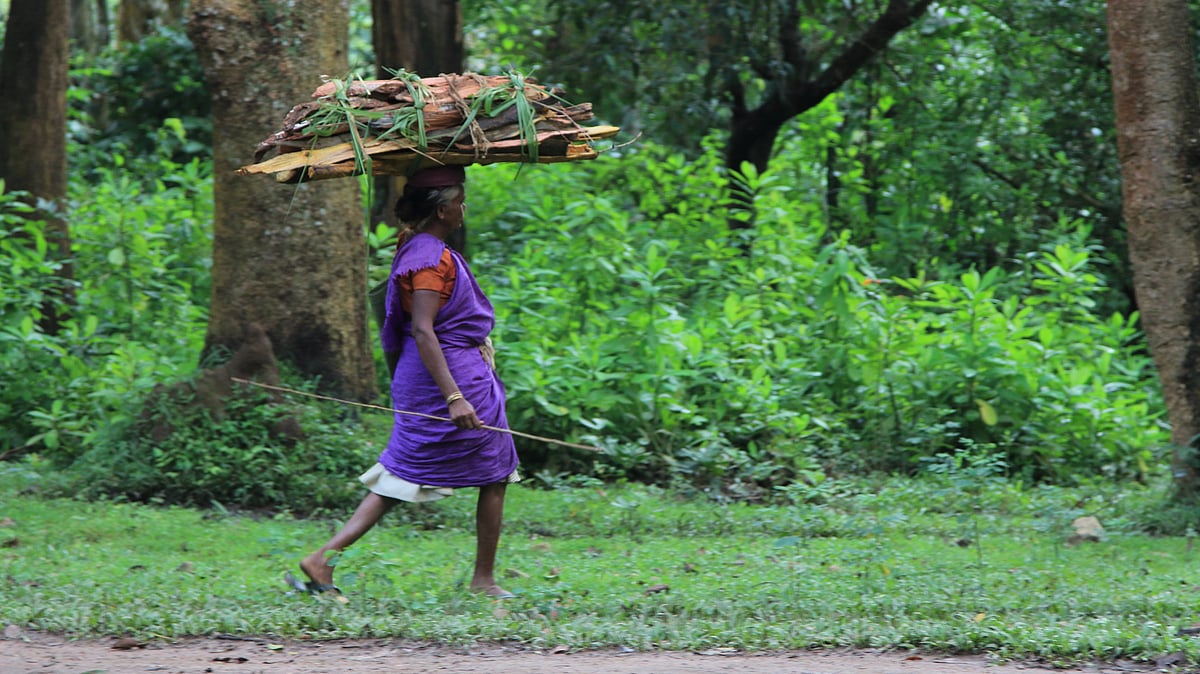
For a population of 32 million, including a significant percentage of Adivasi communities, forests are not merely carbon assets. They are the primary asset for livelihoods, food security, culture, and economic survival, all of which are being threatened by the climate emergency.
With close to 3 lakh women self-help groups (SHGs) across the state, facilitated by the Jharkhand State Livelihood Promotion Society (JSLPS), this network has grown into one of the most extensive platforms for grassroots action.
As part of a wider national ecosystem of women’s collectives, these groups are increasingly playing a role beyond livelihoods and economic empowerment, contributing to local decision-making and shaping community-led responses to climate challenges.
Building on this institutional base, JSLPS has introduced specialised, interactive training modules on the interlinkages between gender and climate change.
Delivered through trained community resource persons known as Setu Didis, the module enables women with a grounded understanding of local climate impacts and the gendered dimensions of vulnerability across food security, health, nutrition, sanitation, financial security and social protection.
The Modules Go Beyond Just Awareness
Delivered through trained community resource persons, the Setu Didis, these modules enable SHGs to analyse risks, map local vulnerabilities, and develop practical, community-level action plans rooted in lived experience. Critically, this knowledge does not stop at the SHG.
These efforts are to feed into formal planning processes, with community-level plans feeding into gram panchayat development plans.
Apart from this, the state has a total of 10,903 Joint Forest Management Committees (JFMCs), comprising approximately 2.18 lakh members, who collectively manage nearly 21,860 sq km of forest area.
Notably, about one-third of these members are women.
These committees play a crucial role in supporting the Forest Department in protecting forests and wildlife from fire, theft, and poaching, while also contributing to plantation activities, soil and moisture conservation, and infrastructure development.
However, a key challenge lies in the lack of coordination between these two community-based grassroots institutions.
While the JSLPS operates under the Department of Rural Development, the JFMCs fall under the Department of Forests, Environment and Climate Change.
There is a pressing need for these two strong and capable entities to collaborate more closely to enhance livelihoods and strengthen climate resilience.
This can translate into landscapes with mixed plantations of indigenous and non-timber forest-produce species such as mahua, tamarind, and bamboo, alongside restored village commons, regenerated pasturelands, and strengthened forest edges.
These interventions can support biodiversity, enhance groundwater recharge, and create more resilient local ecosystems.
Placing Women at the Centre of This Carbon Sink
The strategic logic of placing women at the center of this "carbon sink" mandate is grounded in both equity and efficiency.
For women in forest-dependent communities, the climate emergency is not a future projection but a present-day resource crisis.
As the primary managers of household energy, water, and food security, women bear a disproportionate burden when natural systems fail, worsening outcomes for their health, education and livelihood, deepening existing gendered inequalities.
However, this proximity to the crisis also grants them a localised expertise in ecosystem management. Creating a carbon sink of 4 billion tonnes requires more than just mass sapling distribution.
It requires the selection of hardy, indigenous species and a multi-year "nurturing" cycle that ensures high survival rates.
By leveraging the deep traditional, ecological knowledge held by women’s collectives, we move beyond "tokenistic" plantation drives toward a sustainable model of stewardship.
(Ravi Ranjan IFS is the Principal Chief Conservator of Forests, Wildlife & Chief Wildlife Warden, CAMPA & State Nodal Officer for Climate Change, Government of Jharkhand. This is an opinion piece and the views expressed are the author's own. The Quint does not endorse or is responsible for them.)