
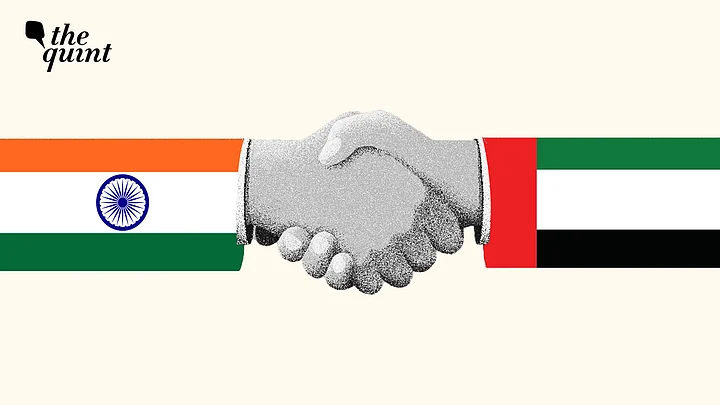
Sometimes small countries can have a huge impact, particularly when it comes to the global order. This comes to mind as we examine the relationship between India and the United Arab Emirates (UAE).
The UAE is perhaps one of the smallest countries in the world, but the size of its strategic importance, its influence, its vision, and the far-sightedness of its leaders, is something that a lot of Indian policy makers could possibly absorb and learn from.
Perhaps they have in some ways. Because since the last four to five decades, successive Indian governments have pursued a policy of strategic partnership with the UAE, which has been paying significant dividends, not just for the Indian economy and Indian citizens, but for the region as a whole.
Beyond Dubai and Sharjah
Back in the 1980s, the UAE was hardly even a speck in the minds of most Indians. Of course, there were the expatriates who lived in Dubai, Sharjah, and other places—and earned a decent livelihood. Most of them were from Kerala and possibly Andhra, and some from other states. In those days, the UAE was known more for the kind of cricket matches played between India and Pakistan than strategic significance, rather than being the seat of a new, emerging global order.
But that has changed dramatically since the 1980s. Sharjah had seen India triumph against Pakistan in cricket matches. It also had seen bitter disappointments in cricket matches against Pakistan in the same venue.
The relationship, which in those days was nebulous at best, has nonetheless transformed into one of the most significant ones as far as India is concerned.
Let’s look at some data. First, it may be a small country, but the UAE is the third largest trading partner of India, with the trade value between the two countries well in excess of $100 billion.
Just imagine the US, with a population of 350 million people and a GDP of close to $30 trillion is along with China, another country with a population of possibly 1,300 million people and a GDP of about $20 trillion, are the two largest trading partners of India.
Now, both the countries and their economies are huge, but what most Indians would be surprised to know is that after the US and China, it's not the UK, not Canada, not Japan, nor any of the large countries across the world which take the status of the third largest trading partners of India. It is the UAE.
India-UAE, Economic and Diplomatic Allies
Economically speaking, the UAE-India partnership is a defining one for the region, because ever since the 2022 mutual pact was signed between the two countries, trade has exploded because tariff walls have been broken. And it is not a one-way traffic as the Indian relationship with China is.
The China-India relationship is heavily loaded in favour of China because it has massive trade surpluses. Not so with the UAE. India is a successful and large exporter to the UAE and, of course, India also is a large importer.
The target in 2022 was to cross $100 billion in mutual trade by 2030. That has already been achieved over a year ago. So, the target of a trade value of $200 billion is no longer unlikely or improbable. That is, as far as the economic part of the issue is concerned, in macroeconomic terms.
In terms of microeconomics, close to four million Indians live in the UAE. They don't just live and earn their livelihoods, they lead a life of dignity, of respect, of hard work, of security, of well-being, and of being blessed with a feeling that they are well taken care of because the rule of law in this UAE is quite amazing.
Anyone who has visited the UAE would understand the value and importance of what a rule and orders-based society is. So, it's no longer just about citizens of India living in the UAE, sending close to $25 billion a year in remittances.
It is also about how a country which was virtually unknown till about five decades ago, can transform itself, because of visionary leadership, into a country that has become one of the most powerful trading, banking and finance and investment hubs in the global economy.
Once upon a time, it used to be only Singapore, which was the most attractive destination for a lot of citizens who wanted to live in a society with clear rules and regulations laid down by the government. Singapore remains one of the favourite destinations, but now, the UAE is also one of the significant nations that expatriates have decided to call it their home.
Whether it's the US or the UK, Russia, Malaysia, or Indonesia or India or Pakistan or any other major country, the UAE has become a safe haven for hard working professionals, entrepreneurs, and others who dream of a better life and livelihood for them and their own families.
Strategically Aligned
Now, let us come to the strategic part of it, strategically speaking, the UAE-India partnership is one of the most consequential ones in this century, not because the UAE prefers India over Pakistan or some such other silly notions that are displayed in Indian media and social media. The UAE-India relationship is very, very significant, because it is a vehicle to not just promote the global economy, global trade, and investments, but also to possibly secure a very, very safe and peaceful global order. The India corridor to Europe will transit through the UAE when that happens, perhaps a decade from now.
But till then, the UAE and India will probably remain the best possible partners. It is silly to call such relationships brotherly or friendly or permanent friends, or what Pakistan claims is a "higher than the mountains" kind of frienship (with China). The India-UAE relationship is based on mutual national interests. It is pragmatic, and it bolsters both peace and economic development.
To that extent, one needs to look at the recent conflict in the West Asian region as a temporary aberration. No doubt there are people, particularly on social media, who take perverted pleasure in the discomfort felt by other countries. But in the longer run, such perverts are best ignored, and they will, anyway, fade into background once the dust settles.
Being Indian in the UAE: A Home Away from Home
There are almost four million Indians who call Dubai, and the UAE, their second home. Some have been here for decades (yours truly has been here for more than 15 years now) and raised their families in the most safe and secure environment one can even think of. The rulers are not just pragmatic but lead from the front. Somehow a bit number of people back home look at Dubai only with two keywords: “tax-free” economy and “gold”-vending ATM machines.
But if a big number of blue-collar or white-collar Indians are making the UAE their second home (or the first, in many cases now), it’s for a reason that goes way beyond the usual optics of tax-free or cheaper gold. If you talk to people around here, the biggest USP of living in the UAE, is neither the tax regulations or the gold. It’s the safety and security parameters UAE offers that take the top spot.
Effortless digitised governance, which never throws bureaucratic tantrums in terms of running a business, would come in second on the list of pros. World-class infrastructure would come third and feeling right at home due to the large diaspora and cultural/culinary affinity would come in fourth for sure.
The fifth one would be being closer to India, in fact so close that we can fly to more than a dozen Indian cities directly, and you can literally take a flight to Delhi every hour or two.
The fact that the founder of this country made consistent effort to make this a destination for millions of hard-working expats, without compromising on their national identity is something to learn from.
Coming down to the current crisis, I have read multiples accounts of how this war is going to take away the USP, ie, safety and security aspect of living in the UAE. These so-called experts, however, forget that safety and security is not only about preventing a missile from coming your way, but also about how one is living in their day-to-day life.
A government can make one feel safe and secure by intercepting drones and missiles, not unlike what the skies of Jammu, Ambala or Amritsar were witnessing last year during Operation Sindoor. But, as people living in these cities will also tell you, such events are a blip in the radar over a long timeline of living in uncertainty.
In the case of Dubai, we shall overcome these hard times. It’s our home. A second home, but still our home. You don’t leave your home in crisis. You stick to it, sail together and be with it, more so in the time of crisis. The four million Indians in Dubai and the UAE, at this point of time, are staying put. We, as in our value system, are bound to do so. Gratitude in these defining moments will sail us through.
This current crisis also will pass, as so many crises have passed in the last four or five decades. But one thing is for certain, because the UAE and India share mutual interests, their bilateralism is likely to remain one of the most defining ones of this century.
(The author is Founder-Director, CVoter International. This is an opinion piece and the views expressed are the author's own. The Quint does not endorse or is responsible for them.)
