
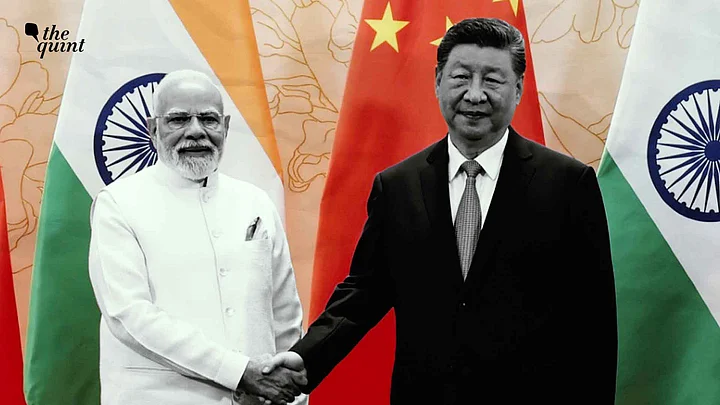
Earlier this month, Air India restarted non-stop Delhi-Shanghai flights, a route suspended for years. For travellers, it is connectivity. For geoeconomics, it is a signal that India and China are willing to reduce some transactional frictions amid an increasingly unpredictable US trade posture, even as the economic relationship remains strategically tense.
That is also the frame I used in my testimony before the US-China Economic and Security Review Commission in Washington, DC, on 17 February, arguing that India’s economic relationship with China is best understood as managed interdependence under strategic competition.
India must keep growing, industrialising, and creating jobs at scale, so it cannot treat trade as a purely geopolitical instrument. At the same time, India cannot treat trade and technology dependence purely as commercial, given the hardened security environment in contemporary times.
The numbers explain why India’s posture can look contradictory yet remain internally coherent. In FY2024-25, India-China merchandise trade totalled about $127.7 billion, leaving a deficit of $99.2 billion. China accounted for around 16 percent of India’s total imports. The relationship, therefore, sits at the intersection of industrial necessity and risk management, a place where slogans rarely survive contact with supply chains.
The reset in Delhi-Beijing relations is hence best read as tactical stabilisation alongside continued hedging, not as reconciliation. Flights fit this logic. They make commerce easier, but they do not change the underlying objective in keeping selective economic channels functional where growth needs them, while tightening guardrails around high-risk dependencies.
Why the Deficit Is Not a Sin, but a Signal
India’s deficit with China is often treated as moral evidence of being “outplayed”. That is not how trade balances work. A bilateral deficit, by itself, is not proof of unfairness or exploitation. In global value chains, products cross borders multiple times as components
and sub-assemblies, which can inflate bilateral balances compared with the underlying value-added relationship. Macro stability is better reflected in the current account and savings–investment dynamics, not in any single bilateral gap.
Still, deficits become policy-relevant when they cross thresholds that signal structural risk. The first threshold is scale and persistence. India’s overall external position can remain manageable even when a single bilateral deficit is large. In FY2024-25, India’s current account deficit was roughly 0.6 percent of the GDP, even as goods imports were very large. But a near-$100 billion bilateral gap with China that persists suggests a competitiveness and capability gap that markets alone may not close quickly.
The second threshold is composition. Deficits matter more when imports are concentrated in intermediates and capital goods embedded deep inside domestic production, because substitution is slow and costly. The third threshold is concentration and chokepoints. The strategic concern is not “imports from China” in the abstract. It is single-supplier dominance in specific items that causes disruptions to cascade across sectors. That is where deficit talk turns into resilience planning.
Seen through this lens, India’s objective is not to eliminate the deficit with China, which would be neither realistic nor economically efficient in the near term. The aim is to compress it into a more sustainable band by raising domestic value addition, expanding sourcing options, and reducing exposure to inputs that are hard to substitute. That also means taking the export side seriously. India’s exports to China have not kept pace with the surge in imports over the past decade, which is precisely why the flight’s symbolism can outpace its economics.
Why 'Decoupling' Is a Slogan in Asia
Rapid decoupling is difficult because of how Indo-Pacific production networks are wired. China remains deeply embedded as an upstream supplier and processing hub, even as final assembly shifts elsewhere. The International Monetary Fund (IMF) notes that roughly 60 percent of Asia’s intermediate-goods exports remain within the region, compared with only about 30 percent for final goods, a pattern typical of multi-stage production. Diversification, therefore, often means reconfiguring stages within value chains rather than instantly replacing upstream China-linked inputs.
This is why India’s preferred adjustment mechanism is not a big-bang separation. It is capability-building and steady diversification. Upgrading within global value chains can raise intermediate imports in the short run even as downstream capacity expands. If supplier ecosystems deepen over time, reliance can fall. But the path is structural, not instantaneous.
The Indian Toolkit: Build and Guard
India’s post-2020 response has been a layered toolkit designed to preserve the developmental benefits of openness where they remain productivity-enhancing, while reducing tail risks in domains where disruptions, opaque upstream dependencies, or loss of control carry outsized strategic costs.
A quiet but important part of that toolkit is rules-based defensiveness. Instead of indiscriminate closure, India relies on standards, conformity requirements, and trade remedy processes to manage surges and compliance risks at the border and in the domestic market. These instruments are slower than bans, but they are more scalable and easier to sustain politically, especially when India still needs competitively priced inputs for industrial upgrading.
The centre of gravity is capability-building at home. The Production Linked Incentive (PLI) framework across 14 sectors aims to pull manufacturing and supplier ecosystems onshore, crowd in investment, and expand export capacity. Its gains do not erase upstream dependencies overnight, but they make substitution feasible over time, so resilience becomes practical rather than rhetorical.
The second strand is guardrails around sensitive nodes. India tightened scrutiny of investment from countries sharing a land border with India via a government-approval route, framed as a safeguard against opportunistic takeovers. In telecom, India’s “trusted” framework for products and sources reflects the view that communications networks underpin emergency response, financial services, industrial control systems, and sensitive public platforms, so auditability and security vetting matter. In the platform and data domain, India banned 59 mobile applications in June 2020, reflecting a belief that data-rich platforms can create scale-based exposure when strategic trust is low.
India’s priority is to reduce the probability of renewed escalation and to stabilise the relationship enough that targeted supply frictions do not become an additional crisis variable. External pressures matter, but largely at the margin. A more uncertain global trade climate and episodic friction in major-power economic policy can reinforce India’s incentive to keep some stabilising channels open.
This is where the Delhi–Shanghai flight becomes a mirror. It reflects India’s doctrine more than China’s charm. India is buying room to manoeuvre while it builds options. Strategic autonomy, in this reading, is resilience through choice: reduce the likelihood that targeted supply frictions translate into macroeconomic stress or policy constraints, while leaving space for calibrated engagement where it serves stabilisation.
The US Angle: Build, Don’t Box In
In Washington, India’s calibrated stabilisation moves are sometimes misread as strategic drift. The more productive US response is not binary pressure, but a partnership that expands India’s options at scale by treating resilience as a shared objective and building capability, redundancy, and diversified supply chains across key chokepoints, including electronics, pharmaceuticals, and critical minerals, through finance facilitation, risk-sharing instruments, and regulatory clarity that crowds in private investment.
This also means deepening institutionalised technology cooperation through mechanisms such as the US–India Initiative on Critical and Emerging Technology (iCET) to move beyond episodic coordination and create predictable pipelines for semiconductors, trusted connectivity, AI applications, and secure digital infrastructure. Predictability in export controls and sanctions matters because, when uncertainty rises, India’s incentive to hedge rises.
The Delhi-Shanghai flight is back, making commerce and travel easier, but it does not reset the underlying reality: the trade imbalance remains stark, China’s position in Asian supply chains remains scale-defining, and strategic trust remains constrained. That is precisely why the flight is not nostalgic. It is a strategy—and India’s task is to use periods of stabilisation to build durable autonomy by widening partnerships and reducing chokepoint dependence.
(Soumya Bhowmick is a Fellow at the Observer Research Foundation (ORF), India, and a Visiting Fellow at the Stimson Center, Washington, DC. This is an opinion piece, and the views expressed above are the author’s own. The Quint neither endorses nor is responsible for the same.)
