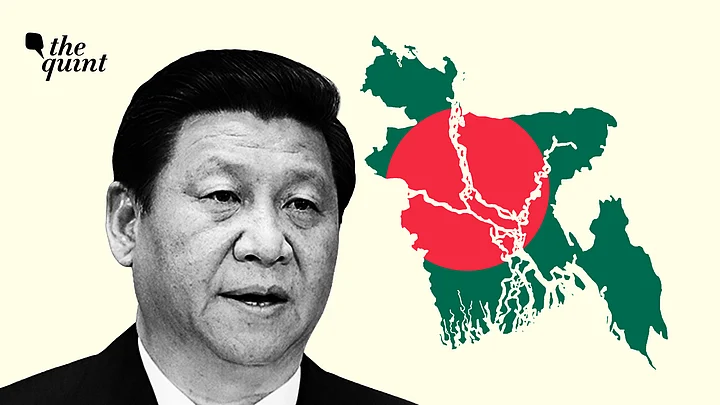
In a move that has deep implications for South Asia’s security balance, Bangladesh and China have signed a deal to make civilian and military drones in its Chittagong region, barely 100 kilometres from the Indian border, which was granted to India in 2015 to develop its Special Economic Zone (SEZ).
The deal, signed on 27 January 2026 between the Bangladesh Air Force and Chinese Electronics Technology Group Corporation (CETC), has rattled India’s strategic community as they recognise what it means for India’s national security.
What's in the China-Bangladesh Deal?
For New Delhi, this deal comes in the wake of growing hostility between Dhaka and Delhi after Muhammad Yunus took over Bangladesh following a coup that overthrew the India-friendly Begum Hasina Wazed’s Awami League party.
Dhaka’s choice of drones and its promise to buy some 20 aircraft from China for 2.2 billion dollars stems from the realisation that China and its flying machines are not just value for money. They proved themselves in the four day scrap between India and Pakistan in May 2025.
It is apparent that Bangladesh, before buying into the idea, was cognisant of how the nature of war has changed ever since drones and aircraft have been deployed ahead of tanks and other equipment used by the infantry. During the four-day war with Pakistan, India reportedly lost only three army men.
As per the deal, Bangladesh would make and assemble different kinds of drones that include Medium Altitude Low Endurance (MALE) drones and Vertical Take-off and Landing platforms (VTOL) drones. The deal will cost 55 million dollars and is being positioned for humanitarian use too due to natural calamities that routinely rack Bangladesh.
So, is this Indian hysteria over drones premature?
A New Troika?
India is concerned about the emergence of a new troika comprising of China, Pakistan, and Bangladesh.
What is concerning for many observers is that the tensions between India and Bangladesh are not reducing, even if the reasons may not be compelling enough to break the settled ties.
The Indian government and its media is incensed by the manner in which the Hindus of Bangladesh are allegedly being harassed and even lynched.
Though these Hindus are Bangladeshi citizens and inordinate attention to their alleged mistreatment could be construed as ‘ internal interference’ in the neighbour’s affairs, India’s shared history and recent policy initiatives by like the Citizen Amendment Act (CAA) that grants Indian citizenship to non-Muslims experiencing trouble in their respective countries lend a new perspective to this issue.
This ugly geopolitical face-off is feeding politics in both countries.
Take, for instance, how the inclusion of Bangladeshi fast bowler, Mustafizur Rehman, in Bollywood star Shah Rukh Khan-owned team, Kolkata Knight Riders, triggered a full-blown crisis after a Bharatiya Janata Party leader, Sangeet Som, took issue with his induction in the Indian Premier League team.
The matter spun out of control when not just Bangladesh boycotted the upcoming T20 World Cup, scheduled to take place in India and Sri Lanka, but Pakistan also cried foul about playing any match against India in an expression of solidarity with Dhaka.
In all this, there is no one crying over the loss of secularism in the region allowing foreign policy to be hijacked by the right wing clergy controlled political parties.
Missing Mediation as Bangladesh Goes to Polls
This ugly scrap with India is being resented by many well meaning Bangladeshis, who are wondering why there are no mediators any more. Moreover, many of these reasonable voices also see reason in Yunus and his government's demand to get their former Prime Minister, Sheikh Hasina repatriated from India to Bangladesh to face the court cases that have been slapped against her.
Expectedly, the cocktail of issues in the upcoming elections in Bangladesh are helping the Jamat-e-Islami. The party had exercised considerable influence over the years, but electorally made little impact. This time it could be different.
If Jamat fails to secure majority support, then the other party that could emerge on top is Tarique Rahman’s Bangladesh National Party (BNP). Called the “prince of darkness" by his detractors, he and his mother, the late Khaleda Zia, have previously displayed dislike for India. Upon his return to Dhaka after 17 years, though, he has been making friendly noises.
Rahman's spokesperson says he will try to mend ties with India. While a BNP win could change the geopolitical euation, the big question would be, what happens, in that case, to the shift that Yunus has brought to Bangladesh’s foreign policy?
Looming Dangers
In the recent months, Special Advisor Yunus has stitched ties with Pakistan, severed since the 1971 war and the alleged rape of lakhs of Bangladeshi women. Putting the acrimony behind, the Pakistan Air Chief met his counterpart in Dhaka recently and promised to work together.
China, too, has been enlarging its footprint in the neighborhood, true to its policy of not engaging directly with India, but continuing with salami slicing its neighbor’s unpoliced land. It is also empowering countries that surround India. Though the Indian government never endorsed it, the Chinese fighter aircrafts and missiles reportedly proved better than the ones used by the Indian Air Force.
There was also merit in the accusations of Indian defence officials claiming China provided real-time intelligence to the Pakistani Air force during Operation Sindoor.
There is merit in this charge as many believe that the Indian intelligence failed to ascertain the range of Chinese missiles that hit the Indian targets. It was the success of their weapons during the operation that allowed the Chinese to sell or showcase their weapons at airshows in Paris and other places.
India has realised that it would make sense to ally with China if it needed to neutralise Pakistan’s soaring regional ambitions. The latter has made overtures to normalising ties with Beijing, but there are no takers for this in the Indian strategic establishment or the media.
More recently, took some time sorting out flights between the two countries. Indian government is not keen to liberalise a visa regime for the Chinese. Some of those close to the Chinese government claim that even the meeting between the two leaders do not remove the misgivings between India and China. The growing animosity between India and Bangladeshi and the emergence of a hostile troika proves it.
(Sanjay Kapoor is a veteran journalist and founder of Hardnews Magazine. He is a foreign policy specialist focused on India and its neighbours, and West Asia. This is an opinion piece. All views expressed are the author’s own. The Quint neither endorses nor is responsible for them.)