
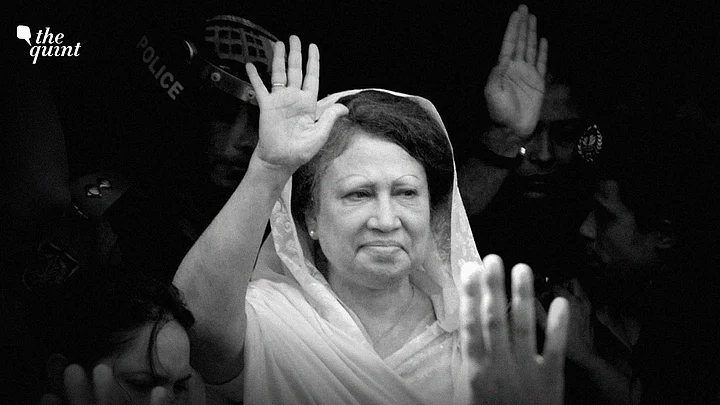
Bangladesh’s first woman prime minister, Begum Khaleda Zia, waited for the nominations for the upcoming general election to end on Monday before calling it a day, for the last time. She was 80 and the end of the day marked the end of the long and politically transformative innings she played.
She was barely 36 when her husband, General Ziaur Rahman, the then president, was assassinated on 30 May, 1981 by a group of military officers in Chittagong.
Pre-empting a military takeover, his Vice President, Justice Abdus Sattar, took over immediately as acting president and the president of the Bangladesh Nationalist Party (BNP).
The army chief, Lt General Hussain Muhammad Ershad, who is believed to have been part of the conspiracy to assassinate Zia, initially supported Sattar’s government.
Ershad blamed Major General Abul Manzoor for the attempted coup and had him killed in jail. However, after Sattar led the BNP to an electoral victory in early 1982, Ershad took over in a bloodless coup in March that year.
All this while Khaleda Zia remained out of active politics. In March 1983, Sattar gave up the BNP presidency to Khaleda Zia and after she was formally elected as president of BNP in 1984, she launched a massive agitation for the ouster of Ershad. He jailed her seven times but mass agitations forced Ershad to resign in 1990. That was Khaleda’s first major political victory.
First Big Steps into Power
She led the BNP to power in the 1991 and became Bangladesh’s first woman prime minister, second among Muslim countries after Benazir Bhutto. She ensured that Bangladesh would be firmly anchored in parliamentary democracy by ending the Presidential system, thus ushering in multiparty democracy. The restoration of civilian rule became her lasting legacy to Bangladesh.
She also built the BNP into a dominant political force, ensuring healthy multiparty competition with Sheikh Hasina’s Awami League.
Her policies embodied women’s empowerment and gender justice. She is remembered for expanding women’s role in education. Making education free for girls up to college level contributed both to a higher literacy rate and increased female participation in the labour force in Bangladesh. Her government pursued path-breaking market reforms by liberalising the economy and promoting private investment in infrastructure growth.
Her rule was, however, also marked by deep failures. Rivals accused her of corruption and of authoritarian practices such as manipulating elections, weakening institutions and suppressing democratic voices.
Alliance and Ideology
A significant strategic shift that defined her political tenure was her alliance with the Jamaat-e-Islami, which represents political Islam. The alliance was rationalised as an electoral compulsion to counterbalance the Awami League. Despite the election victory of the alliance in 2001, it was criticised as a moral compromise with those who collaborated with Pakistan in the 1971 Liberation War.
The alliance with Jamaat deepened Bangladesh’s ideological split between secular nationalism (a platform claimed by the Awami League) and religious conservatism (BNP and Jamaat alliance). It also damaged the BNP’s international image, alienated moderate Bangladeshi voters and smeared it forever with India.
In her first tenure (1991-96), Khaleda forged excellent relations with India, working to improve ties after years of mistrust created by having to deal with military regimes. Her government expanded trade links with India and initiated dialogues on water sharing (later, resulting in the Ganga Water Treaty signed during Hasina’s regime) and border management.
However, the presence of Jamaat in the government in her 2001 term, created unease in India. Bangladesh harbouring militant groups from India’s northeastern states led to that bilateral security cooperation taking a major hit.
India’s fears come true with the arms haul at Chittagong in April 2004 ostensibly meant for ULFA insurgents in India. The weapons (4,930 firearms, 27,000 grenades, more than 800 rocket launchers, 300 rockets and thousands of grenade launching tubes) were intercepted at a state-owned jetty belonging to the Chittagong Urea Fertilizer Limited, which was under the Ministry of Industries led by a Jamaat minister in Khaleda’s government, Motiur Rahman Nizami. The trust deficit between India and the BNP-Jamaat government of Khaleda increased.
Even today, the BNP is plagued by the toxic legacy of the Jamaat alliance. Now it is at pains to stress that India remains “very important” for Bangladesh and that it was ”high time to start a new chapter in bilateral relations”. India also seems to be opening up to the BNP in the present circumstances.
End of an Era
The passing away of Khaleda has put an end to the acrimonious politics of “two Begums”, marked by political and personal rivalry between her and Sheikh Hasina. Now that personal duel is over.
It was a cussed duel. Hasina evicted Khaleda from her house in Dhaka cantonment in 2010, leaving her in tears. The house was later bulldozed. Her son, Tarique Rahman, was tortured by the intelligence agencies damaging his spine. She was blockaded in her party office in Dhaka from January to March 2015—for three months—with the government cutting off water, electricity, internet and phone connections. At the time, she was leading an agitation for fresh elections.
Khaleda was convicted in a corruption case lodged against her by the Hasina government and sentenced to 17 years in jail. She became the sole inmate of Dhaka Central Jail between 2018 and 2020 after all other prisoners were relocated. She was moved to her house on humanitarian grounds with the onset of COVID-19, but banned from political activity. She was ultimately acquitted of the corruption charges.
However, the end of the “two Begums” politics will not necessarily mark the end of Bangladesh’s binary politics. The rivalry between the BNP and the Awami League is embedded in party structures, ideologies and voter loyalties.
The BNP will remain a major political pole but it remains to be seen what will become the second pole of Bangladesh’s emergent politics with the banning of the Awami League. It could be an Islamist one led by Jamaat till the Awami League recovers.
A New Chapter for Bangladesh
Her demise a few weeks before the general election, seems eerily reminiscent of Indira Gandhi’s assassination in a similar context in 1984. Will Tarique Rahman sweep the February general election in Bangladesh, as Rajiv Gandhi did following his mother’s death?
Indira Gandhi’s assassination was violent, dramatic and nationally traumatic. The impact of Khaleda’s demise may not produce the surge of emotion that Rajiv Gandhi benefited from as it is linked to deteriorating health and age.
Moreover, the Bangladesh general election has been triggered by complete public disillusionment with governance in the past. Tarique Rahman and the BNP will nonetheless gain some emotional support depending on how the BNP is able to mobilise public grief.
Khaleda Zia will be respected for never going into exile despite severe persecution. She passed away at a time when, with the fall of the Hasina regime, respect for her was at an all time high.
(The writer is an independent journalist based in Delhi. This is an opinion piece and the views expressed above are the author’s own. The Quint neither endorses nor is responsible for the same.)
