
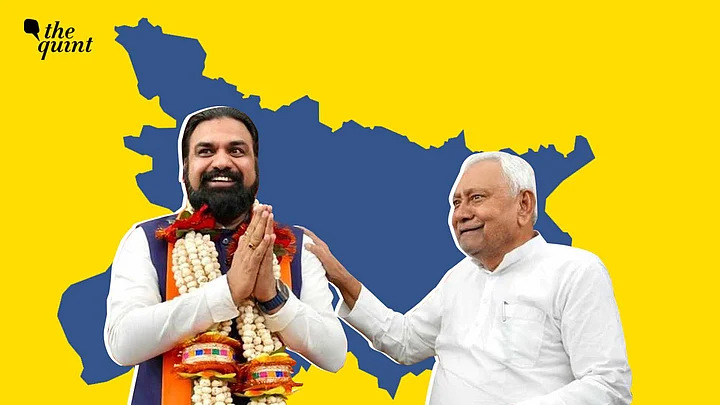
Exactly five months after winning a fresh mandate, Nitish Kumar, on 14 April, handed over his resignation to Bihar Governor Syed Ata Hasnain. Bharatiya Janata Party's (BJP) Samrat Choudhary, who sat alongside Kumar at the Raj Bhavan, was elected leader of the legislative party, as well as that of the NDA in Bihar in a quick succession of events.
The script—written on the day of the Bihar Assembly poll verdict on 14 November 2025—seems to have played out seamlessly. The BJP, with 89 MLAs and a nearly decimated Opposition in Bihar, achieved an astounding victory, checkmating arguably the most maverick politician of India by catching hold of his jugular vein—ie, Kumar's ability to forge strategic alliances that allowed him to remain Chief Minister over the years.
Samrat Choudhary takes charge of Bihar as the Chief Minister at a time when the BJP is unveiling its visibly domineering face in Indian politics. The BJP has cut Janata Dal (United) [JD(U)], a key National Democratic Alliance (NDA) ally, to size.
Despite having 84 MLAs, the JD(U) will now be a junior partner to the BJP—a sharp role reversal from post-2020 elections in the state when Kumar stayed on as CM and completed the full term despite his party winning just 43 seats.
The move coincides with BJP’s further assertion to dictate terms of Indian politics, as seen in its summoning of a special, three-day session of Parliament to pass three consequential bills with far-reaching ramifications on delimitation and women’s reservation.
Samrat as BJP’s Himanta in Bihar
For decades, the BJP in Bihar remained caught in self-doubt. Carrying the label of being a ‘Brahmin-Baniya party’, the saffron party conveniently backed Kumar to break the hold of Lalu Prasad Yadav in state politics. Lalu, as the “messiah” of social justice politics, seemed invincible. But as cracks eventually emerged from within, Kumar first bolted to the Lalu Prasad Yadav camp, and then went on to script his own strand of social engineering.
In time, the Kurmi-Koeri caste alliance in Bihar became a potent political force under the leadership of Nitish Kumar.
As a counterweight to the Muslim-Yadav base of Lalu Yadav, Nitish Kumar sought to politically empower the fringe within the Other Backward Classes (OBC) bloc. As the BJP's support base remained largely consolidated within the Brahmin-Bhumihar-Baniya castes, Kumar became Bihar’s political master.
But the Koeris, also called Kushwahas, began growing restive. Its leaders would often lament that though the Koeris in Bihar are twice in number than the Kurmis, their share in power was insignificant. Kumar hails from the Kurmi caste, and he often face the accusations of promoting leaders and bureaucrats from his own caste.
The BJP sniffed out an opportunity in this caste split, one that would finally empower it to grow out of the shadow of Kumar. Samrat Choudhary’s father, Shakuni Choudhary, was a towering Koeri leader in the Rashtriya Janata Dal (RJD). Choudhary inherited his father’s RJD legacy to launch his political career until he parted ways to align with the BJP in 2018.
The party bet big on Samrat Choudhary by first making him the party's Bihar unit president in 2023 and eventually the Deputy Chief Minister after the NDA's 2024 win.
But all is not smooth for the saffron camp. While BJP gets its first CM in Bihar, party workers have to live with the fact that Choudhary is a turncoat with no substantial background in the Rashtriya Swayamsevak Sangh (RSS), and also not raised in the saffron laboratory. The consolation for them, nevertheless, will be the fact that Choudhary opens the doors of the politics of social justice for the BJP in Bihar.
The Long Shadow of Nitish Kumar
But in Bihar, there’s no politics without Nitish Kumar, as the popular political adage goes in the state. Even after leaving the CM's post, Bihar’s most powerful political statement may remain strong.
The BJP will risk disturbing the social engineering stitched by Kumar to its own perils, with the Kurmi-Koeri alliance at the centre stage and upper castes, extremely backward castes, and Mahadalits in supporting roles.
The long line drawn by Kumar in governance that earned him the tag of ‘Sushasan Babu’ may act as a high wall for Samrat Choudhary to scale in near future.
Having been an engineer by qualification, Kumar already had a fair bit of political experience following his stints as Union Minister when he assumed the charge of Bihar CM in 2005. Kumar had already built bridges with the bureaucracy before becoming the CM.
The BJP, even if it desires, may not touch Kumar’s prohibition policy, which brought loads of votes for the NDA in elections, while carving out a core women constituency. That in itself limits the scope of a Samrat Choudhary-led government in Bihar.
Bihar is Not Turning Saffron
Since getting the home department, Choudhary, in the last five months, had sought to model himself on Uttar Pradesh CM Yogi Adityanath. His bulldozer actions against encroachers of public land grabbed headlines in the state. He also carries the onus to fulfil poll-time promises by Amit Shah to “identify and deport” illegal infiltrators.
But an aggressive saffronisation bid risks rupturing the delicate BJP-JD (U) equations. BJP appears to remain sanguine with this understanding, as JD(U) insiders claim that Samrat Choudhary has also been a choice of Kumar as his successor.
But Kumar, after losing the CM's chair, now has nothing to lose, which, in turn, may make him more assertive in managing the affairs of the NDA in Bihar. This has already been hinted at by Kumar repeatedly in the last few days, as he told his supporters—“Hum kahin nahi ja rahe hain" (I am not going anywhere).
Indeed, Kumar is moving to his 7, Circular Road residence in Patna from where he has staged more than one political comeback in the past. There he will also be a neighbour to his predecessor Rabri Devi.
After becoming Prime Minister, Narendra Modi sent several BJP’s veterans—LK Advani, MM Joshi, Yashawant Sinha, Shanta Kumar, and others—into the Marg Darshak club. That club proved to be a retirement home. Nitish Kumar now takes on the role of Marg Darshak too. But Kumar, with the strength of 84 MLAs, is showing no desire for a life of peaceful retirement yet.
A day before resigning as the CM, Kumar had hit the road with party leaders and officials on an inspection tour of a district. He may possibly become a tough monitor of the Samrat Choudhary-led government in Bihar.
(Author is a senior Delhi-based journalist, with over two decades spent in reporting affairs of the BJP and the JD (U) for India’s leading English dailies. This is an opinion piece and the views expressed are the author's own. The Quint does not endorse or is responsible for them.)
