Muslims are no longer just ‘daai maas’ or 'langda chachas'. They are either bomb-chucking lumpens or dons who squat in dimly lit ghettoes. Is this what we are?
Minorities are expendable, and if at all, featured in today's films or web series as sidebar accessories in order to appease the Muslim audience, a sizeable vote bank of film and OTT aficionados.
In any case, how many of this generation’s filmmakers even know about the cataclysmic details of the country’s 1947 Partition, or are motivated in doing something constructive about the sub-continent’s trauma through a populist medium? Entertainment, it is presumed, just doesn’t gel with purposeful stories.
Certainly don’t expect a Garm Hava (1974) today, which lingers in the heart and mind, as one of the very few films that did justice to the depiction of Muslims, without patronising, caricaturing, or belittling them. The finale asserted that India is their ‘watan’, their homeland, whatever agenda the vested interests might have to broadly depict them as anti-nationalists.
In the new millennium, trying to hawk a script with Muslim protagonists like I have (three of them now gathering cobwebs) takes you straight to the exit gates, manned by Sphinx-like security guards.
'The Great Shamsuddin Family'
Which brings me to the topic du jour—The Great Shamsuddin Family—written and directed by Anusha Rizvi who returns to the scene 15 years after her debut Peepli Live.
The compact 97-minuter—a rarity these days—on a 'normal' miyan tabbar was recently released on Jio Hotstar. It revolves around Bani, a writer in her early 30s who has had her fill of rejection slips, controversies, and blanked-out reports as a journalist.
The film opens in a roomy barsaati in Jangpura close to Humayun’s Tomb in New Delhi. Bani has a ‘presentation’ to submit to an American university within a maddeningly impossible deadline. In her professional life, she’s desperate to escape the everyday anxieties of the politically coloured ‘naram-garam hawa’, visible in the national capital’s poor air-quality control.
Circa 2015, when Aamir Khan and his then-wife and filmmaker Kiran Rao expressed their doubts on television about intolerance and what the future portends for people of his faith. After Khan said he was mulling over such thoughts frequently, a huge furore erupted. Trolled mercilessly, he backed off the objectionable remarks prudently.
Bani, no celebrity, obviously is beset by similar doubts—or call it paranoia if you must.
A Funny, Cautionary Chamber Piece
Gratifyingly, Bani’s troubled state of mind isn’t amplified, but whispered among the lines of dialogue.
In fact, Rizvi’s screenplay appears to be semi-autobiographical, reflecting the voices of secularists, a word of virtue now mangled into 'sickularists'. In the same vein, liberalists and intelligentsia are mocked as rabble-rousers.
So who’s the villain of The Great Shamsuddin Family?
The barsaati’s doorbell is—with Rizvi electing to narrate her story as an often-funny, often-cautionary chamber piece, rather than one more work of political frank speak, articulated by, say, Shyam Benegal’s trilogy on Muslim women (Mammo, Sardari Begum, and Zubeidaa); Sagar Sarhadi’s immensely undervalued Bazaar; Mani Ratnam’s Bombay; and in its own hyper-glossy fashion, inadvertently so, by Karan Johar’s My Name is Khan.
The Quintessential Muslim Family
Back to the hyperactive doorbell, which admits a motley crowd of as many as 15 characters, who charge into Bani’s home with their disparate crises to resolve within 24 hours. As the clock ticks, that application to the American university is as dead as Bani’s laptop without a charger.
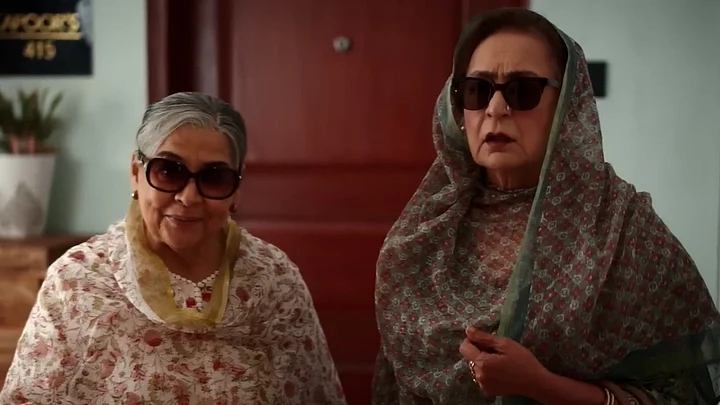
Of the unwelcome visitors, there's her ageing mother with her equally magpie-like aapas who want to take off on an Umrah pilgrimage; her elder sister who's in a soup over a hefty withdrawal from a bank; a Humbert-Humbert-esque pseudo-university professor accompanied by his very own Lolita student; a cousin who must urgently marry the love of his life, and a Hindu. Inevitably, it comes to a juncture where more isn’t the merrier.
However, this overpopulated ensemble is essential to bleep the nature of a quintessential Muslim family.
Yes, women can smoke and drink without guilt pangs. The conservative old women perform their daily namaz dutifully. A Damocles sword does hang over the minority community. Inter-caste marriages still have to be accepted.
The Muslim family, because of circumstances, is strongly matriarchal, while the Hindu bride-to-be comes from a patriarchal backdrop, with her cellphone being called incessantly by her father.
Unannounced bank mergers send common people, especially senior citizens, into a tizzy. Significantly, at the end of a madcap day, Bani resolves, like Balraj Sahni did in Garm Hava, that her homeland is the place to be in, whatever the daunting odds may be.
To Live and Let Live
Playing out theatrically, with little or no respite to venture towards the outdoors, the film may not to be technically top-grade, what with too many over-the-shoulder scenes and some jarring close-ups of the bridegroom-to-be. And the excessively jaunty background music is unbearably ‘cute’ occasionally.
Never mind such niggling flaws. Of the performances, Kritika Kamra is surprisingly life-like as Bani.
Expectedly, though, Farida Jalal as a jabberwocky aunt is perfection personified.
All the pros and cons considered, Rizvi has given us a miniature of a film which states that it’s not all about loving your family. Above all, it’s about co-existence—to live and let others live respectfully.
(Khalid Mohamed is a film critic, film director and screenwriter. He has written novels and biographies and is currently working on his memoirs of Bollywood.)