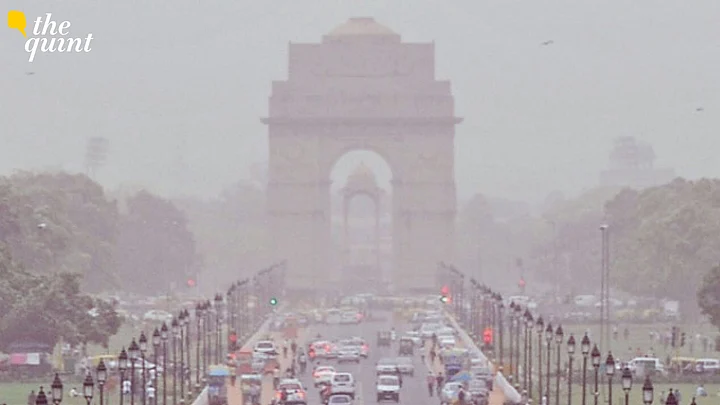
A recent summit in Delhi has triggered online discussions on whether AQI (Air Quality Index) can be viewed as “a temperature” and the effectiveness of spraying water at pollution hotspots to curb toxic air.
Such misconceptions only add to the everyday confusion about how pollution actually works—what the AQI measures, what measures like water-spraying can and cannot achieve, and how weather and emissions interact.
So what does the AQI actually measure? What can water-spraying do, and not do? And how do weather and pollution sources shape the air we breathe? Let’s break it down in simple terms.
How AQI Really Works?
No, AQI isn’t like a temperature that “can be measured using any instrument”, but it is like the current outdoor temperature reading on your phones in that AQI is the daily report card of our air quality.
It aggregates levels of little particles, such as PM2.5 and PM10 (dust that gets deep into your lungs) along with gases like nitrogen dioxide from car exhaust, sulphur dioxide from factories, carbon monoxide from our vehicles. The measurement of each, done through specialised machines is standardised and carried out by the Central Pollution Control Board (CPCB).
It’s all about location. To measure ambient air accurately, monitors must have at least 20 metres of open space around them, free of trees, walls, or buildings.
When pollution gets filtered out by nearby obstructions, the monitor records less than what’s actually in the air.
Some Delhi stations in news reports have been hidden behind trees or up against walls which could lead to a 20-50 percent discrepancy in readings.
Once those monitoring systems are in place and generating real, consistent numbers, everyone from the general public to those who are trying to policymakers can rely on the numbers and act based on them.
Why Winter Smog Hits So Hard?
Delhi’s air quality is at its worst in winter. In November 2025 alone, the city saw 23 ‘very poor’ days and 6 ‘severe’ days, with PM2.5 levels crossing 200 micrograms per cubic metre—roughly equivalent to inhaling the smoke of about 12 cigarettes a day.
Understanding how weather and emissions interact helps explain why November feels so suffocating: the air isn’t just polluted, it’s stagnant, allowing contaminants to accumulate for days.
During winter, farm fires in neighbouring states add another 20–30 percent to the city’s pollution load, carried in by seasonal winds.
Cold weather traps it all. A layer of warmer air sits above the city like a lid, trapping pollutants in the cooler air below. This season also brings low wind speeds, which limit fresh air flow, while high humidity makes particles stick together and grow. And although improved farm machinery has reduced stubble burning, heavy traffic across 62 congested intersections and persistent construction dust continue to keep pollution levels high.
Festivals like Diwali add to the burden, leaving behind toxic residue from fireworks. Meanwhile, the lack of sufficiently disaggregated data makes it hard to track real trends, even though doing so is crucial for identifying patterns.
The Limits of Water Spraying and Better Dust Fixes
You can't just sprinkle water on the roads or pavements to address an entire city’s pollution problem.
Misting may calm down the dust on the roads for a few hours, but it certainly does not address the fumes from vehicles or the smoke from factories.
Tyres and brakes generate road dust loaded with metals like zinc and iron. Spraying water can temporarily pin this dust to the ground, cutting it by about 50 percent for a short period. But it dries quickly, especially in Delhi’s arid conditions, and requires large amounts of water that could be better used elsewhere.
And even then, it tackles only a small slice of the problem, since dust accounts for just about 20 percent of fine particles.
A better approach would be to vacuum the roads, which can remove dust and reduce levels by 40–60 percent; build full pavements with proper drains to prevent puddles and sludge from turning into mud; and use dust suppressants to keep dirt down for longer. Combined with fewer potholes, this also reduces how much dust cars kick up in the first place.
These measures last longer and are more resource-efficient, allowing water to be diverted to drinking supplies or agriculture. Moreover, studies from cities such as those in California show that vacuum sweepers and paved roads can cut dust pollution by about 50 percent, without the need for daily re-wetting.
Lessons from Recent Plans and What Science Suggests Next
Some recent measures to curb Delhi’s air pollution include live monitors on factory smokestacks, bans on old polluting trucks, a target of 5,000 electric buses in the city (each replacing hundreds of diesel buses), and tree planting with community involvement. These initiatives brought early wins in 2025, with PM2.5 levels falling by 15–18 percent in some areas between January to August.
To sustain progress year-round, especially during the winter, policies must tackle the biggest sources directly.
Accelerating the shift to electric buses and autos is key.
This can be done with incentives to ensure that 80 percent of public transport vehicles are electric by 2030, supported by widespread charging hubs and subsidies. Traffic congestion can be reduced with AI-enabled cameras at hotspots, dynamic traffic signals, and fines for idling vehicles, cutting emissions by up to 30 percent.
Monitoring and transparency are equally important.
Relocating poorly placed monitors, publishing raw hourly data online, and cross-verifying with satellite imagery can improve accuracy, build trust, and help identify trends early.
Dust control is another critical step.
Implementing 1,000 vacuum sweepers citywide, paving all roads and streets with sidewalks by 2027, banning debris and sand trucks, and avoiding bio-stabilisers on construction sites can significantly reduce particulate pollution.
Regional coordination is crucial.
The Commission for Air Quality Management in the National Capital Region and Adjoining Areas (CAQM) should enforce fines for stubble burning, scale bio-decomposer use to 90 percent of fields with drone monitoring, and set deadlines for industrial pollution control—with tax incentives for early compliance.
States should also share wind maps and trajectory models for farm fires and industrial plumes to anticipate pollution movement.
Finally, public participation can amplify these efforts.
Apps for reporting illegal burning, school programs on air science, and neighbourhood green audits can make citizens active partners. Aligning budgets with air-quality objectives under independent supervision ensures accountability.
These measures are far from pie-in-the-sky. Beijing implemented similar policies and halved PM2.5 levels in a decade. Delhi’s air quality has improved slightly each year, but winter spikes show the problem persists. Transparent data, science-backed policies, and collective action can turn knowledge into cleaner air for residents and children playing outside.
(Anjal Prakash is a Clinical Associate Professor (Research) and Research Director at Bharti Institute of Public Policy, Indian School of Business (ISB). He teaches sustainability at ISB and contributes to IPCC reports. This is an opinion piece and the views expressed above are the author’s own. The Quint neither endorses nor is responsible for the same.)