If we must watch men enact graphic violence on each other, then I would much rather they came from the house of Vishal Bhardwaj than that of Aditya Dhar (Dhurandhar). At least Bhardwaj has some taste when it comes to displaying violence. At least the violence isn’t coloured by religion. At least the women have strong, colourful presences. At least we still get the gangster Khan sa’ab (Nana Patekar) looking at a married Hindu woman in a burqa and saying, ‘Burqa mein sindoor? Yahi to hai humaara India.’
And luckily, the orgy of violence doesn’t blunt Bhardwaj’s distinctive authorial voice.
Coming from the musician-turned-filmmaker, Bhardwaj’s O’Romeo is a marvellous crime opera, filled with unusual musical cues (the dreamy love ballad ‘Hum To Tere Hi Liye Hain’ gets a rock makeover in an action scene), absurd humour in the unlikeliest places (major scenes take place in both a Mumbai Ganpati visarjan and a masked carnival in Spain), and a stacked cast.
Randibaaz to Romeo in 1990s Mumbai
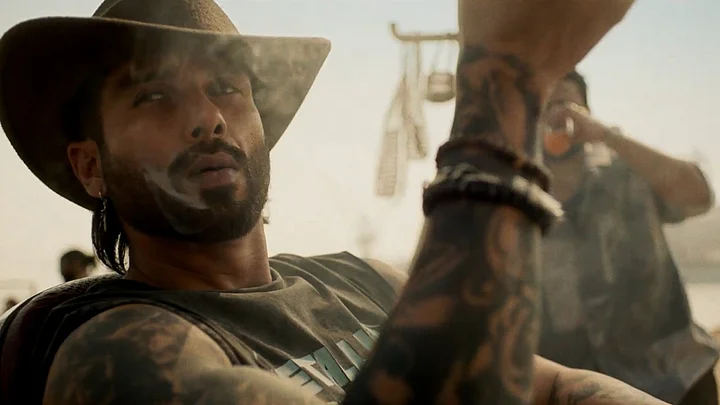
Shahid Kapoor plays a gangster in 1995 Mumbai by the name Ustara, a smooth, sexy criminal who carries out hit jobs on Khan sa’ab’s orders. One such hit job involves an action scene set at Liberty Cinema. On the screen is playing—once again, Bhardwaj’s absurdist humour—the song ‘Dhak Dhak’ from the 1992 hit Beta (which also starred Aruna Irani, who plays a madam here). As Madhuri Dixit and Anil Kapoor cavort in haystacks, Ustara single-handedly slices and dices about 20 men in the cinema hall. Ben Bernhard’s cinematography is aces here, fully capitalising on the film projection as a source of light to frame our hero against.
In his downtime, Ustara likes to spar with his daadi (Farida Jalal) and also fool around with women from the local kotha run by Aruna Irani’s madam. But the film’s title tells us what lies in store for Ustara: as a character remarks, he will go from randibaaz to Romeo. He may shake a leg with the dancer Julie (Disha Patani in the film’s sole forgettable role), but he will be unable to stop himself from falling for the shareef ladki Afshaan (Triptii Dimri).
Kapoor is, unsurprisingly, magnetic: fully in tune with Bhardwaj, he conjures up Ustara as a many-coloured manic man and sticks him in our minds.
Dimri is also good, although not revelatory. (We have seen her play these tremulous but courageous women facing up to angry men before, in Animal and Dhadak 2.) And Afshaan is a memorable heroine. She has her own motives: she arrives at Ustara’s door with a hit job for him. And she wants not one but four men killed.
A Pacy Film
Her story is laid out in the first of the film’s several skilfully woven flashbacks—editor Aarif Sheikh maintains a masterful handle on Bhardwaj and Rohan Narula’s script (from a story by Hussain Zaidi).
There is a rhythm to the film that rarely lets up. You could argue that there is a slight slackening post-interval, but despite my initial misgivings about the film’s three-hour length, I couldn’t begin to point at what should have been cut out (except perhaps the outrageously generic item number “Aashiqon Ki Colony”).
Everything interlocks very satisfactorily and almost every last character has a part to play—and a specific flavour. The romance between Afshaan and Ustara is delicately arrived at, but—and this is where O’Romeo differs once again from Dhurandhar—Afshaan has a mission and she won’t allow affairs of the heart to come in her way. One of her targets is Jalal (Avinash Tiwary, who is introduced fighting a bull and is built like a bull himself), a gangster who lives in Spain with his wife Rabia (Tamannaah, who steals her few scenes).
All these characters thunder towards each other, with overlapping backstories and individual interpersonal ties.
Some of these are not fully developed (in particular, Ustara’s past association with Jalal is elided for most of the film), but Bhardwaj’s control is very good at tiding us over these grievances.
Vishal Bhardwaj as a Conductor
I like to think of him less as a filmmaker than as a conductor. He knows how to direct the strains of his story and when to allow different pieces to take precedence so that his audience is consistently invested. There are very few “aha!” twists in this film, but the suspense is thrilling nonetheless.
And there really isn’t anything like his feel for music. His songs—peopled with riffs designed to hook you—are only part of the musical landscape. The background score is something else, making its presence felt in welcome ways, allowing space for dark humour and setting the stage for slick action. And there’s music everywhere in the film. Afshaan is a trained classical singer, and Ustara fiddles around with a guitar. One of Ustara’s lackeys is perpetually playing the flute (the film opens with a shot of him).
But Bhardwaj is also self-aware, poking fun at his own musical flourishes. At one point, in a heated moment, a major character is playing the trumpet as one of his associates tries desperately to talk to him. The associate, in anger, switches off the trumpet’s amplifier and cuts off the music.
It’s a classic Bhardwaj moment of violence mixed with humour. And O’Romeo is a very enjoyable example of the man’s many talents.
O'Romeo releases in theatre on 13 February.
(Sahir Avik D'souza is a writer based in Mumbai. His work has been published by Film Companion, TimeOut, The Indian Express and EPW. He is an editorial assistant at Marg magazine.)