
"Whether we like it or not, if the US is seen as a 'disruptor' and the EU [European Union] is not really there, it gives the Chinese space. The least you can do is for the world to see you by their sight," says Manjeev Singh Puri, former lead negotiator for India at the United Nations Framework Convention on Climate Change (UNFCCC).
"It is important for our global standing, especially within the Global South. That’s the nature of COPs—they are like power games," Puri, who's also a former Indian Ambassador to the EU, tells The Quint.
A heavyweight in climate diplomacy, India has long led the charge for climate justice at the annual UN climate summits. It has consistently pushed for more accountability from Global North countries, arguing that historical emissions require more transfer of money and technology from them. "They were also one of the only countries that put forward an official estimate for the climate needs at COP29," Pooja Vijay Ramamurthi, Fellow, the Centre for Social and Economic Progress (CSEP), tells The Quint.
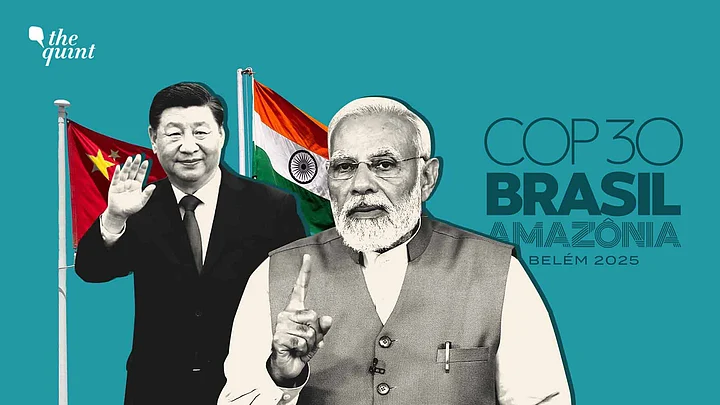
But, as COP30 commences in Belém, Brazil on Monday, 10 November—with UNFCCC Executive Secretary Simon Stiell urging countries that "your job here is not to fight one another; your job is to fight this climate crisis together"—India faces the same turbulent geopolitical headwinds shaping the summit. Especially so, as the US' absence has elevated China’s role as a leading climate actor.
"China is on track to be the global hegemon. If the Global South has to choose between India or China as its leader, the answer is known already," says Sanjeev Ahluwalia, Distinguished Fellow at independent think tank, Chintan Research Foundation.
"We should avoid trying to measure up because we can't. But, for the next three decades, India has to steadfastly build itself into a global leader."Sanjeev Ahluwalia