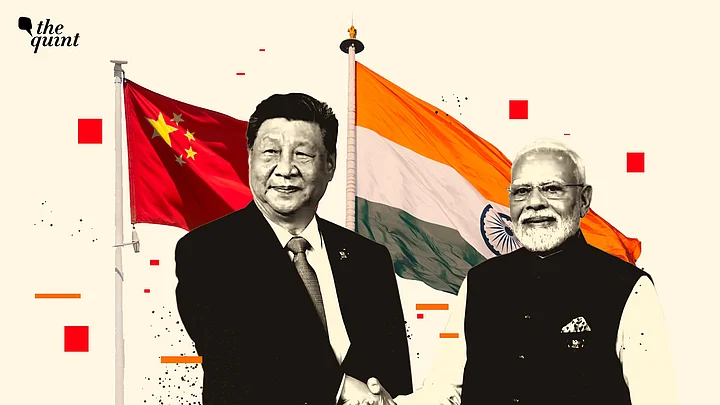
Long before India’s National Security Advisor (NSA) Ajit Doval travelled to Beijing, there were justifiable fears in the security establishment that the Chinese defence forces may get ambitious and try capturing parts of Arunachal Pradesh when the country was busy hosting the BRICS Summit. It is Doval who is reported to have convinced the Chinese to keep their swords in their scabbards and attend the summit, held in New Delhi over the weekend, as well as a bilateral with Prime Minister Narendra Modi.
The persuasion worked as Chinese President Xi Jinping himself arrived in New Delhi on 12 September.
BRICS, Bilaterals and Power Moves
Within moments of his arrival, body language experts got cracking. When Jinping got off his aircraft, his body language did not appear friendly. Some felt he seemed angry and off-puttish. In contrast to these readings, though, he did not get straight into his armoured car as is typical, pausing briefly to look at the performances of Indian dancers organised for his welcome at the airport instead.
Expectedly, Jinping was in Delhi for exactly a day (instead of the proposed two-day visit). While he was here, he made it abundantly clear that he had a lot on his "dinner" plate—pun intended. He did not attend the formal vegetarian banquet, and instead spent time eating in the comfort of his room, where he met a number of his advisors. By many, this has been read as a message to imply who's in charge.
At BRICS, Jinping offered to mediate in stopping the US-Iran war. In a stunning gesture, seen with trepidation by pro-West Indian diplomats, he offered a five-point AI-centred manufacturing plan. Nothing will come into action till the next BRICS summit that takes place in China next year, with China having a clear idea of what it expects of BRICS, sans the display of Indian ambivalence towards the US and the West.
Despite displaying policy clarity, PM Modi appeared concerned by what Jinping thought of the BRICS deliberations navigated by him. He was heard twice, saying, “Is everything fine, President Xi?"
Jinping Needed Some Convincing
The circumstances in which NSA Doval was sent to keep the Chinese leader restrained about intrusions in Arunachal Pradesh—and the re-christening of Indian posts and border points with Chinese names—suggest serious forays in Ladakh (in 2019) that needed urgent intervention of political leadership from both sides.
The quiet buzz in both the capitals was that the Chinese Army and its political leadership led by Jinping are not on the same page on how they perceive borders between the two countries.
The Chinese Army top brass was of the view that India only understands the language of power, and hence, their defence forces need to teach India a lesson by displaying the considerable might of their fighting machine. By way of record, China shares border with 14 of its neighbours and it has settled its border with12 of them.
Only Bhutan and India have unsettled borders with China. Bhutan, too, is on course of settling it—leaving just India. Informed sources in the government made it amply clear to NSA Doval that he should convey to his counterpart, Foreign Minister Wang Yi, and his boss that they should not "embarrass Delhi and engage in mindless adventurism when the countries of the BRICS grouping were converging at India’s capital," an expert in India’s security establishment told The Quint.
It is learnt that the Chinese wanted guarantees about Indian sincerity in sorting out border issues.
Despite the promise of sorting out the border issue, Jinping had to be "persuaded" to attend the summit. His absence would have robbed the event of the glamour as well as the importance of BRICS, which is growing into something far bigger than what the Goldman Sach’s economist, who conceived the compact, must have conceived.
The Quint has learnt from sources close to the developments that Jinping relented after he was given assurances from India, including better management of media, which he felt was really going rogue.
"Xi had issues with Indian social media. He was of the opinion that US-controlled social media company cause his grief to humiliate him. Xi wanted the Indian government to stop it," an expert in India’s security establishment told The Quint while requesting anonymity.
Border Issues Loom in Background of BRICS Banter
That is the reason why the border talks between the two special representatives began in right earnest on 25 August—about 20 days before the BRICS summit. The progress in the talks were encouraging with a suggestion of ensuring early harvest or agreeing in settling issues in sectors where the disagreement is less.
This was particularly in the Sikkim sector. India had talked of early harvest in its past conversations, but rescinded on it at a later date. The belief expressed by the Chinese official, a former ambassador, was that early harvest could benefit from an increase in trade between the two sides, a move that the Indian government has been resisting for a while.
The disputed areas are not just in Sikkim, but also in the Ladakh and Bhutan region where a scrap in Doklam (2020) led to a major slide in ties between the two neighbours.
The latest flashpoint is in Arunachal Pradesh where reports of intrusion are coming from a number of NGOs and legislators. In the BRICS meet, it was made clear by the Indian media that the Chinese PLA troops were still forcefully occupying all their positions in Arunachal Pradesh.
China did not make Arunachal Pradesh an issue, but left its Commerce Minister to negotiate with his Indian counterpart, Piyush Goyal. China wants a reset in ties, like they were in 2014, but New Delhi wants “incremental” approach to the ties. India still does not trust China, which insists on an "all-or-nothing" approach. It wants India to give the same concessions and privileges to China as it does to the Western countries. India is not willing as yet. However, Indian companies and economic tsars want Chinese investment back in india.
This is unlikely to happen as the border issue still gnaws India and China both.
The allegation is that the Chinese have gobbled up pastoral land making it difficult for local people to take their cattle to the same pastures. Additionally, for people belonging to Arunachal Pradesh, the Chinese government has been issuing paper visas for a while.
The idea of early harvest, though talked of in the Sikkim sector only, seems interesting, but nearly everyone suggests that India, being a noisy democracy, may find it difficult to hand over any part of the land it considers as its own. The Opposition may just fry the ruling party as an entity that cannot look after national interest.
Gepolitical Foregrounding
Besides the compulsion of buying peace at the border with China in order to smoothly host BRICS, there are many geopolitical reasons that have metamorphosed India-China ties in the last year or so.
The biggest change that has been precipitated by the presidency of US President Donald Trump. He has followed a two-tack approach with India and has diminished its status as a favoured power that served as a counterpoint to China. Instead, it has given greater priority to China—and maybe hosting a "G-2" summit with Jinping later this month in Washington.
Trump has had to backtrack on a number of issues with China, just to ensure that its technology companies are not starved of critical inputs and markets. Moneybags like Elon Musk who have sizeable exposure to the Chinese market were the drivers of the American policy on China. Trump also slapped more sanctions on already existing levies, invoking a smorgasbord of all kinds of economic measures against China.
Ever since the US attacked Iran on 28 February, the sanctions against China and Russia have increased. This has not lowered China’s profile as it has not bent to Trump’s diktat. In fact, when Trump initiated a new round of deathly sanctions against Iran to pauperise its society, China as well as Russia did not back off.
Though silent, India is exercising its strategic autonomy and continue to converse with Iran. PM Modi met the Iranian President in Delhi. This was their second meeting after Bishkek where the Shanghai Cooperation Organisation (SCO) meeting took place. In many ways, it was a meeting that set the course for BRICS and allowed India to refurbish its credentials as a nation whose heart beats for the poor and oppressed.
The SCO resolution signed by India was critical of the US and its unprovoked attack on Iran. It also accused Israel of a genocidal war in Gaza. This was a major departure in its foreign policy. Sources claim that China and Russia were determined that India would not be allowed to ride on two boats, the other one being the US. BRICS could have been an opportunity for India to solve many issues—including to prove to its BRICS allies that its no longer close to the US and is keen to mend fences with its neighbour China.
Whether it has succeeded or not would become evident soon enough.
(Sanjay Kapoor is a veteran journalist and founder of Hardnews Magazine. He is a foreign policy specialist focused on India and its neighbours, and West Asia. This is an opinion piece. All views expressed are the author’s own. The Quint neither endorses nor is responsible for them.)