
UPI MDR is a Fancy Name for BJP’s Dream Policy: Bank Transaction Tax
The government says it’s not a tax. But who pays, and cash restrictions, tell another story, writes Manu Ramshetty.
advertisement
On 14 September, a gazette notification quietly redefined 'free UPI'.
Instead of a guaranteed 'free UPI' for everyone, the law now only covers payments up to Rs 2,000.
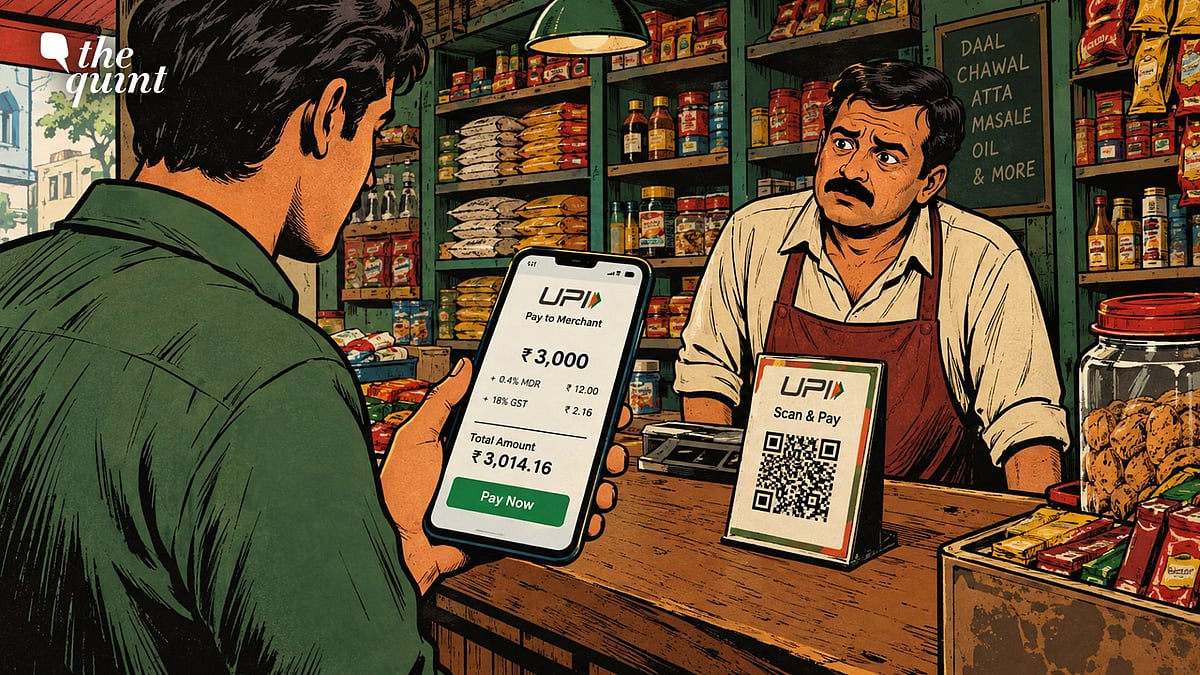
The new rates came out a day later. From 15 October, merchants receiving over Rs 2,000 via UPI must pay a Merchant Discount Rate (MDR) of 0.4 percent, capped at Rs 300. The government set a flat Rs 5 fee for railway, fuel, telecom, and insurance payments.
Small merchants receiving up to Rs 1 lakh a month via QR codes do not pay this fee. Transfers between individuals also remain free.
In August 2022, the Finance Ministry called UPI a "digital public good" and promised they would not charge for it. In June 2025, they dismissed rumours of an MDR on UPI as "completely false, baseless, and misleading".
Now, they have officially announced the MDR, and officials say they will not roll it back. The Opposition calls it a "UPI tax". I go further.
The Merchant Pays, and Then You Do
The Finance Minister told the Parliament that merchants will bear the MDR, and the National Payments Corporation of India (NPCI), too, says merchants cannot pass it on. But shopkeepers set their own prices. No regulator can stop a jeweller from adding 0.5 percent to the price tag or an electronics dealer from offering a cheaper "cash price".
The government claims the fee ignores 96 percent of merchant transactions. However, in 2025-26, payments above Rs 2,000 made up only 4 percent of merchant UPI transactions, but roughly two-thirds of the total money transferred. The MDR targets where the money is.
The Rs 300 cap also favours the biggest payments. The charge hits Rs 300 on a Rs 75,000 payment and stops rising. So, a Rs 1 lakh purchase effectively pays a 0.35 percent rate, while a Rs 5,000 purchase pays the full 0.4 percent.
The Subsidy That Was Always There
The government's argument about subsidies deserves a look. The Centre paid Rs 3,631 crore in 2023-24 to encourage RuPay debit cards and small UPI payments, and it budgeted Rs 2,000 crore for 2026-27.
But giving citizens a way to exchange money is a basic duty of the State, whether they use paper or digital money. Cash has never been free. The Reserve Bank of India (RBI) spent Rs 4,875 crore printing banknotes in 2025-26 and Rs 6,373 crore the year before.
This does not even include the costs of mints, currency chests, cash vans, guards, and salaries. Nobody bills citizens directly for cash or calls it a subsidy.
The "compensation" excuse also fails. The government never paid the UPI incentive to the NPCI. It paid the merchant's bank, which shared it with the customer's bank, the payment provider, and the apps.
The new MDR will go to these exact same companies. Brokerages estimate the MDR will give banks and fintech firms Rs 15,000 crore to Rs 20,600 crore a year. This is many times larger than the subsidy the government claims it is replacing.
Meanwhile, the government says it will still pay incentives for rural expansion anyway. Paytm's founder even told analysts that the MDR money "will come in the bottom line".
The exchequer gets its cut elsewhere: tax experts estimate the GST on this MDR will bring the government Rs 3,500 crore to over Rs 5,000 crore a year before input tax credits.
The Law Fences In Cash
This is why I call it a tax. You don't have a choice but to pay digitally. The Income Tax Act, 2025, restricts cash usage. Section 186 (formerly 269ST) forbids anyone from receiving Rs 2 lakh or more in cash in a single day, from one person, or for one occasion.
If you break this rule, you pay a penalty equal to the cash amount. Sections 185 and 188 (formerly 269SS and 269T) forbid taking or repaying loans or deposits of Rs 20,000 or more in cash. If a business pays an expense over Rs 10,000 in cash, it loses its tax deduction.
For 10 years, the government told citizens to scan QR codes, and citizens obeyed. The government used laws to push people away from cash and used habit to push them into UPI.
Now, the State lets private companies take a percentage at the very door most people use. When the government issues a notification that creates an unavoidable charge, that charge is a tax in everything but name.
An Old Idea On New Rails
Since 1999, the Arthakranti Pratishthan in Pune has campaigned to abolish income tax and replace it with a single 2 percent BTT, alongside banning high-value cash notes.
The group's founder, Anil Bokil, claims he discussed this with Narendra Modi for 90 minutes in 2013 when Modi was the Gujarat Chief Minister.
A tax on bank transactions could not work when most people used cash. Demonetisation, cash limits, and a decade of UPI changed that. In August alone, UPI handled 24.51 billion transactions worth Rs 29.82 lakh crore.
The network is ready, and now a percentage charge rides on it. This instinct is not unique to the BJP. The UPA government charged a 0.1 percent BTT on large cash withdrawals from 2005 to 2009. However, that levy only targeted cash.
The new MDR targets the digital payments the government urged citizens to make. In one way, this is worse than Arthakranti's plan. That plan at least promised to abolish other taxes.
Revenue That Flows Whether You Win or Lose
Governments have profited from this model before. They introduced the Securities Transaction Tax (STT) in 2004 as a trade-off: traders paid a small levy on every trade, and the government made long-term gains on listed shares tax-free.
In 2018, the government brought back the gains tax, but it kept the STT. The STT rate on futures jumped from 0.01 percent in 2023 to 0.0125 percent that year, 0.02 percent in 2024, and 0.05 percent this April. Collections soared from Rs 16,927 crore in 2020-21 to about Rs 55,000 crore in 2024-25.
These levies force you to pay whether you make money or not. The government charges STT on turnover, not profit. The SEBI found that about 91 percent of individual futures and options traders lost money in 2024-25, losing a total of Rs 1.05 lakh crore. Yet, the government still collected STT on their trades.
In this model, concessions are temporary. The long-term capital gains exemption lasted 14 years. UPI's legal guarantee of zero fees lasted less than seven years. The new notification only protects UPI payments up to Rs 2,000 and RuPay debit cards.
You can still transfer Rs 5,000 to your mother for free, but only because the Finance Ministry promises it, not because the law guarantees it. The government can easily change the Rs 2,000 limit, the Rs 1 lakh small-merchant exemption, or the Rs 300 cap with a simple notification or a committee meeting.
Once MDR revenue grows large, what stops a future Finance Bill from changing the law so the money flows to the State instead of the banks? The exchequer already takes the first slice through the 18 percent GST.
This helps the Finance Ministry meet its targets, but a true welfare state should want its revenue to rise when its citizens prosper and ease off when they struggle.
The Constitutional Question
Article 265 of the Constitution states that the government cannot levy or collect a tax without the authority of law. Courts separate compulsory taxes from fees paid for services.
The government will likely call the MDR a fee. But look at how they created it. In August, the Parliament amended Section 10A of the Payment and Settlement Systems Act using the Taxation and Other Laws (Amendment) Act, 2026.
This is the exact same law that made interest tax-free for foreign investors buying Indian government bonds. The Parliament did not set a rate. The government created the Rs 2,000 limit through a notification.
A steering committee headed by the NPCI, a not-for-profit company promoted by banks, created the 0.4 percent rate and the Rs 300 cap, and then announced it in a press release.
The government created an unavoidable charge outside of the Parliament that generates GST for the State. Whatever you call it, this clashes with Article 265.
A public interest litigation at the Supreme Court currently challenges the notification and the amended Section 10A. The petition argues that the new rules are arbitrary, lack legal protections, and will force traders to either raise prices or reject UPI.
What We Stand to Lose
UPI succeeded because it was convenient and free. More than 55 crore Indians use it. It brought street vendors and village shops into the banking system. Every payment creates a record, and the tax base grew alongside those records.
Gross GST collections doubled from Rs 11.37 lakh crore in 2020-21 to Rs 22.08 lakh crore in 2024-25. Many of us stopped carrying wallets years ago. But trust breaks quickly. In July 2025, the Karnataka commercial tax department used UPI data to send GST notices.
In response, Bengaluru traders took down their QR codes and put up signs saying, "No UPI, only cash." A merchant facing a 0.4 percent charge plus GST has the same option: demand cash or offer a cash discount.
Even if a fee were unavoidable, a percentage is the wrong approach. The network costs the exact same to process a Rs 5,000 payment as a Rs 50,000 payment. A charge that grows with the bill takes a share of the transaction.
A share of every transaction is exactly how a BTT works. The government partially admits this. Payments for railways, fuel, telecom, and insurance carry a flat Rs 5 fee, and every other charge caps at Rs 300. If a flat fee works for a train ticket, it can work for a refrigerator.
At Rs 95 to the dollar, that equals Rs 2.75 lakh crore. A 1 percent UPI cess on outward remittances would raise about Rs 2,750 crore a year. Even if the government exempts education and medical treatment, it would still raise the Rs 2,000 crore budgeted for UPI incentives.
This cess would also slow down dollar outflows when the country needs foreign currency the most. The current account deficit widened to $4.2 billion in April-June. Capital has left the country for three straight quarters.
There are other options, too. The government could fund UPI directly from the budget as public infrastructure, just like it funds physical currency. Out of all the options, a percentage-based MDR is the worst choice and a blatant mistake.
A welfare state should not allow a committee to tax its citizens' spending, let the payment industry keep the money, add 18 percent GST, and then tell the public it is not a tax.
(The author is a Chartered Accountant based in Hyderabad. This is an opinion piece and the views expressed are the author's own. The Quint does not endorse or is responsible for them.)
- Access to all paywalled content on site
- Ad-free experience across The Quint
- Early previews of our Special Projects
Published: undefined