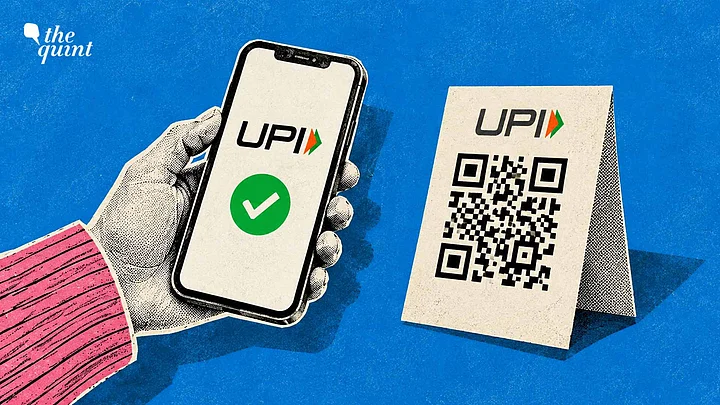
(This article has been updated in light of the Union government's recent clarification that UPI transactions above Rs 2,000 will attract a merchant fee of 0.4 percent starting 15 October. It was first published on 8 August 2026.)
Imagine three highways. In the first, anyone can move freely without paying anything because it is funded by the government through taxpayer money. In the second, motorists pay a toll to pass through to recover the cost of building the highway. The third is one that passes from one country to the other, like the road that passes at the Attari-Wagah border, where immigration and customs officials stop passengers at designated check-posts.
Knowing these differences helps as one navigates the controversy over the government reportedly levying charges to recover the costs for UPI payments.
You can picture the UPI infrastructure like a set of financial highways linked by a clover-leaf interchange (or flyovers) enabled with checkpoints that enable safe, legal, certified transactions.
Who Pays vs Who Ought to Pay
Officially, UPI is short for Unified Payments Interface. Unofficially, I call it the Ubiquitous Pride of India. With everybody from your local street vendor to high-life financiers using the fintech infrastructure to pay each other through a mobile-linked interface, this is the new substitute for cash that has eased up things for nearly everybody—those who count cash, those who look for small change, and those who keep records.
RuPay, UPI's close sibling with a common parent in the National Payments Corporation of India (NPCI), issues debit, credit and pre-paid cards that work smoothly with your mobile. The UPI-RuPay partnership is a powerful one.
Here’s the problem: Who pays for all that fintech chutzpah? And there’s a hidden question: Are UPI and RuPay threatening America’s payments giants Visa and Mastercard in a manner that US President Donald Trump’s administration, negotiating a tough trade deal, gently twists the arm of Prime Minister Narendra Modi’s government to frame a law that picks the pockets of Indians?
It all depends on who you are talking to. But more importantly, we need to look beyond sophisticated spin-doctoring to arrive at who ought to pay in a manner that Uncle Sam feels stumped rather than chuffed. Some hard facts and deep-diving may help.
In the beginning of August 2026, amid the noise over donation thefts in Ayodhya’s Ram Temple and Gen Z protests, the Lok Sabha passed—without discussion or debate—the Taxation and Other Laws Bill to amend the Payment and Settlement Systems Act, 2007, to authorise the government to permit banks and other service providers to levy charges on payments made through the UPI and other notified electronic payment modes.
A day before it did, Reserve Bank of India (RBI) governor Sanjay Malhotra, referring to the UPI infrastructure, diplomatically and cryptically said: “The costs have to be paid someone.”
The subtext was that UPI transactions, currently free of charge, may carry a price tag. Finance Minister Nirmala Sitharaman is shouting for all who care to hear that the Average Janardhan or Jamuna won’t have to pay, but the catch is that those who actually bear the costs may well pass it on quietly in the technological maze—much like how e-commerce companies earn delivery charges or platform fees.
When a delivery is dubbed free, its costs are built into the volume or membership fees. Who knows how it works in this financial labyrinth?
Credit cards traditionally work on a Merchant Discount Rate (MDR), which is a percentage fee that businesses pay to banks and payment processors for accepting digital payments through debit or credit cards or digital wallets. UPI thus far has been more or like a free debit card that had no processing or transaction fee. Delivering on the anxiety among fintech watchers, a backdoor MDR has now been foisted on unsuspecting citizens of India.
“The cost is already getting passed on. It may not be directly on to the very user, but someone is paying the cost,” Malhotra said. It took many years for the NPCI, set up by the RBI and a host of Indian and foreign, public sector and private banks, to collectively build the UPI’s financial clover-leaf. Officials are now saying it is payback time.
The new legal amendment removed a provision that barred banks and payment service providers from charging MDRs on notified electronic payment modes. Focus on the “notified” part. Whoever, the notified entity is, may directly or indirectly pick some pocket. From the point of view of a Visa or Mastercard, this levels the playing field and adds costs to UPI transactions somewhere.
Sitharaman says MDRs apply only to merchants, not consumers, countering Congress leader Jairam Ramesh, who has explicitly mentioned Visa and Mastercard as hidden beneficiaries of the emerging UPI fee scenario.
Let’s look at all this through our highway analogy. It costs money to build, maintain and operate highways.
Some toll roads (like the one linking Delhi with Gurugram or the Delhi-Noida-Delhi (DND) Flyway) have now become toll-free after public protests and court wrangles. But they are still being maintained with taxpayer money or commercial properties linked to the access roads.
Can UPI Go the Same Way?
That is the question that needs to be answered.
Now, let’s look at who are the winners/gainers and losers in the UPI game. Visa and Mastercard most certainly are potential losers, as UPI and RuPay reduce the chances of their gaining plum customers from India’s emerging millions. The winners may include small businesses, street vendors as well as end-customers for the sheer convenience that UPI brings. Banks also gain because every rupee sent to a bank instead of resting on someone’s palm as a coin is a lendable resource fetched at a low cost to the bank.
But methinks the RBI may be the biggest gainer—though it is only a regulator. Here’s why. The RBI did not build the UIDAI (Unique Identification Authority of India) on which the entire banking system is now riding piggyback, indirectly scaling up the UPI as well. Will the banks now pay for the authority that created the Aadhaar ID system?
More significantly, the central bank already rolling in cash from its transactions in bonds and foreign exchange, actually gains more by not having to worry too much about printing currency notes. Every time you shun a currency note payment, you are reducing the headache for the RBI to print, transport and store currency notes. It also has to worry less about Dhurandhar-movie-style printing of counterfeit notes by some foreign power. As a lawyer might say in an old-world Bollywood courtroom drama: “Isey note kiya jaaye, my lord!”
You can think of the RBI using the UPI system like a Fortune 500 company that saves costs by outsourcing software services to an Indian IT firm.
The big question: If the RBI can save so much money and has loads of cash on its hands, where is the need for someone downstream to pay for UPI? Like a toll-free highway, UPI oils India’s economic growth and its tab may as well be picked up by the RBI. That’s the suggestion from opposition parties like the Congress.
Looming US Effect
The government says a fee on UPI will enable companies to invest more in infrastructure, innovation, and security. That is a fair point, but what stops the RBI from picking up the tab? Unlike public sector organisations that run scientific research, the RBI has enough resources on its own.
Notably, the new legal amendment came in the wake of a recent US Trade Representative report that explicitly criticised the UPI and RuPay set-up. That seems more than a coincidence.
The NPCI that builds and administers the UPI system is the financial cousin of the National Highways Authority of India (NHAI). However, unlike the NHAI, which is like a middle-class kid, the NPCI has a rich parent in the RBI, which in the year ended March 2026 paid the government a record Rs 2.86 lakh crore in dividends mandated by law.
One way out is for the RBI to create a corpus from its cash pile as part of its administrative costs and use the investment gains to fund the maintenance of the UPI infrastructure. Another way is for it to take the NPCI public someday and make handsome capital gains.
All that should keep Uncle Sam guessing.
(The author is a senior journalist and commentator who has worked for Reuters, Economic Times, Business Standard, and Hindustan Times. He can be reached on Twitter @madversity. This is an opinion piece and the views expressed above are the author’s own. The Quint neither endorses nor is responsible for the same.)