
Why PM Modi Should Think Twice Before Joining Trump's 'Board of Peace' for Gaza
For one, Trump has also invited Pakistan Prime Minister Shehbaz Sharif to join the board, writes Vivek Katju.
advertisement
(US President Donald Trump's formal invitation to Prime Minister Narendra Modi to join the Board of Peace for Gaza, as part of a 20-point plan aimed at de-radicalising and redeveloping the region, has led to debate over India's response. In this View, Vivek Katju argues why India should think twice. Read the Counterview in which Sanjeev Ahluwalia argues why joining the Board could be in India's favour.)
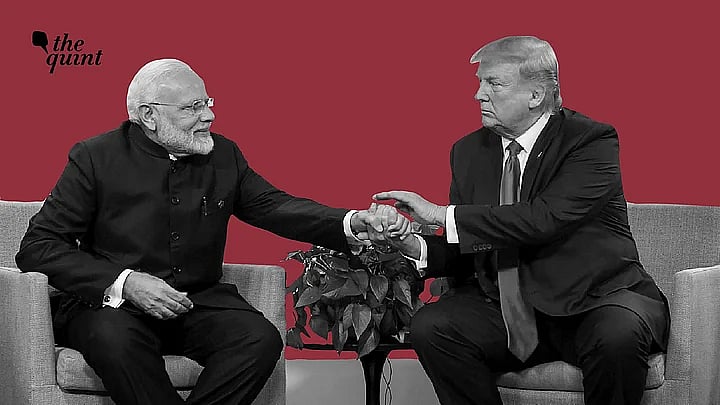
Prime Minister Narendra Modi is among a number of world leaders who have been invited by Donald Trump to join a Board of Peace (BOP) for Gaza, which the US President will chair.
The text of Trump’s letter, made public by one of the invitee’s, Argentine President Javier Milei, indicates Trump’s intention to expand this BOP’s scope much beyond its United Nations Security Council (UNSC) mandate.
The UNSC had, in its Resolution 2803 of November 2025, approved, with China and Russia abstaining, the establishment of the BOP “as a transitional administration with a legal personality” for the “re-development of Gaza”. However, Trump’s letter considers it as part of a “Historic and Magnificent Effort to solidify Peace in the Middle East and, at the same time, to embark on a bold new approach to resolving Global Conflict”!
Trump has also asserted “The board will be one of a kind, there has been never been anything like it.”
Initial media reports indicated that China and Russia have not been invited to join the BOP, though latest reports now indicate Russia has indeed been invited. As gleaned from these reports, among the countries invited are:
Britain, France, Germany, Italy, Hungary, Greece, Cyprus, and Albania from Europe
Argentina, Brazil, and Paraguay from South America
India, Turkey, Vietnam, and Pakistan from Asia
Australia, New Zealand, Jordan, and Egypt
A Selective Guest List
It is clear that Trump is attempting, through this BOP, to create a permanent structure of a coalition of the willing under the US leadership, to address global issues—including those relating to international peace and security. He has withdrawn the US from the membership of over 65 international and multilateral organisations and has shown impatience with the UN system.
At the same time, he realises, even as he wishes to go away from the world order put in place after the Second World War by his predecessors, he cannot do without a group of countries that are tied to the US and accept its leadership. This is essential for the US as it girds itself to meet the challenge of a rapidly rising China and a Russia which is unwilling to adhere to its advice. Russian President Vladimir Putin’s continuing aggression in Ukraine demonstrates that.
Hence, whatever decision PM Modi takes regarding the invitation would impact India’s interests and its foreign policy now and in the future.
Why Modi’s Choice Matters
The Indian PM would have to consider the following points:
Trump has been peeved with Modi for insisting that the cessation of hostilities between India and Pakistan was accomplished bilaterally between the two countries. India has correctly asserted that the Pakistani DGMO called his Indian counterpart for this purpose and that India agreed. On the other hand, Trump has said over 60 times that it was his intervention that brought about a ceasefire between the two countries which possess nuclear weapons. He has claimed that he had prevented the possible deaths of millions of people.
Pakistan has fed Trump’s ego on this issue. More significantly, it has formally nominated him for the Nobel Peace Prize. That is what Trump personally seems to desire above all. There is little doubt that he considers India’s non-acknowledgement of his role in bringing about a ceasefire as an important element in his not getting the prize. He has retaliated viciously through the imposition of the 50 percent tariffs on Indian exports which still continues.
The Ministry of External Affairs (MEA) has gone on record to state that Modi and Trump have spoken to each other on eight occasions last year. These conversations have not changed his negative approach towards India. Modi would like that to change and would not like to irk him further by refusing to join the BOP. However, there is considerable danger in joining the BOP.
The Ceasefire Credit Dispute
Trump has invited Pakistan Prime Minister Shehbaz Sharif to join the BOP. It is not clear if he would do so. Pakistan’s instinct would be not to get caught in the crossfire of Arab politics, but Shehbaz cannot alienate Trump. If, on balance, he decides to join the BOP and Modi does so too, then the latter can be embarrassed by Trump through attempting to mediate peace between India and Pakistan.
The international community is aware of Indian sensitivities on third-party involvement, but that will not prevent Trump from acting as the peacemaker. This is not a far-fetched scenario because the temptation for Trump to bring about peace between India and Pakistan, especially if both are members of the BOP, may be impossible for him to resist.
As it is, India has moved away from its traditional policy of having only bilateral relationships in West Asia. By joining the I2U2 grouping—India, Israel, the UAE, and the US—it has moved away from its traditional approaches. Today, when Saudi Arabia and the UAE have major differences on Yemen, and India has to do a balancing act between them, the wisdom of its traditional policy becomes apparent.
As a member of the BOP, India will necessarily have to follow the US lead on the Palestine issue and other regional matters. Thus, its objectives in West Asia would not be served by joining the BOP.
West Asia Complications
India has been frustrated by the lack of reform of the UNSC. It has just claim to the permanent membership of the council. But the BOP would hardly raise its international stature or give it a greater role in issues relating to international peace and security. Therefore, its long-term diplomatic objectives are ill-served by joining the BOP.
All in all, at this time Modi should turn to the manner in which the then Indian PM Atal Bihari Vajpayee succeeded in ably side-stepping the US desire that India should send troops for peacekeeping in Iraq in the wake of the US’s war against Saddam Hussain in 2003.
(The writer is a former Secretary [West], Ministry of External Affairs. He can be reached @VivekKatju. This is an opinion piece, and the views expressed above are the author’s own. The Quint neither endorses nor is responsible for the same.)
- Access to all paywalled content on site
- Ad-free experience across The Quint
- Early previews of our Special Projects
Published: undefined