
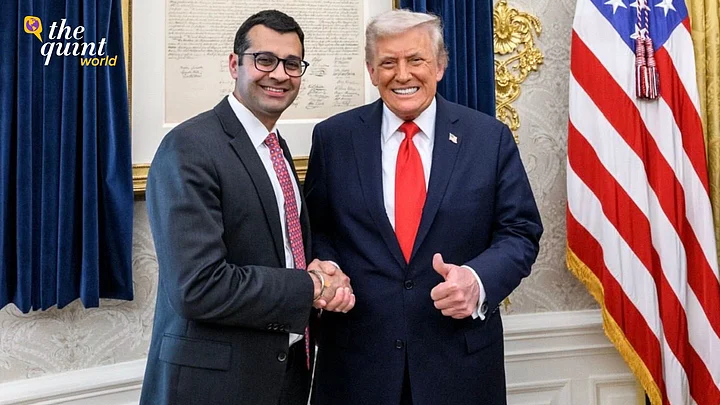
Disregarding India's rebuttals over the last few months, US President Donald Trump has again claimed that Washington mediated a ceasefire between India and Pakistan following Operation Sindoor in May this year. This time, by awarding Ricky Gill, a National Security Council (NSC) staffer who led a US delegation visiting New Delhi in August this year, for his purported role in the ceasefire negotiations.
"It is a pity that Trump remains obsessed with his supposed role in bringing about the ceasefire," says Sumit Ganguly, Director of the Huntington Program on India-US relations at the Hoover Institution of Stanford University.
"India should ignore these moves on Trump’s part and simply focus on matters of continuing mutual interest," he tells The Quint, adding, "Standing on ceremony on the issue of Trump’s putative role in ending the conflict is not serving India well."
Gill, who serves as Senior Director for South and Central Asia and Special Assistant to the US President, was given the 'Distinguished Action Award' by Secretary of State Marco Rubio earlier this week. However, the nature of his contribution wasn't specified.
Before getting to the political dynamics of the award, let's take a look at who Ricky Gill is.
Trump's Point Man for South Asia
A law degree-holder from University of California, Berkeley, 38-year-old Ranjit Singh Gill aka Ricky, who is of Indian origin, was appointed in his current post in January this year following the swearing in of President Trump in his second term.
His work mostly revolves around overseeing ties with India, Pakistan, Afghanistan, and other South and Central Asian countries at the NSC.
In August, Gill visited New Delhi for a high-profile meeting of India-Middle East-Europe Economic Corridor (IMEC) partner nations.
According to a report in The Washington Post, some former Indian diplomats had expressed their frustration during a dinner with Gill in New Delhi about Trump having called India a "dead economy". Trump had made the statement on 31 July, a day after he announced the first tranche of 25 percent tariffs against India.
The report, citing two sources, claimed that the Indian officials were also unhappy about the US president claiming credit for the ceasefire between India and Pakistan in May 2025.
Gill, however, tried to assuage the situation, saying that Washington still viewed New Delhi as a crucial partner. However, he noted that India's "obsession" with how the conflict ended in May was still a matter of annoyance to the US government.
Soon after Gill's return to the US, Trump had announced a fresh 25 percent tariff on a wide range of Indian imports, taking total duties as high as 50 percent for goods such as textiles, gems, furniture, and chemicals.
During Trump's first term from 2017-2021, Gill had served as Director for Russia and European Energy Security at the NSC. His past positions also include Senior Advisor at the US State Department's Bureau of Overseas Buildings Operations.
Gill has also forayed into national politics, having contested as a Republican candidate in the House of Representatives from the state of California. However, he was edged out by Democrat Jerry McNerney in a tight contest.
Born to parents Param and Jasbir Gill in New Jersey, Gill holds a bachelor's degree from the Woodrow Wilson School of Public and International Affairs at Princeton University.
India-US Ties Were Slowly On the Mend. Will the Award Play Spoiler?
The Narendra Modi government has been keen to put the ceasefire chapter behind them and create a fresh start for India-US ties, especially following the bitterness which had creeped in following President Trump's imposition of 50 percent tariffs on Indian goods.
As Trump again spotlighted Washington's role by bestowing upon Gill the award, there has been no official response from the Ministry of External Affairs (MEA). The Quint has reached out to the MEA and is awaiting a response.
In the past, both, the MEA and External Affairs Minister S Jaishankar have asserted that India-Pakistan ties are "strictly bilateral" and that the end to hostilities in May was achieved through Director General of Military Operations (DGMO)-level talks between both countries.
This despite the fact that Trump has claimed dozens of times during public events that his administration ended the "war" between the two countries. He also claimed to have used trade as a sword over New Delhi and Islamabad, threatening to cut economic ties lest they solve their differences—another claim the MEA has denied.
Pakistan, however, had hailed Trump's alleged role in the ceasefire, and even nominated him for a Nobel Peace Prize for the same. Islamabad's softening stance had led to Trump endowing special treatment upon Prime Minister Shehbaz Sharif, and more so on Army Chief Asim Munir, who was repeatedly invited for talks at the White House.
The Modi government had made several efforts to tide over the bitterness, such as by dispatching Commerce Minister Piyush Goyal to Washington to deliberate over economic negotiations and hammer out a comprehensive bilateral trade agreement. That is yet to see the light of day.
Amid all this uncertainty, Trump's latest move is set to become another irritant in ties.
"Trump awarding his staffer over the ceasefire can hurt trade negotiations with Washington, but only if New Delhi chooses to highlight it," Ganguly asserts.
Michael Kugelman, South Asia expert and Senior Fellow at the Atlantic Council, agrees.
"I do think New Delhi will ignore the award. We're going to see a consistent position from the Indian side of late: that of radio silence," he tells The Quint.
Even days after news of the award emerged, there has been no response from India's MEA. Kugelman says that the reason for this is that New Delhi's hands are tied while dealing with the US at the current juncture.
"By refusing to give any credit to the US whatsoever, it makes India look like it has no solution to this problem, so to speak, of continuously having to deal with messaging from the US side."Michael Kugelman
How Can Trump's Claims on the Ceasefire Be Understood?
Meanwhile, several views have been exchanged on why Trump claimed credit for the ceasefire, and India's response to it.
"Trump is not constrained by the normal decorum of how presidents function," says Sanjeev Ahluwalia, senior advisor at the Observer Research Foundation (ORF), "He's a corporate man—that, too, a reckless one."
Ahluwalia says that often times, Trump says things, no matter how absurd, with the intention of bolstering his domestic and global image.
On the other hand, Harsh V Pant, professor of international relations, says that Trump was eager to take credit for something in which the US may have played a role, but not the central role.
"This is very Trumpian—he says things which have little to do with facts on the ground. So long as it serves him and his optics, he goes for it," Pant says.
You can read more about the reasons behind Trump's varying claims on the ceasefire here.
