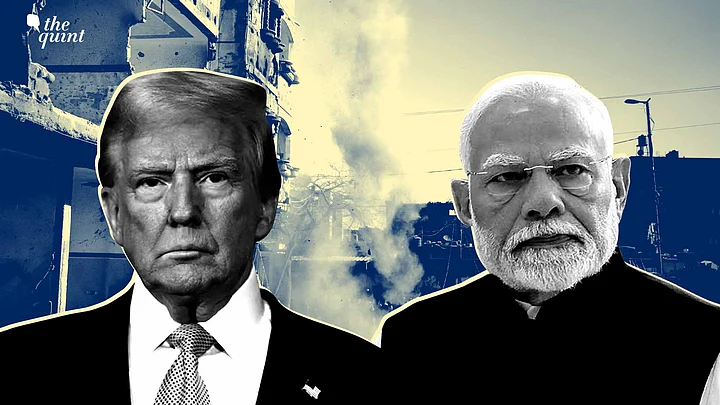
(US President Donald Trump's formal invitation to Prime Minister Narendra Modi to join the Board of Peace for Gaza, as part of a 20-point plan aimed at de-radicalising and redeveloping the region, has led to debate over India's response. In this Counterview, Sanjeev Ahluwalia argues why joining the Board could be in India's favour. Read the opposing View in which Vivek Katju argues why India should think twice.)
US Presiden Donald Trump delights in stirring things up, especially in deeply embedded institutions, like the US bureaucracy, and now the United Nations (UN). He comes across as a disrupter, albeit undoubtedly creative and potentially effective.
All developing countries, including India and China, have long felt that the UN system needs deep reforms. But is enlarging the Security Council membership the only silver bullet available? Why would outcomes be any different than presently, given the “clunky” nature of decision making in the UN?
Trump, the 'Peacebuilder'
In contrast, Trump has walked the talk. He withdrew from 31 UN entities he considers “detrimental for US interests.” This sounds peevish, but it is legal speak for “of no value for the US” to defeat judicial review of executive discretion.
Trump did not stop there. On 16 January this year, he announced the creation of a ‘Board of Peace” (BoP) for peaceful resolutions of conflicts arising from Israel’s occupation of Gaza. Invitations were sent to leaders of over sixty countries to join as a permanent member by paying a onetime fee of $1 billion or for free for a three-year term.
An invitation was received by Prime Minister Narendra Modi too. But he can nominate a special envoy instead, since state elections in India crowd his present calendar. It does not have to be somebody within government. A prominent philosopher, a distinguished former diplomat/civil servant/minister, or even an Indian businessperson — anyone who has PM Modi’s trust — would do.
Disrupting UN's Monopoly Over World Peace
Opinion in the local press is against India joining the BoP because it is viewed as a potential substitute for the UN. India has no interest in destabilising the UN. Nor does it have an interest in destabilising its emerging relationship with the US, in forsaking its friendship with Russia, or prejudicing the establishment of a better relationship with testy China.
The UN has a poor record of negotiating or maintaining peace. It is outgunned and perceived to be subservient to the national interests of the permanent members of the UNSC, in proportion to their economic heft. It might be time to try alternative options, like the BoP, so long as we do not destabilise the UN or harm India’s interests.
Terms of Reference for the BoP have not been issued yet. The 16 January statement of the White House titled “President Trump’s Comprehensive Plan to End the Gaza Conflict” envisages a National Committee for the Administration of Gaza (NCAG), led by Dr Ali Sha’ath, a Palestinian official. Major General Jasper Jeffers, an American, is the Commander of the International Stabilisation Force to “establish security, preserve peace, and establish a durable terror-free environment.”
To supervise the NCAG, it identifies a seven member “founding Executive Board” including Tony Blair and the President of the World Bank, Ajay Banga. HE Nickolay Mladenov will also serve as the High Representative for Gaza providing the ground link between the Board of Peace and the NCAG.
To support the Office of the High Representative and the NCAG, an 11-member Gaza Executive Board will consist of seven politicians: Steve Witkoff, US special envoy to the Middle East, Hakan Fidan, the Foreign Minister of Turkiye, Minister Ali Ai-Thawadi of Qatar, Sir Tony Blair, Minister Reem Al Hashimy of UAE, Nickolay Mladenov, a Bulgarian politician and previously Minister of Defence and Sigrid Kaag, a Dutch politician and the UN special coordinator for the Middle East Peace process since 2025.
The three businesspeople are Jared Kushner, Trump’s son-in law, Marc Rowan, an American billionaire and the Cypriot real estate billionaire Yakir Gabay. General Hassan Rashad is Egypt’s Head of Intelligence.
Readers will notice the ubiquity of Sir Tony Blair who is part of the BoP (the highest level) as well as in the Gaza Executive Board (at the nuts-and-bolts level).
Why India Must be a Part of it
Objections to India participating in this geopolitical “start-up” centre around three key issues.
First is that India has never destabilised the UN and now is not the time to start. This argument lacks substance because the UNSC resolution 2803 of 2025 broadly endorses the Trump proposal. If during its functioning, the BoP structure runs amok, caveats can be tabled to highlight the divergences from the resolution. Conditionalities against subverting UN processes can also be proactively included in India’s acceptance itself. But why be more loyal than the king?
Second is a red herring; that if Pakistan and India, both join, Trump might press for arranging a "truce" between the two neighbours. Our historical stance is that India negotiates disputes only bilaterally and not via an intermediary. To be doubly sure the Indian envoy to the BoP, should explicitly not have the bandwidth to speak beyond the Gaza issue.
It is doubtful that Trump would bother pursuing his claim for settling the short military skirmish between Pakistan and India if the Gaza process—potentially a historic achievement—proceeds well.
Third is the misconception that joining the BoP marks India out as a US groupie, thereby alienating China or Russia. The Cold War is long over. America, Russia, and China all have multipolar arrangements. We are newbies at this game. Refusing to play, lest we offend a biggie, is the wrong way to begin.
(Sanjeev Ahluwalia is distinguished fellow Chintan Research Foundation and was previously in the IAS and the World Bank. This is an opinion piece and the views expressed are the author's own. The Quint does not endorse or is responsible for them.)